
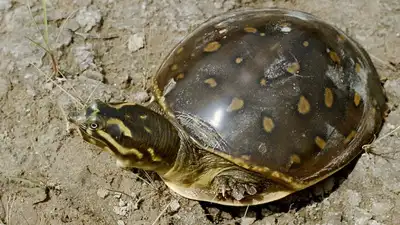
An Indian flapshell turtle (Representative image)
Singh said officials must also prepare site maps, record GPS coordinates, draw up seizure memos and make a general diary entry at the local police station. “A formal report must then be submitted to the state’s chief wildlife warden before the carcass is disposed of under official supervision.”
The examination involves documenting external and internal injuries and collecting biological samples, including visceral contents, tissue and blood, for forensic analysis,” the CCF said. Singh said forest staff must cordon off the site after a wildlife carcass is found to preserve evidence. “A post-mortem examination must then be conducted by a panel of govt veterinary officers designated by a senior forest officer. For Schedule I species, videography of the procedure, site and carcass is mandatory. They must photograph and videograph the undisturbed site, surrounding terrain and carcass, and look for signs of an accident, including vehicle-impact or collision marks.
However, divisional forest officials neither conducted an autopsy nor registered a departmental case. Both are mandatory under the protocol for dealing with the death of a Schedule I species.