
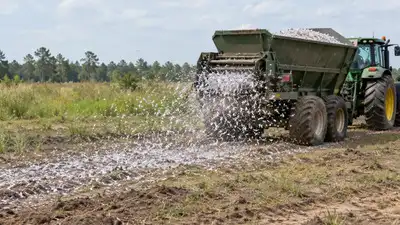
Representative AI image of a tractor-mounted spreader distributing pulverised paper. (Image Credits: ChatGPT)
The US Agricultural Research Service (ARS) reported that native plant cover was 45% higher on plots receiving the recommended paper treatment compared to control plots. The findings were published in 2019 in Soil and Tillage Research , wherein researchers recommended applying pulverised paper at 35.9 metric tonnes per hectare. How researchers tested the paper amendment The field experiment began in April 2015, when researchers spread pulverised paper obtained from document-shredding facilities across experimental plots and incorporated it into the upper 15 centimetres of soil. The Ultisol plots received rates of 17.9, 35.9, 53.8 and 71.7 metric tonnes per hectare, and the rates at the Alfisol site were 9.0, 17.9, 26.9 and 35.9 metric tonnes per hectare. Consequently, 71.7 metric tonnes per hectare was the highest rate tested at the Ultisol site. The conventional treatment consisted of lime, applied at 2,240 kilograms per hectare, and nitrogen fertiliser at 56 kilograms of nitrogen per hectare. Representative image of a military training ground. (Image Credits: Pexels) Different soil conditions produced different results The scientific paper provides the site-specific figures behind the findings, and at the Alfisol site, native plant cover at 35.9 metric tonnes per hectare was 48% higher than the control and 62% higher than the conventional treatment. Conversely, at the Ultisol site, native plant cover at 71.7 metric tonnes per hectare, the highest rate tested there, was 42% higher than the control and 17% higher than the conventional treatment. At the Ultisol site, native plant biomass at 71.7 metric tonnes per hectare was 71% lower than the control, while the conventional treatment produced 355% more. At the Alfisol site, native plant biomass at 35.9 metric tonnes per hectare was 90% higher than the control and 96% higher than the conventional treatment.
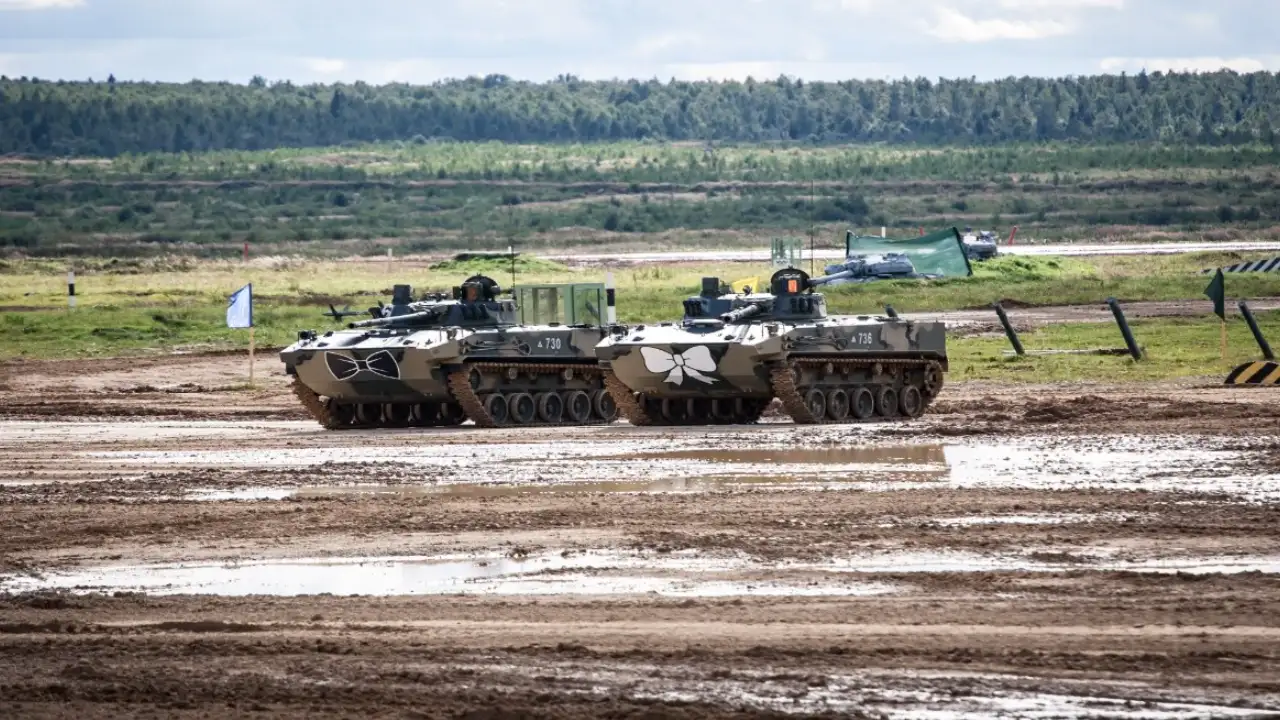
Because the researchers encountered difficulties incorporating the highest application levels into the Alfisol soil, the rates differed. Researchers at Fort Polk, Louisiana, investigated whether pulverised classified paper waste could help restore military training land. Military training grounds can experience soil disturbance from movement of vehicles and soldiers across the land, making vegetation establishment more difficult. The experiment examined whether shredded paper could serve as a soil amendment while providing an alternative use for waste otherwise sent to landfill. They then planted four native warm-season grasses: big bluestem, Indiangrass, little bluestem and switchgrass. The experiment used two soil types; the first was an Alfisol, taken from more fertile soil conditions at one site, while the second was an Ultisol, which had lower fertility. Different quantities of paper were then applied at each location, and the results were compared to untreated control plots and plots that were treated with conventional soil. The control plots received neither amendment nor fertiliser, although they were prepared and seeded in the same way as the other plots. In terms of plant cover and plant biomass, different results were also produced. These measurements indicate that greater plant cover did not necessarily mean greater plant biomass across both sites.
ARS also reported estimated savings of about $11,600 per hectare and annual savings of around $20,000 per military facility, alongside a potential diversion of about 64 metric tonnes of paper from landfill. The researchers linked the contrasting responses to differences in nutrient availability. The Ultisol site showed improvements in certain physical and chemical soil properties, but its low fertility meant that nitrogen immobilisation could constrain grass growth. At the more fertile Alfisol site, the carbon-rich paper tied up nitrogen, which helped reduce competition from weeds and invasive plants and favoured the planted native grasses. Subsequently, the Corps of Engineers produced a user guide based on the research to help military facilities consider the approach to land rehabilitation. You use AI every day. Now get your AI Quotient. Take the AIQ test.