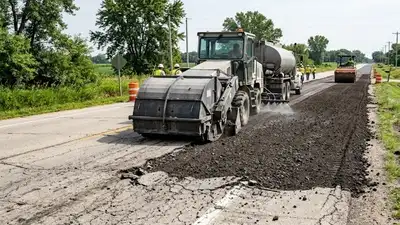
AI-generated representative image showing deteriorated asphalt being reclaimed and stabilised with fly ash during a rural Wisconsin road-rehabilitation project. Credits – Gemini
In October 2001, the road was repaired utilising full-depth reclamation on County Trunk Highway JK in Waukesha County. Estimated modulus increased by 49% in 2002 and by 83% in 2003 from the first 2001 test. The repaired segment was around 1,009 metres long and ran between County Trunk Highways KF and K.
Follow-up measurements revealed that the base stiffened significantly with age. It is not always necessary to remove the old pavement and lay new quarry material to rebuild a failing road. The state of Wisconsin experimented with a strategy to recycle the current road and strengthen it using coal fly ash, a byproduct of power generation. Rather than cart off the worn asphalt, they pulverised it, blended it with water and self-cementing fly ash, and pressed it into a fresh road base. The results highlighted the ability of recycled pavement to increase structural strength with time. Subsequent monitoring indicated that cracking and seasonal conditions continued to be relevant problems. How the old pavement became a new base County Trunk Highway JK was a two-lane road in Waukesha County, Wisconsin.
The Wisconsin project’s usage of Class C fly ash to stabilise the recycled asphalt base was noted in the 2004 Transportation Research Record study. The early field study showed that the modulus of the base had increased by 49 percent one year after construction, indicating that the material continued to gain strength after the road was opened to traffic. Because it has the ability to generate cementitious characteristics when coupled with water, class C fly ash was used.
The construction approach was full-depth reclamation (FDR). Crews utilised specialised equipment to crush the current asphalt and the material underneath it in place, creating a blend that could be employed as the basis for the reconstructed pavement. The requirement to take out the old road and re-base it totally with new aggregate was reduced. The completed structure utilised the recovered material as a basis instead of treating it as construction waste. What the measurements of stiffness indicated
The road had challenges with a low-lying position and silty subgrade soils that had contributed to frost-heave problems before the construction. The ash was included in the recycled pavement material, blended, compacted and allowed to cure before the new asphalt surface was applied.
When the first measurements were taken in 2001, the modulus of the fly ash-stabilised base was calculated to be about 1.24 gigapascals or 180,000 pounds per square inch. By 2002, the estimate had climbed to almost 1.84 gigapascals, or 268,000 pounds per square inch. Measurements in 2003 indicated another increase to around 2.27 gigapascals, or 329,000 pounds per square inch. That is an 83% increase compared to the 2001 baseline, not an extra 83% increase above the 2002 number. In 2001 it was about 0.16; it grew to 0.23 in 2002 and reached about 0.245 in 2003. During the six years of evaluation, the modulus grew in the first three years but was lower in the sixth year compared to the measurement in 2003. In 2008, the American Society of Civil Engineers reviewed the fly ash-stabilised pavement, utilising deflection measures and pavement distress surveys to assess the road’s performance over a longer period of time. The calculated modulus increased by 49% by 2002 and 83% by 2003 over the 2001 baseline, enabling the usage of the material as a structural road base.
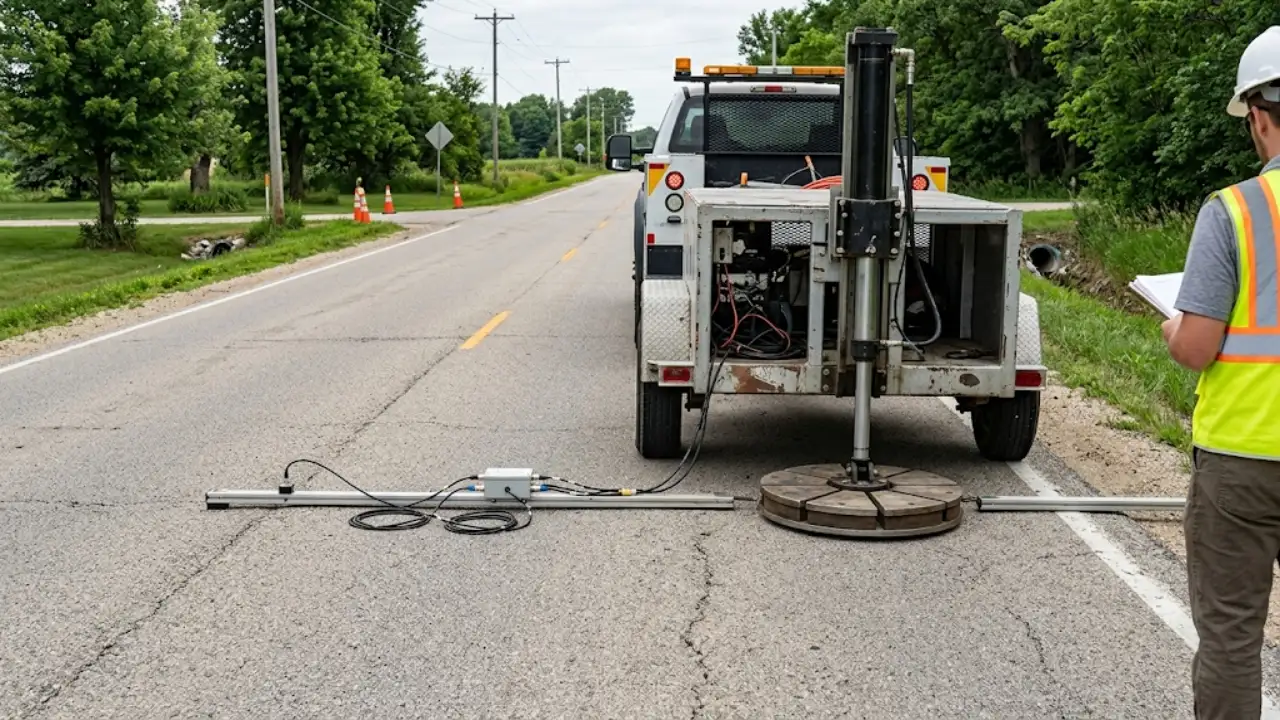
Because they don’t have the same soils, traffic, drainage and weather exposure as Waukesha County, other roads could act differently. The research team also employed a falling-weight deflectometer to measure the pavement’s response to loading. The equipment drives down the road in a regulated fashion and measures how much the surface yields. Engineers utilise those measurements to evaluate the structural qualities of the pavement layers, such as the modulus of the stabilised foundation material. Modulus is a stiffness parameter. The greater the number, the less a material will deform under a particular load, but the value does not in itself guarantee that an entire road will endure longer or be free of cracking generally. The ongoing pozzolanic and cementitious processes in the fly ash mix were cited by researchers as the cause for the gains. These reactions may also persist after initial compaction and curing, helping to bond the particles in place and improve the strength of the material. The year-by-year growth in published studies on in-place recycling of asphalt pavements with fly ash is detailed, and the conclusion is drawn that self-cementing fly ash could assist in improving the structural capacity of recovered pavement bases. The calculated coefficient of the structural layer also rose. This parameter is used by pavement engineers to evaluate the contribution of a certain layer to the structural capacity of the whole road. Thus, the improvement was obvious in more than one computed measure. The modulus calculated increased considerably. The layer coefficient also showed that the stabilised base was providing greater structural support than it did during the original test. AI-generated representative image showing a falling-weight deflectometer test used to measure the structural stiffness of a recycled, fly ash-stabilised road. Credits – Gemini What longer-term surveillance showed The first results were good, but the longer-term performance of the road was a more difficult story. The first three years were followed by engineers monitoring County Trunk Highway JK to see if the stronger base could continue to perform as well under traffic and changing weather conditions. Researchers theorised that exposure to freeze-thaw may have damaged the stabilised base. The result indicates why increases observed shortly after construction should not be taken as evidence of a continuing rise in stiffness. Pavement deterioration was also detected during field assessments. Top-down cracking occurred after the third year of construction, followed by thermal cracking and rutting. The high stiffness of the base was thought to be a likely cause of the cracking pattern, but friction between the asphalt surface and the base may also have been a factor in the thermal cracking. It showed that a good recycled base still had to perform well with the asphalt layers above it and adapt to seasonal variations. Why this is important is that a road is a multi-layered structure. A firmer base may offer more load-carrying support, but the qualities of the base and surface must be suitable. Engineers have to consider cracking, changes in temperature, moisture and traffic, as well as stiffness measures. The uniformity of the fly ash and the condition of the previous pavement both affect the full-depth reclamation. The material needs to be mixed properly and compressed, and the moisture level and curing conditions can influence the ultimate strength. The Wisconsin project indicated that recycled asphalt stabilised with Class C fly ash could become stiffer within the first two years of service. Later findings added an essential qualification. Increasing stiffness may increase the load-carrying capacity of a pavement but does not prevent cracking or ensure that performance will not vary. The project’s lasting contribution was to show the possibilities of reusing existing pavement and the need to review the whole road system over time. You use AI every day. Now get your AI Quotient. Take the AIQ test.