
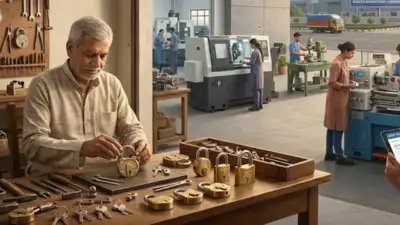
(AI IMAGE) Recognized as a hub for lock and hardware production, Aligarh is transforming its industrial identity through recent initiatives aimed at diversifying into engineering and defense manufacturing
From traditional clusters to organised MSME growth The foundations of Aligarh’s industrial economy were already substantial before 2017. The MSME Ministry’s district industrial profile had identified locks and hardware as the principal manufacturing cluster, with around 2,500 functional units, estimated cluster turnover of about Rs 1,500 crore and exports of approximately Rs 800 crore at the time of that assessment. The Uttar Pradesh MSME Promotion Policy 2017 emphasised expansion and technological upgrading of existing MSMEs, support for new enterprises and creation of a more favourable business environment. ODOP gives Aligarh’s locks a new identity One of the most significant interventions has been the One District One Product (ODOP) programme, launched by Uttar Pradesh in 2018. The state’s ODOP 2.0 approach announced in 2025 places greater emphasis on global competitiveness, technology integration, quality standards, premium packaging and access to national retail and e-commerce platforms. The state government says ODOP products accounted for Rs93,000 crore of Uttar Pradesh’s exports in 2024.
Because access to technology, finance and markets can determine whether a traditional unit remains a small workshop or grows into a competitive manufacturing enterprise, for a district such as Aligarh, where thousands of enterprises operate at relatively small scales, these interventions are significant. A wider industrial ecosystem The transformation of Aligarh is therefore best understood as an evolution from a single-identity industrial cluster towards a diversified MSME ecosystem. AGRA: Aligarh’s industrial identity has long been associated with locks and hardware. Its small workshops and manufacturing units have produced padlocks, door locks, bicycle locks, multipurpose locks, hardware and metal products that have found markets across India and abroad. The district’s industrial character was built largely around this traditional manufacturing ecosystem, with thousands of enterprises, artisans, traders and ancillary workers dependent on metalworking. Over the last nine years, Aligarh has been witnessing a broader industrial transition. The traditional lock and hardware industry remains at the centre of its manufacturing identity, but the district is increasingly being positioned as an MSME, engineering, defence and advanced manufacturing destination. The change has been supported by Uttar Pradesh’s industrial policies, the One District One Product (ODOP) programme, improved industrial infrastructure, investment promotion and the development of the Aligarh node of the Uttar Pradesh Defence Industrial Corridor. The profile also highlighted constraints such as inadequate modern technology, power-related issues and infrastructure limitations. The policy approach of the last nine years has increasingly focused on addressing precisely these structural issues. This has helped shift the conversation from merely protecting traditional industries to improving their competitiveness. Aligarh was designated for locks and hardware, building on an already established industrial ecosystem. The programme provides a framework for skill development, finance, marketing, technology, packaging and market expansion. The official ODOP platform continues to identify lock manufacturing as a key Aligarh enterprise opportunity, while the national ODOP portal recognises Aligarh’s locks, hardware and metal handicrafts as its distinctive products. The importance of ODOP for Aligarh lies in the fact that it connects thousands of small manufacturers to a more organised value chain. Instead of treating the lock industry merely as a collection of small workshops, the programme seeks to improve product quality, branding, packaging, technology and market access. The state’s ODOP Common Facility Centre framework further provides for testing laboratories, design and development, training, raw-material banks, common production facilities, logistics, packaging, labelling and barcoding. Such shared infrastructure can reduce the technology and investment burden on individual small enterprises. Beyond locks: The rise of engineering and defence manufacturing Perhaps the most important dimension of Aligarh’s transformation is diversification. The establishment of the Aligarh node of the Uttar Pradesh Defence Industrial Corridor has created an opportunity to connect the district’s existing metalworking capabilities with higher-value engineering and defence manufacturing. The official Defence Industrial Corridor website identifies locks and hardware among the existing MSME clusters in Aligarh. This creates an important industrial linkage. Enterprises that have traditionally worked with metal, machining, casting, fabrication and precision components can potentially participate in wider engineering and defence supply chains after meeting the required standards and technological specifications. Thus, the emergence of defence manufacturing is not necessarily a replacement for the lock industry. It represents an additional layer in the district’s industrial ecosystem. MSMEs becoming the backbone of diversification The broader MSME ecosystem has also benefited from Uttar Pradesh’s policy framework. The state’s MSME policy provides incentives related to capital investment, infrastructure, employment, quality certification and other aspects of enterprise development. It also contains provisions aimed at encouraging women, SC/ST entrepreneurs and new enterprises. The state’s approach has increasingly combined traditional cluster development with investment facilitation and digital systems. Platforms such as Nivesh Mitra have sought to simplify approvals, while newer initiatives are aimed at connecting MSMEs with finance, certification, markets and institutional buyers. The state government’s emerging entrepreneurship-support architecture also links MSMEs, ODOP enterprises and startups, with programmes covering areas such as compliance, costing, access to credit, testing, certification, GeM listing, packaging and buyer connections. From local markets to wider markets Another important aspect of the transformation is market expansion. Aligarh’s locks and hardware already have national recognition, but government programmes have increasingly focused on formalising marketing and connecting traditional products with modern retail and e-commerce channels. ODOP’s emphasis on branding, packaging and market access has created new possibilities for enterprises to reach buyers beyond traditional wholesale networks. Locks and hardware remain the district’s signature industry. Metal handicrafts continue to provide employment and preserve traditional skills. At the same time, engineering, defence-related manufacturing, fabrication and other industrial activities are adding new dimensions to the economy. This diversification is important for employment as well. A broader industrial base creates opportunities not only for traditional artisans but also for technicians, engineers, designers, logistics workers, quality-control professionals and entrepreneurs.
You Can Also Check: Gold Rate in Agra | Silver Rate in Agra | Bank Holidays in Agra | Public Holidays in Agra | Agra AQI | Weather in Agra | Petrol Price in Agra | Diesel Price in Agra | CNG Price in Agra | LPG Price in Agra Stay updated with the latest Agra news. Future course Aligarh’s industrial journey over the past nine years demonstrates how an established traditional cluster can become the foundation for wider economic diversification. The objective is not to replace the identity of the City of Locks but to build upon it. The district’s traditional strengths in metalworking, its MSME base, ODOP recognition and emerging defence-industrial ecosystem together provide the building blocks for a more diversified manufacturing economy. The next stage will depend on continued technology adoption, access to affordable finance, skilled manpower, quality certification, stronger supply chains and integration with national and international markets. Uttar Pradesh’s newer industrial initiatives, including plug-and-play infrastructure for MSMEs, are also intended to reduce the time and capital required for enterprises to begin production. From locks and hardware to engineering and defence-related manufacturing, Aligarh’s industrial story is consequently becoming broader. The transformation of the last nine years is less about moving away from the district’s traditional identity and more about using that industrial heritage as a platform for a larger MSME-led manufacturing economy. Download the TOI App.