
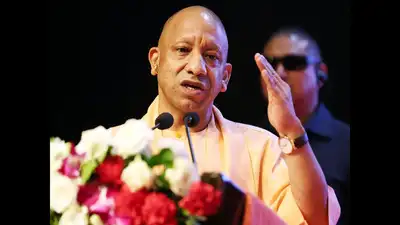
UP CM Yogi Adityanath
With a clear focus on improving productivity, increasing farmers’ incomes, building climate resilience and strengthening market linkages, the project is set to bring a new agricultural ecosystem to 21 districts of Eastern Uttar Pradesh and seven districts of Bundelkhand. The approximately Rs 4,000-crore World Bank-supported project is focused particularly on Eastern Uttar Pradesh and Bundelkhand—two regions with enormous agricultural potential but which have historically faced developmental and productivity challenges. The project is being implemented across 123 development blocks in 28 districts, with the objective of benefiting nearly 10 lakh farmers, 35,000 fish-producing farmers and around three lakh women. During the Kharif season of 2026, around 1.75 lakh hectares have been brought under the project. A similar target has been set for the Rabi season of 2026-27, with efforts focused on improving the productivity of important crops such as wheat, peas, gram, lentils and mustard. During Kharif 2026, Direct Seeded Rice, or DSR, is being experimented with across 3,000 hectares. A particularly significant proposal is the development of a 1,500-acre paddy cluster in Bahraich in accordance with quality and residue standards, including MRL requirements. The initiative aims to improve farmers’ income per acre by 20 to 30 percent while reducing urea consumption by 25 percent and achieving savings of 25 to 30 percent in labour and irrigation.
Describing the agreements as a commitment to giving a new direction to agricultural productivity and farmers’ income, Chief Minister Yogi Adityanath said that UP-AGREES is designed to move agriculture beyond the conventional objective of increasing production. NEW DELHI: Uttar Pradesh is preparing to take a major leap in agricultural transformation through the World Bank-supported Uttar Pradesh Agriculture Growth and Rural Enterprise Ecosystem Strengthening (UP-AGREES) Project. These partnerships bring together technology, digital infrastructure, climate-smart agriculture, market systems, aquaculture and private-sector expertise under a common vision of farmer prosperity. The larger goal is to transform the farmer from merely a producer into an active participant in the modern agricultural scenario. For decades, agricultural success was often measured primarily in terms of rising foodgrain production. However, the crucial questions of reducing cultivation costs, ensuring remunerative markets, strengthening value addition and improving farmers’ incomes did not always receive equal attention. UP-AGREES seeks to address this gap by creating an integrated ecosystem that connects the farm with technology, markets, processing, entrepreneurship and global value chains. It aims to cover approximately six lakh hectares. The scale of implementation is already becoming visible. At the heart of UP-AGREES is a simple but comprehensive philosophy articulated by the Chief Minister: Productivity, Technology, Climate Resilience, Market, Enterprise and Farmer Prosperity. Together, these six elements represent a shift from traditional agriculture towards a more diversified, technology-driven and market-oriented model. One of the major components of the project is the introduction of scientific and climate-responsive farming practices. In partnership with the International Rice Research Institute (IRRI), modern agricultural techniques are being taken directly to farmers’ fields. Along with paddy, the action plan also covers maize, millet, sorghum, pigeon pea, sesame, urad and groundnut. The objective is not simply to introduce new crops or techniques but to combine Uttar Pradesh’s rich agricultural tradition with global scientific knowledge. Climate change, water scarcity and rising input costs have made such interventions increasingly important. Scientific farming can help farmers improve productivity while using resources more efficiently. Digital technology will form another important pillar of the transformation. Through the partnership with Google and Network for Humanity, the state is working towards developing an Open Network for Agriculture. The proposed platform draws inspiration from successful open digital infrastructure models such as UPI and ONDC. The idea is to reduce the complexity farmers often face in accessing multiple apps and platforms. Through a unified digital ecosystem, farmers could access services related to weather, market prices, soil information, agricultural advisory and other Agritech solutions through a single interface. At the same time, Agritech startups and private companies will have the opportunity to offer services to a wider network of farmers. Such an ecosystem can potentially make agriculture more data-driven and efficient. Timely information about weather conditions, market trends and agricultural practices can help farmers take better decisions, reduce unnecessary expenditure and improve returns. Climate-smart agriculture is another major focus area. Under the partnership with ITC, UP-AGREES proposes to develop climate-resilient commodity clusters for paddy and wheat. Climate-smart agricultural practices are proposed to be expanded across more than two lakh acres. These interventions will include zero tillage, Direct Seeded Rice, climate-resilient improved seeds and decision-based nutrient management.
The initiative received fresh momentum on Wednesday when, in the presence of Chief Minister Yogi Adityanath, the Uttar Pradesh Diversified Agriculture Support Project (UPDASP) signed Memorandums of Understanding with Google and Network for Humanity, ITC and Aquabridge.
The agreements signed in Lucknow, therefore, represent more than institutional partnerships. You Can Also Check: Gold Rate in Lucknow | Silver Rate in Lucknow | Bank Holidays in Lucknow | Public Holidays in Lucknow | Lucknow AQI | Weather in Lucknow | Petrol Price in Lucknow | Diesel Price in Lucknow | CNG Price in Lucknow | LPG Price in Lucknow Stay updated with the latest Lucknow news. This approach reflects an important shift in agricultural policy—from quantity alone towards quality, sustainability and market competitiveness. Farmers are increasingly being linked with production standards that can support access to premium domestic and export markets. For Eastern Uttar Pradesh and Bundelkhand, the project carries particular importance. These regions, once primarily associated with backwardness and developmental challenges, are now being placed at the centre of a new agricultural transformation strategy. By bringing together government institutions, global development agencies, technology companies, research organisations and private enterprises, UP-AGREES seeks to create a more resilient and prosperous rural economy. They mark a roadmap for taking agriculture from productivity to prosperity. If implemented effectively, UP-AGREES could help create a model in which better technology, sustainable farming, stronger markets, rural enterprise and farmer income reinforce one another. The ultimate objective is clear: the farmer of Uttar Pradesh should not remain merely a producer of crops, but emerge as a prosperity partner in a modern, competitive and innovation-driven agricultural economy. Download the TOI App.
An Integrated Aquaculture Project is also being developed across 60 acres under the IMC Industrial Corridor in Unnao. The Chief Minister Yogi Adityanath’s vision is therefore to make the farmer an active partner in this new economy of agricultural innovation. Market integration and value-chain development are also central to the UP-AGREES strategy. Partnerships with leading private companies are being developed for crops including paddy, wheat, chilli, maize, green peas and tomato. These collaborations are expected to strengthen production, collection, storage, processing and market access. The objective is to ensure that agricultural produce does not remain confined to the farm or the traditional mandi system. By strengthening every stage of the value chain, farmers can gain access to better procurement arrangements, value addition and new markets. The project also gives special attention to fisheries and the emerging blue economy. Through its partnership with Aquabridge, Uttar Pradesh plans to transform aquaculture from a largely traditional activity into a technology-driven enterprise. Fish farmers, cooperative societies and entrepreneurs will be connected with modern technology, training and capacity-building programmes. Special emphasis is proposed on AI-based aquaculture management and automatic feeding systems. The proposed ecosystem includes a hatchery, feed manufacturing unit, processing facility and dedicated training centre. UP-AGREES is also looking beyond primary production towards food processing and exports. A Mega Food Park and Agri Export Centre has been proposed near Noida International Airport, with the objective of connecting Uttar Pradesh’s agricultural produce to processing, logistics, value addition and global markets. The broader significance of UP-AGREES lies in its attempt to prepare Uttar Pradesh’s agriculture for the economy of the 21st century. Data science, digital platforms, climate intelligence, scientific research, supply chains and market information are becoming equally important. If farms become digital, cultivation becomes climate-smart, production meets quality standards and markets become wider and more accessible, the benefits can extend far beyond higher crop output.
Agriculture today is no longer driven only by soil and weather.