
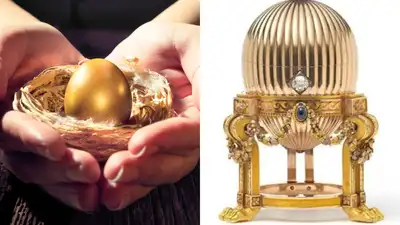
The dealer flew to London with a photograph, unknowingly carrying clues to a lost imperial Fabergé treasure.
Bought for about $14,000 with the intention of selling it for scrap, the object instead turned out to be one of the long-lost Imperial Easter eggs created by Carl Fabergé for the Russian imperial family, states a report by JCK online. As per the report, further examination established that the object was an Imperial Easter egg dating to 1887. It was commissioned by Russian Emperor Alexander III as an Easter gift for Empress Maria Feodorovna and was among a celebrated series of 50 Imperial eggs produced by Fabergé. Only 42 of the 50 are currently accounted for. The egg was subsequently reported to have sold to a private collector for as much as $33 million, although that figure has never been officially confirmed. The egg was later displayed at Wartski, marking its first public appearance in 112 years.
The dealer had hoped to make a quick return on his purchase, according to the online report. With interest in the item dwindling, the dealer turned to the internet and searched for clues using the words “egg” and “Vacheron Constantin”. Sometimes history turns up in the least likely places. For one Midwest scrap-metal dealer, that moment came at an antiques market, where an ornate gold egg seemed to be little more than an opportunity to make a modest profit. The egg contained a Vacheron Constantin watch, making its gold and timepiece components potentially valuable even if the object itself held little historical significance. But finding a buyer proved unexpectedly difficult. That search led him to an article about surviving Fabergé eggs, featuring an image that appeared strikingly similar to the object sitting in his possession, explains the online report. The discovery prompted an extraordinary journey to London, where he approached Kieran McCarthy, director of the renowned antiques dealer Wartski, with a photograph of the egg. Eight remain missing, although five are thought to have been destroyed. Three are believed to have escaped Russia, and this egg is one of them, claims the report. Its survival is particularly remarkable given the upheaval that followed the Russian Revolution, states the report. The imperial treasures were seized by the Bolsheviks, many of which were subsequently sold abroad. The egg eventually disappeared from the historical record before resurfacing decades later in an American antiques market, also claims the report. The egg is more than a valuable curiosity. Its pedestal is decorated with coloured-gold garlands suspended from cabochon blue sapphires and topped with bows set with rose diamonds. Inside sits a ladies’ Vacheron Constantin watch, featuring a white enamel dial and diamond-set gold hands, elaborates the report by JCK. Despite its long and uncertain journey, the piece remains in remarkably good condition, although several gemstones are missing. How it travelled from revolutionary Russia to a Midwest antiques market remains unknown. One possibility is that it passed through the hands of American collector Armand Hammer, who had extensive connections to Russia and was known for acquiring Russian treasures. From there, its provenance may have gradually disappeared as it moved through private collections and dealers, states the report. The scale of the discovery became clear when McCarthy eventually travelled to the dealer’s home. The priceless imperial treasure was reportedly sitting in his kitchen, beside a cupcake. The anonymous finder is nevertheless believed to have received a life-changing sum. After spending decades hidden in plain sight, the Imperial Easter egg had finally returned to the spotlight. Images Courtesy: istock and Instagram You use AI every day. Now get your AI Quotient. Take the AIQ test.