
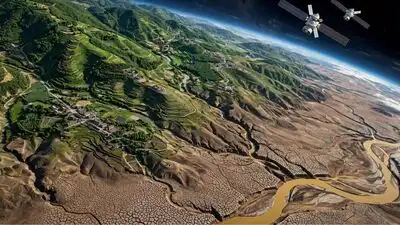
PC: AI Generated
China began a large-scale vegetation restoration programme in 1999 to improve the environment. Researchers studied this relationship between 2003 and 2015 to understand how expanding vegetation affected groundwater drought. On the Loess Plateau, however, the rapid growth of vegetation coincided with a decline in groundwater storage and worsening groundwater drought. The region in north-west China already faces frequent droughts and severe water shortages, making the availability of groundwater important for vegetation and the wider ecosystem.
How did satellite data help researchers track groundwater drought
According to research published in the Journal of Hydrology titled ‘ Effects of vegetation restoration on groundwater drought in the Loess Plateau, China ’, vegetation growth had a stronger association with groundwater drought than weather conditions. The Loess Plateau is a water-limited region where drought frequently affects agriculture and the wider environment. The researchers used observations from the Gravity Recovery and Climate Experiment (GRACE) satellite mission alongside data from the Global Land Data Assimilation System (GLDAS). GRACE measures changes in terrestrial water storage, which includes groundwater, soil moisture, surface water, snow, ice, and biomass. The researchers estimated groundwater storage anomalies by separating the contributions of other water-storage components.