AI representation/Gemini
A finding that also included children with autism The researchers also examined an independent group of 24 children aged 25 to 47 months, including children diagnosed with autism and typically developing children matched by age and sex.
The research is titled “Toddler EEG Power Reflects Behavioral Social Engagement State During Naturalistic Parent-Child Interaction” 8 Oct 2026 | 14:25 Photo: Canva The study included 49 toddlers aged 24 to 44 months, with varying language abilities. These patterns are associated with attention and social information processing, although neither brain-wave pattern is a direct measure of learning or proof that a child has understood what is being said. The adult can respond immediately, repeat a word or change the conversation according to the child’s interest.
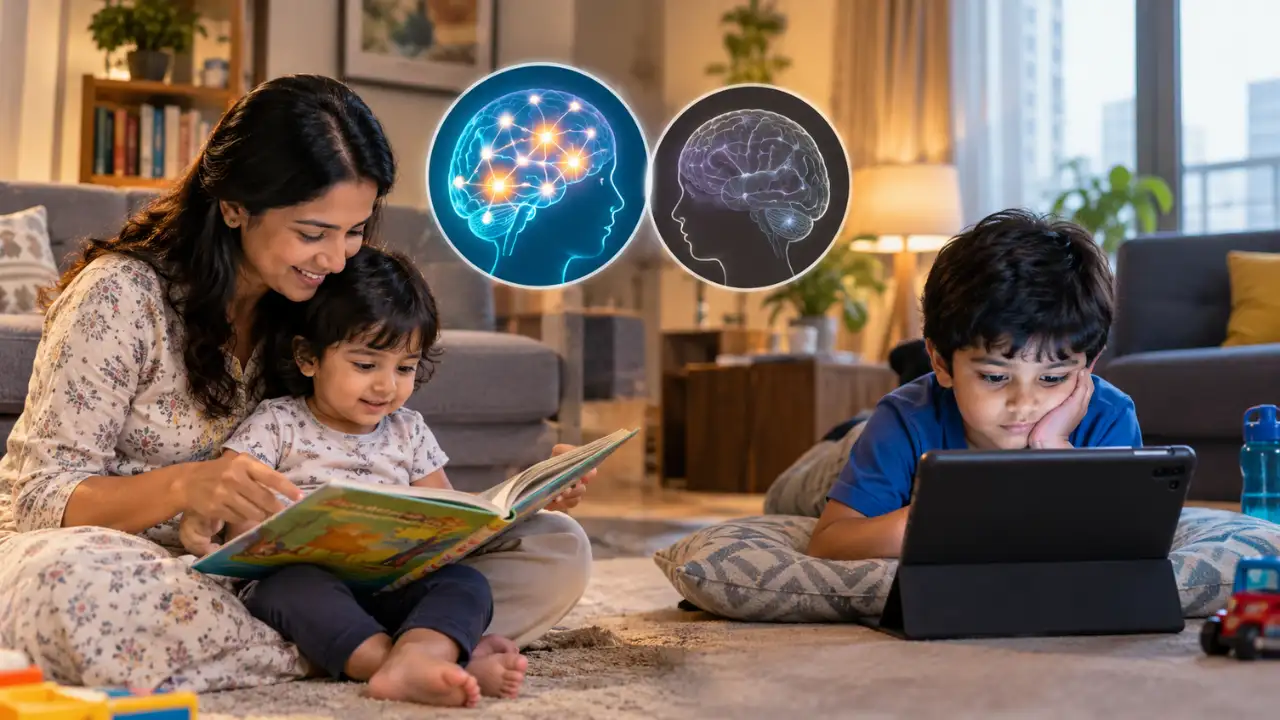
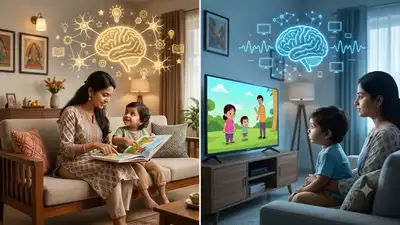
A toddler may sit quietly in front of a screen, eyes fixed on the moving images. But when a parent opens a picture book, points to an animal and talks about what is happening on the page, something different may be taking place in the child’s brain. A study by researchers at Northwestern University has found that toddlers show brain activity associated with attention and social engagement during moments of interaction with a parent that differs from the activity seen while watching a movie. The findings suggest that a child’s engagement is not just about how closely they appear to watch something, but also about whether they are interacting with another person. Researchers fitted the children and their caregivers with child-friendly electroencephalography (EEG) caps to record electrical activity from the scalp. Instead of asking the children to complete a series of artificial tasks in a laboratory, the team observed them during familiar activities. Parents and toddlers read interactive books and solved puzzles together. The researchers also recorded brain activity while the children watched a movie alongside their parent. The team then examined recordings moment by moment, identifying periods when the child was socially engaged with the caregiver and comparing them with periods when the child’s attention was directed towards the movie. The researchers focused on two patterns of brain activity: alpha and theta waves. Alpha activity decreased during moments of social engagement with a parent, while theta activity increased. The researchers found that the changes were statistically significant. The results suggest that the brain responds differently when a toddler is sharing attention with a caregiver than when the child is focused on a movie. AI representation/ChatGPT When a parent reads a book with a toddler, the activity can involve much more than hearing a story. A child might point at a picture, name an object, ask a question, imitate a sound or look at the parent to share a reaction. Puzzle play can involve similar exchanges: the parent and child look at the same object, take turns, solve a problem and respond to each other. A video can hold a child’s attention, but watching a movie does not necessarily involve the same reciprocal interaction. The difference examined in this study was not simply between a book and a screen as objects; it was between moments of social engagement with a caregiver and attention directed towards a movie. The same general brain-wave pattern appeared in this group: alpha activity decreased and theta activity increased during social engagement. Children with autism and those with language delays showed moments of engagement with their caregivers, and their brain activity during those moments followed the same pattern. However, the researchers observed social engagement less frequently in these children than in typically developing children in the study. The findings do not mean parents must eliminate screen time or turn every story into a lesson. They do offer a reason to make room for activities in which a toddler can interact with an adult. During story time, a parent can pause to ask what the child sees in a picture, let the child turn the pages or follow an unexpected question. During play, the adult can take turns, name objects and respond to the child’s attempts to communicate. These exchanges need not be elaborate. The important element is that the child and adult are paying attention to each other and responding in real time. The study measured brain activity, not the long-term effects of a particular parenting routine. But it adds evidence that the experience of watching something and the experience of sharing it with another person are not necessarily the same for a toddler’s developing brain. You use AI every day. Now get your AI Quotient. Take the AIQ test Get the latest Lifestyle News and more. Download the TOI app.