
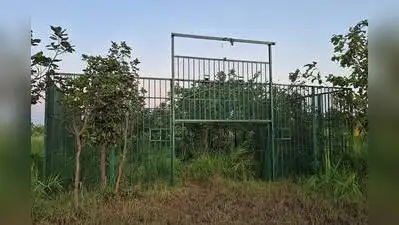
Forest Department has erected a massive 30×30-foot walk-in enclosure inside the Samda forest in Saoli taluka
The operation targets tiger T-122, which officials believe is responsible for all four attacks over the past two months, based on physical evidence and continuous tracking. In Chandrapur district, more than 150 tigers have been captured through tranquillisation, but not a single tiger has been lured into a conventional baited trap cage in the last 25 years. The operation to capture T-122 began on Sept 27. Forest teams have tracked T-122 for about 22 days, repeatedly positioning themselves along its suspected movement routes.
The challenge is not merely locating the big cat but getting it to enter a trap without sensing danger, officials said. Forest Department has erected a massive 30×30-foot walk-in enclosure inside the Samda forest in Saoli taluka Forest Department has erected a massive 30×30-foot walk-in enclosure inside the Samda forest in Saoli taluka Forest Department has erected a massive 30×30-foot walk-in enclosure inside the Samda forest in Saoli taluka Forest Department has erected a massive 30×30-foot walk-in enclosure inside the Samda forest in Saoli taluka Chandrapur: The Forest Department has erected a massive 30×30-foot walk-in enclosure deep inside the Samda forest in Saoli taluka to trap an elusive tiger suspected of killing three people and seriously injuring another in the past two months. The unconventional setup aims to lure the animal into the enclosure while minimising human presence, after repeated attempts to capture it through conventional methods failed. The animal has repeatedly evaded capture teams by detecting human presence and changing its route. Repeated attempts to entice tigers into such cages using bait have failed, prompting the Forest Department to explore alternative capture methods. Adult tigers are powerful, wary animals with highly developed senses. A tiger that has repeatedly encountered human pursuit can become particularly difficult to capture, especially when it associates unusual structures, unfamiliar smells or human activity with danger. Conventional baited cages can fail when the animal avoids the trap or learns to approach the bait without entering it. However, the tiger has retreated whenever it detected human presence. On a few occasions, teams were positioned for a possible tranquilisation, only for the animal to escape. The new enclosure is designed to blend into the surrounding woodland and minimise human presence, encouraging the tiger to enter in pursuit of bait without recognising the danger. The new enclosure has a solar-operated CCTV camera and an arrangement to put a live bait inside.
For this operation, nine ‘Garuda’ CCTV cameras, 20 trap cameras, and three live-feed cameras have been installed. A team of 60 forest department personnel and labourers is keeping a 24-hour watch on the tiger, and intensive efforts are underway to capture it, officials said. You Can Also Check: Gold Rate in Nagpur | Silver Rate in Nagpur | Bank Holidays in Nagpur | Public Holidays in Nagpur | Petrol Price in Nagpur | Diesel Price in Nagpur | CNG Price in Nagpur | LPG Price in Nagpur Stay updated with the latest Nagpur news.
Divisional forest officer Ranjan Talmale said the enclosure was a first-of-its-kind experimental initiative in Maharashtra. He added that the structure could be dismantled and transported to another location for future operations. Its success depends on whether the tiger enters the enclosure and can be safely contained. Meanwhile, the department has intensified surveillance through AI-enabled cameras and CCTV networks, regular ground patrols and awareness campaigns in villages to prevent further human-tiger encounters. Download the TOI App.