
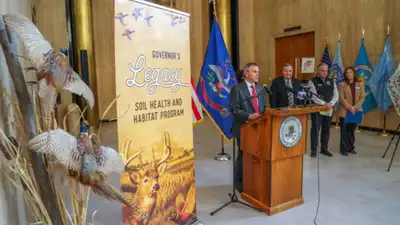
A retired farmer in North Dakota is preparing to turn 35 acres of erosion-prone farmland into grassland, a move expected to earn him $5,250 annually for five years while helping restore the soil and create wildlife habitat. The North Dakota Monitor, which reported on the initiative on May 28, said Roach would receive $150 per acre annually once the grass is planted. Brian Roach, who lives near Wheatland, is participating in the state Governor’s Legacy Soil Health and Habitat Program, which pays landowners to plant perennial grasses on less productive cropland.
Roach’s 35-acre plot is classified as highly erodible land, meaning it is particularly susceptible to soil erosion. However, the 35-acre section has not been productive enough to command the same rental rate as better-quality farmland. Under the programme, Roach expects to receive $150 per acre each year for five years after grass seed is planted in the fall. At that rate, the annual payment would total $5,250, adding up to $26,250 over the five-year agreement, assuming the full payment applies throughout the contract period. The Governor’s Legacy Soil Health and Habitat Program was launched in January 2026 as a voluntary initiative to improve soil health, strengthen cropland resilience and create wildlife habitat across North Dakota. The state’s Game and Fish Department says participating producers can receive $100 per acre to help cover seed and establishment costs, as well as a $10-per-acre reduction in crop insurance premiums for enrolled grassland. This approach is important in North Dakota, where more than 93% of land is privately owned. The North Dakota Game and Fish Department reported that it received 458 applications covering nearly 20,000 acres, with requests totalling about $10.5 million. The pilot programme was designed to enrol up to 10,000 acres. Following the review of applications, the available grant funding was fully committed to more than 9,000 acres of habitat and access projects for 2026. The initiative was launched with a $6.5 million package supported by the state’s Outdoor Heritage Fund and matching contributions from partners. At a roundtable in Mapleton on May 27, US Senator John Hoeven discussed the possibility of using the federal Conservation Stewardship Program to make up to $100 million annually eligible for matching arrangements of this kind. For Roach, the immediate goal is to give the 35 acres time to recover.
Conservation efforts therefore depend substantially on landowners choosing to participate.
It’ll become pretty productive cropland,” Roach told the North Dakota Monitor. “I wasn’t charging (my tenant) $150 an acre rent because that land isn’t that productive, but in five years, if this grass grows, it should become $150 an acre,” Roach said. It was developed to help farmers restore less productive farmland while supporting conservation, according to the North Dakota state government. The state said the programme was developed partly in response to concerns about continuing losses in the federal Conservation Reserve Program, which also pays landowners to take certain agricultural acres out of production and establish vegetative cover. Roach has land enrolled in the federal programme as well, but he told the North Dakota Monitor that he preferred the state scheme’s simpler application process. Richard Fordyce, the US Department of Agriculture’s under secretary for farm production and conservation, said federal officials would seek to help if a funding opportunity emerged. Governor Kelly Armstrong said he was looking for ways to expand the initiative but did not want it to become dependent on federal funding or lose its flexibility through federal oversight.
The programme offers farmers a financial incentive to set aside land that may be difficult or unprofitable to cultivate, while allowing the soil to recover and providing habitat for wildlife. “Once it gets some topsoil put back on and you give it a few years to stabilise… we’ll get some root structure from the grass. Roach currently rents his land to a young farmer who grows crops including corn, soybeans, wheat and alfalfa. “In effect, the state is subsidising it to make it more productive land. That’s why it’s a win-win program. The programme is administered by the North Dakota Association of Soil Conservation Districts, with local conservation districts and partners helping implement it. Its five-year agreements provide annual rental payments based on average county rental rates, alongside assistance for establishing grass cover. Landowners can also opt to make eligible land available to hunters through the state’s Private Lands Open To Sportsmen programme, which offers an additional incentive. The scheme focuses on marginal or unproductive cropland, including low-yielding fields and areas near streams or wetlands. Rather than requiring farmers to convert entire fields or large blocks of farmland, it can target smaller sections that are difficult to cultivate efficiently. The programme’s first enrollment cycle attracted far more interest than the state could accommodate. The programme’s popularity has prompted state and federal officials to explore ways to expand it. However, federal funding had not been earmarked for the Governor’s Legacy programme at the time of the North Dakota Monitor report. Establishing perennial grasses could help stabilise the soil, develop root structures and improve the land’s longer-term productivity. The programme also offers a way to earn income from acres that currently generate less from conventional farming.
The wider test for North Dakota will be whether the pilot can secure sustained funding and expand to meet the demand from landowners seeking a practical balance between farm income and conservation. You use AI every day. Now get your AI Quotient. Take the AIQ test.