
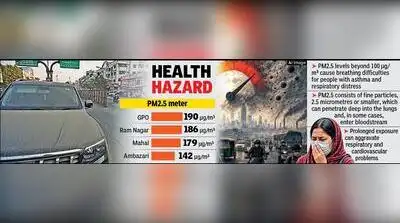
Nagpur: The ambient air quality in Nagpur has worsened sharply, with fine particulate matter (PM2.5) levels exceeding PM10 at all four monitoring stations and reaching alarming levels in GPO, Ram Nagar, Ambazari and Mahal areas on Thursday. Three of these areas have relatively thick green cover, raising further concerns about the situation in other parts of the city.
At GPO, PM2.5 was 190 µg/m³, Ram Nagar recorded 186 µg/m³, Mahal’s PM2.5 stood at 179 µg/m³ and Ambazari at 142 µg/m³. PM2.5 levels beyond 100 µg/m³ cause breathing difficulties for people with asthma and respiratory distress. The rise in PM2.5 points to a more serious health concern. PM2.5 consists of fine particles, 2.5 micrometres or smaller, which can penetrate deep into the lungs and, in some cases, enter the bloodstream. Nagpur’s overall AQI has worsened too, rising to 125 on Thursday from 114 on Wednesday.
A govt official said she reported bursting of firecrackers in Laxmi Nagar area in the last two days to police and Nagpur Municipal Corporation (NMC), but no action was taken. You Can Also Check: Gold Rate in Nagpur | Silver Rate in Nagpur | Bank Holidays in Nagpur | Public Holidays in Nagpur | Petrol Price in Nagpur | Diesel Price in Nagpur | CNG Price in Nagpur | LPG Price in Nagpur Stay updated with the latest Nagpur news. PM10 has traditionally been the prominent pollutant in Nagpur. Prolonged exposure can aggravate respiratory and cardiovascular problems. Download the TOI App.
Maharashtra Pollution Control Board (MPCB) regional officer Hema Deshpande expressed surprise over the sharp rise in PM2.5 and said an assessment would be required to determine the reasons. Environmentalist Suresh Chopne said the significant increase in vehicles on roads and rampant burning of municipal waste were major contributors to poor air quality, particularly the rise in PM2.5 in Nagpur.
A former CSIR-Neeri scientist, who has worked on air pollution control projects, said bursting of firecrackers during recent immersion processions and other celebrations and increased vehicular congestion were likely to be among the main reasons for the worsening air quality. Leena Buddhe, who works for controlling pollution from power plants, said the deterioration well before peak winter was a “massive wake-up call”. “Garbage burning is filling our mornings with toxic haze, and early festive crackers are only worsening the trap created by falling temperatures,” she said, calling for immediate dust-control, waste-lifting drives and functional electrostatic precipitators (ESPs) at thermal power plants around the city.
NMC public health engineering officials did not respond to TOI’s calls.