
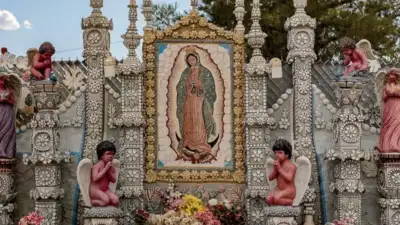
La Casa de Azucar | instagram/@texashighways
Loya was sewing pockets into denim jeans at El Paso’s Levi Strauss manufacturing plant before retiring in 1995. The main construction period ran from 1973 to 1998, and Loya continued to repaint and repair parts of the property after that, and was able to maintain the artwork around the house and its boundary walls. One large altar was decorated with angels and small cherub figures and took more than 600 hours to complete, according to the SPACES Archives, while a separate shrine that was dedicated to the Virgin of Guadalupe took almost a year to construct. Loya also included memorial structures as a tribute to people killed in the September 11, 2001, terrorist attacks. El Paso, Texas | Wikimedia Commons The house remains a private residence The Sugar House is at 4301 Leavell Avenue in El Paso, and its decorations can be seen from the street, but the property is privately owned and the fenced area is not open for unrestricted entry. Photographs documented the property in 2008 and again in 2018, with the intention of preserving views of the house, its decorated walls and its shrines. The archive’s record also notes that Loya died on August 13, 2022, and the future of the site was uncertain. The Sugar House’s main period of construction ended in 1998, but its structures are still a record of the work that was carried out by Loya over a quarter-century.
Because stonework and specialised carving tools were not within his budget, he built the decorations in his spare time and used inexpensive materials. Because of its elaborate ornamentation, with passersby thinking that the layered decorations resembled a cake covered in sugar frosting, the house got its nickname.
Loya used kitchen containers to cast repeated decorative patterns and incorporated them into the yard’s structures, according to Roadside America’s account of the property. Small signs around the property carry messages in English and Spanish, with one reading, “This house is a little piece of Mexico,” which reflects Loya’s connection to his birthplace and his life in El Paso. He used cups, bowls and other kitchen containers as moulds for the shapes that he made from cement and plaster. How an ordinary house acquired its elaborate exterior Loya began with a decorated archway over the path to the front door with rocks and painted plaster flowers, then expanded the project to flowerpot bases, window surrounds, fences and freestanding columns, which eventually extended across much of the property. He moulded cement into flowers, leaves, spheres and beads, with some pieces attached to the house itself, while others became part of pillars and walls in the yard. He also cut aluminium cans into thin flower shapes, fastening the pieces together with bottle caps. The design was inspired by the decorative stonework and religious ornamentation that Loya remembered from Catholic churches in Mexico, and the result was an extensive collection of handmade objects and structures around the original house. Religious shrines became a major part of the property Loya built shrines that were dedicated to the Sacred Heart of Jesus, the Virgin of Guadalupe, Saint Francis of Assisi and other Catholic figures, with intricate painted statues, angels and decorative concrete work. Loya accepted the comparison and stated that the property was a tribute to his adopted city and its residents. The house and its exterior artwork are still visible from the surrounding street, although visitors should not enter the private grounds without permission. You use AI every day. Now get your AI Quotient. Take the AIQ test.

Rufino Loya Rivas bought a modest house in El Paso, Texas, with his wife, Celia, in 1973. He covered the home and its grounds with handmade decorations, painted concrete ornaments, columns, arches, and religious shrines over the next 25 years, and the site became known as La Casa de Azúcar, or the Sugar House, according to the SPACES Archives . He made a promise to transform the property into a place that she would be proud of despite not having any formal training in architecture, art, or construction.