
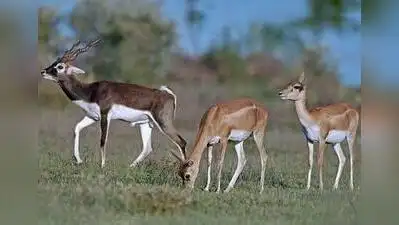
Blackbuck
Prayagraj : Sustained conservation efforts by state govt have led to an increase in the blackbuck population at Chand Khamariya Blackbuck Sanctuary in the trans-Yamuna region of Prayagraj, with numbers rising from 508 in 2022 to 604 at present. The census, carried out between Aug and Sept, recorded a total of 604 blackbucks, including 344 adult females, 92 adult males, 72 sub-adult females, 45 sub-adult males and 51 fawns. The highest blackbuck population, 122 animals, was recorded near Itwa Kala village, followed by 121 in Mahuli Kala, 114 in Kihuni Kala, 90 in Purwa, 47 in Chand Khamariya, 35 in Baijala Pahadi and 34 in Majra Pahadi. The 146-hectare protected area spans four villages, including Chand Khamariya and Mahuli Kala.
With the population of stray dogs increasing in and around the protected area, the department launched a drive to remove them from the sanctuary. Stay updated with the latest Prayagraj news.
“This is not only a positive indicator for wildlife conservation but also demonstrates that initiatives launched by Yogi Adityanath govt to protect wildlife and mitigate human-wildlife conflict are delivering results on the ground,” said Arvind Kumar , divisional forest officer (Prayagraj). He said the blackbuck census was conducted by the forest department in collaboration with experts from Acharya Narendra Dev University of Agriculture and Technology, Ayodhya. Yashmita Naveen, assistant professor in the university’s department of agroforestry, said the protected area was divided into several sectors for the census. Officials said the findings indicate a promising outlook for the long-term sustainability of the blackbuck population in the sanctuary. The DFO said leased land within the protected area is being allotted in clusters in line with directives issued by the divisional commissioner.
Forest department officials attributed the growth to habitat expansion and measures aimed at reducing human interference within the protected area. The exercise involved preliminary, transect, pilot and waterhole-count surveys. Key indicators such as the sex ratio and fawn population were also assessed. However, blackbucks frequently move beyond the designated sanctuary limits into neighbouring villages. The area also contains gram sabha land leased to individuals for various purposes, resulting in regular human activity within the habitat. To minimise disturbance, the administration has initiated efforts to consolidate scattered leased land parcels at a single location. The revenue department is overseeing the process, which is expected to further reduce human interference. The forest department has also undertaken habitat-improvement measures, including cultivation of grasses preferred by blackbucks and construction of permanent and earthen water troughs to ensure the availability of drinking water. Locals have also been sensitised and encouraged to participate in conservation efforts. Download the TOI App.