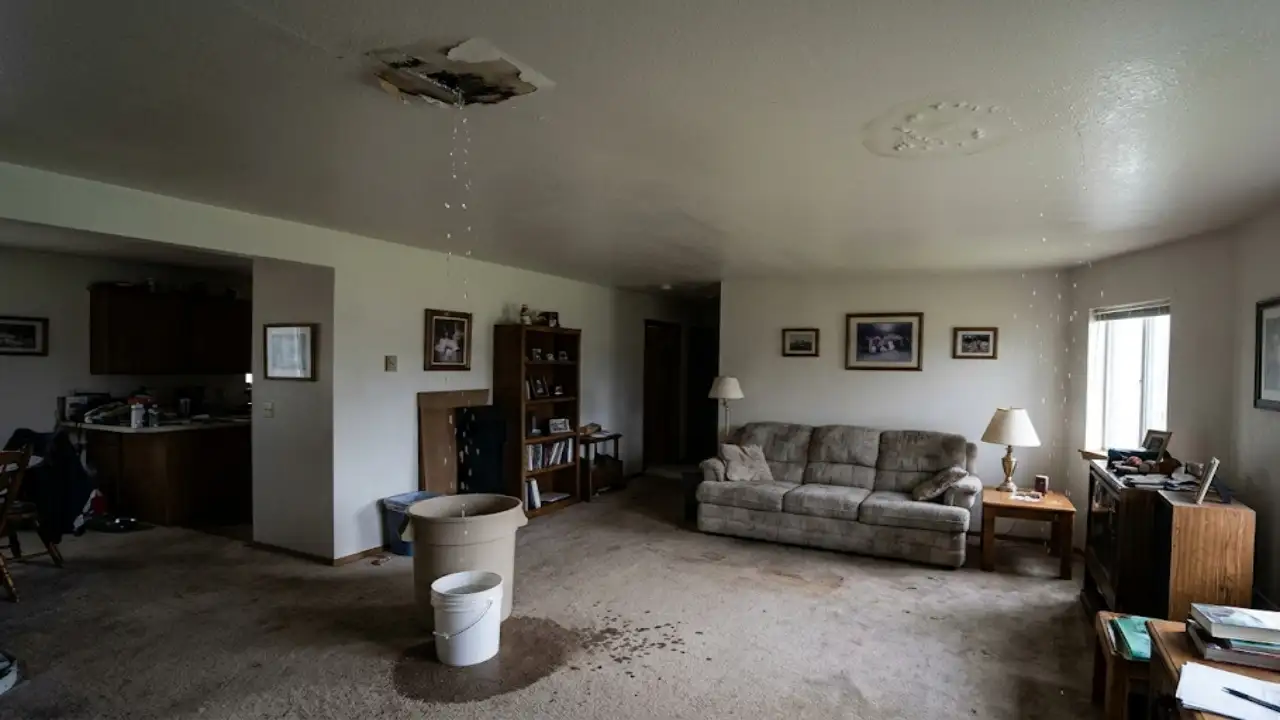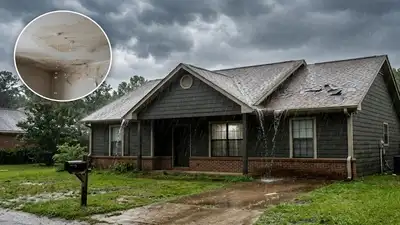
AI-generated representative image showing a house during heavy rain, with the inset highlighting water leaking through a damaged ceiling. Credits – Gemini
The district court granted summary judgment to State Farm, resolving the dispute without trial. The rationale was that the policy covered wind and hail, but not wear, decay or latent faults, and that the Bargers had not shown evidence indicating a covered event caused the additional damage. It also found that the only expert testimony as to cause pointed to faults in the construction. The problem, the appeals judges found, was that the district court had applied the wrong burden of proof. It had relied on the policy wording for personal property, which lists specific risks such as windstorm or hail, instead of the wording for the dwelling itself. Dwelling coverage is different. Insurers call this all-risk protection, which covers accidental direct physical loss unless an exception applies.
That question ended up in federal court after a storm passed through Greenwood, Mississippi, in June 2021. The insurer disputed about $16,000 of the claim, and a lower court agreed. But in March 2025, the Fifth Circuit , the US federal appeals court covering Mississippi, Louisiana and Texas, overturned the ruling on the burden of proof, vacated the dismissal and sent the case back to the lower court. That disparity changes the burden of proof under Mississippi law, the state Supreme Court said in a 2009 case, Corban v.
Rain streamed into their house, and Mark and Margie Barger asked State Farm to pay for a brand new roof. USAA. Simply put, the question is who has the burden of proof to establish why the water got in. With all-risk coverage, the homeowner only has to prove that a physical loss occurred. After that, it is up to the insurer to prove that an exclusion such as wear and tear accounts for it. With a named-perils policy, the burden shifts and it is the policyholder who must prove that the harm was caused by a covered hazard. The trial court misstated the test, and thereby imposed an additional and more onerous duty on the Bargers. State Farm contended that the mistake was a clerical error that didn’t matter. The appeals court wasn’t persuaded and wrote that water had spilt into seven separate portions of the property, enough to create a genuine issue of material fact as to whether the roof system sustained accidental physical loss in the storm. The appeals court did not order any payment to the Bargers. In particular, it declined to opine on whether either side had met its burden on the policy exclusions, such as wear and tear or structural faults, leaving that to the district court when the case returns to it. The insurer may still argue the damage was caused by the way the roof was built or by wear. The difference now is that the insurer must prove an exclusion applies. Keeping dated photos of leaks, storm data, and proof of the roof’s prior condition gives a claim something concrete to rest on, regardless of who bears the burden. The insurer’s argument that only a tiny portion of the roof was storm damaged has yet to be tested at trial. The ruling was not published, so it is not binding on other courts.