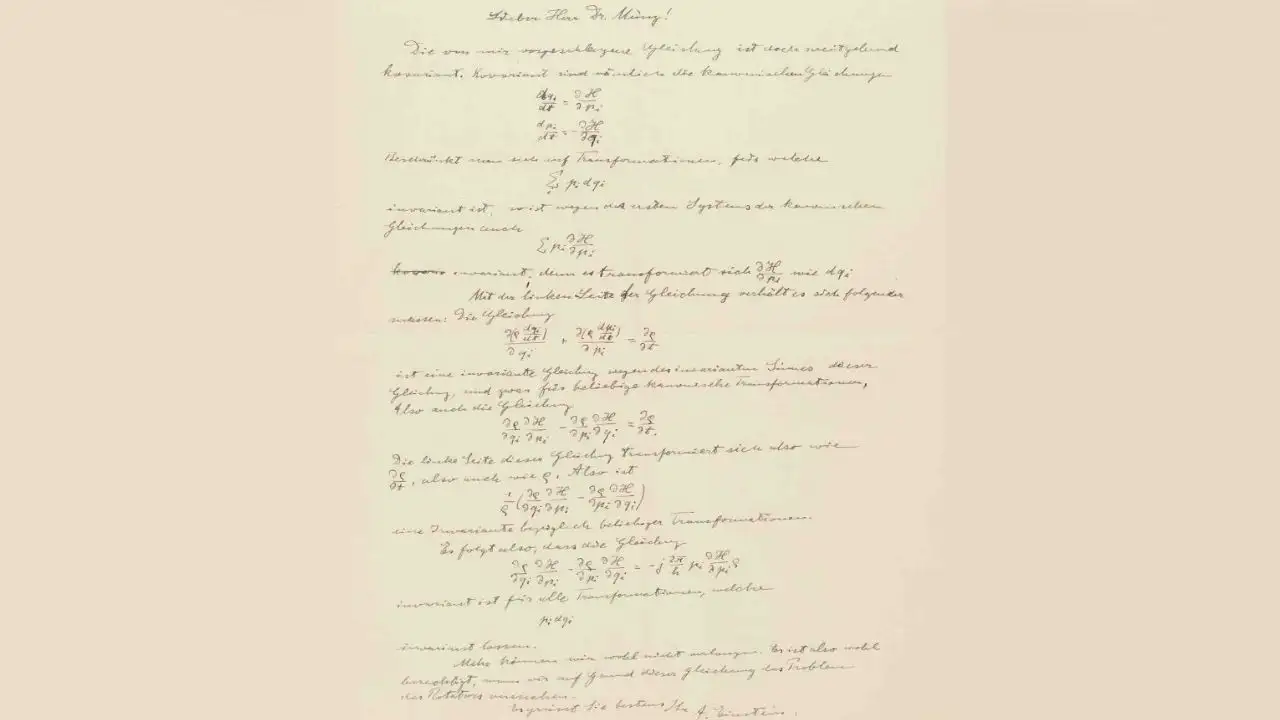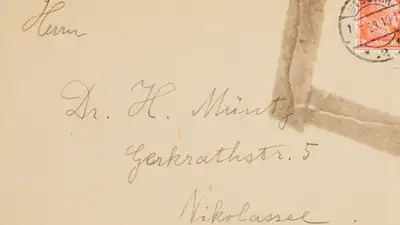
Written in German, the letter was sold with its original envelope (Photo: RR Auction)
A handwritten letter in which Albert Einstein explained a mathematical problem to a fellow researcher nearly 100 years ago has sold for $71,811 at an auction. The document, believed to have been mailed around 1929, contains a page of equations and notes addressed to mathematician Chaim Herman Muntz. Einstein”, the document measures 8.75 by 11 inches. Its exact date is unknown, but the envelope carries a postmark from Potsdam, Germany, apparently dating to 1929. The auction house had placed an estimate of $20,000 or more on the letter, which eventually sold for $71,811, including the buyer’s premium. A document signed by King Edward IV fetched $37,535, while another bearing King Henry VIII’s signature sold for $33,901. An autograph scrapbook containing signatures of prominent figures, including Babe Ruth, Amelia Earhart and Thomas Edison, fetched $28,759.
Written in German and signed “A.
The letter offers a look at a scientific discussion between Einstein and Muntz during the late 1920s, according to the auction house. Bobby Livingston, executive vice president at RR Auction, said the letter allows readers to see how Einstein developed his calculations. “What’s interesting about this letter is that you can follow Einstein’s calculations across the entire page,” Livingston said, as quoted by Fine Books and Collection.
It was sold by RR Auction last week, along with the original envelope in which it had been sent from Germany. The letter concerns Hamiltonian mechanics, a mathematical method used in classical physics to study the motion of physical systems. Einstein was examining whether certain mathematical relationships would continue to hold when the equations describing them were transformed. His explanation takes up almost the entire page. “He’s working through the mathematics, explaining his reasoning to a fellow mathematician and suggesting what they should investigate next. You can see the progression of his thinking right on the page,” he added. Einstein’s letter was one of several historical items offered in RR Auction’s Fine Autographs and Artifacts sale. You use AI every day. Now get your AI Quotient. Take the AIQ test.
A scientific discussion that began years earlier
Einstein and Muntz had been corresponding since 1927, well before the letter was apparently mailed. By 1928, the two were discussing distant parallelism, also called Fernparallelismus. Between 1928 and 1931, he produced several papers using distant parallelism. In 1929, Hamilton’s principle also became relevant to this research as he considered mathematical questions raised by Muntz and Cornelius Lanczos.
Because it contains an extended mathematical explanation rather than a brief message or a simple statement of Einstein’s conclusions, the document is unusual.
Einstein crossed out the word “covariant” and replaced it with “invariant” while discussing one of the mathematical expressions. “We probably cannot demand more than that,” Einstein wrote. He then proposed using the equation to study what he called “the problem of the rotator”.
Their exchanges involved mathematical questions connected to Einstein’s research, including his efforts to bring different physical forces into a single theoretical framework. Einstein was investigating this mathematical approach as part of his attempt to develop a unified theory of gravitation and electromagnetism. Muntz contributed calculations to that work, particularly on a problem involving central symmetry. Einstein later acknowledged his contribution in published research. The collaboration continued while Einstein was developing his ideas about a unified field theory. However, the newly sold letter does not appear to deal directly with the unified-field theory. RR Auction’s description indicates that Einstein was examining a different problem involving the mathematical behaviour of equations in classical mechanics. The letter shows Einstein’s mathematical calculations spread across the entire page. (Photo: RR Auction) At the centre of Einstein’s calculations are two concepts: covariance and invariance. Both concern what happens to mathematical expressions when the variables or mathematical descriptions used in a problem are changed. Invariance means that a particular mathematical expression remains unchanged under a specified transformation. Covariance, meanwhile, concerns how mathematical relationships behave when such transformations are made. Einstein wanted to establish which relationships in the problem would retain the required mathematical properties. To do this, he used Hamilton’s canonical equations, which are part of Hamiltonian mechanics. These equations describe how certain quantities associated with a physical system change over time. The question was not simply whether an equation could be written differently. Einstein was examining the mathematical conditions under which its relationships would remain valid. He considered transformations that preserve a particular expression and used that condition to establish further results. One conclusion provided the basis for another, allowing him to determine the properties of a more complicated equation. The handwritten page also contains a correction. By the end of the letter, he appeared satisfied that the equation met the conditions he had been investigating.