
PC: AI Generated
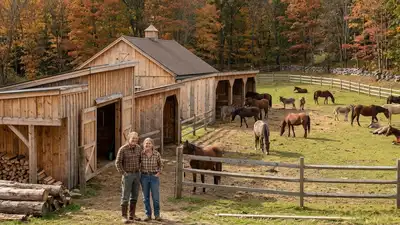
Using timber cut from their land, Bobby built barns to house the farm’s 20 residents, including horses saved from kill pens and the threat of slaughter. As reported by CBS News, what began as Heidi’s commitment to horse rescue has grown into a community effort supported by more than 60 volunteers. As the farm approaches its 15th anniversary in 2027, its mission extends beyond animal welfare, offering people a place to connect and contribute. The farm now houses 20 rescued animals, including horses, mules, alpacas and pigs. The couple, who have been married for 42 years, did not set out to become public figures in their community. More than 60 volunteers now help support the operation, alongside thousands of people who contribute to its efforts. Its public profile grew during the Covid-19 pandemic, when people looked for outdoor activities and places to spend time away from crowded indoor settings. Smokey Chestnut Farm is approaching its 15th anniversary in 2027. The scale of the wider problem is reflected in estimates from the US Department of Agriculture, which put the number of horses from the United States slaughtered each year at between 18,000 and 25,000.
His behaviour has improved since then, according to Heidi. In Norton, Massachusetts, Heidi and Bobby Medas have turned their own property into Smokey Chestnut Farm, a nonprofit sanctuary where rescued horses and other animals can live without being expected to work or entertain people. Heidi and Bobby established Smokey Chestnut Farm as a nonprofit, with Bobby putting his practical skills to work on the land. A retired employee of Norton’s highway department, he built the barns and other structures using timber cut from the property itself. Heidi had been drawn to horse rescue, and the work gradually became a shared commitment. The farm is generally visited by appointment or during fundraising events. The couple also began giving away compost produced at the property, bringing more people into contact with the work being done there. For Bobby, the attention and support have meant adjusting to a role he might not once have chosen. Several of the farm’s horses were saved from kill pens, holding facilities where animals may be bought for onward transport to slaughterhouses, including those in Canada and Mexico. The costs of rescuing a horse extend beyond the purchase itself. Smokey Chestnut Farm must also cover transport and quarantine, with the final bill depending on the animal’s condition and the arrangements needed to bring it to safety. Horses continue to be consumed as meat in several parts of the world, although slaughter for human consumption is not carried out legally within the United States. At Smokey Chestnut Farm, the animals are not expected to work or provide entertainment. Most do not wear harnesses, and there is no requirement for them to be ridden or trained. The intention is to provide care for the remainder of their lives, regardless of whether they can be handled easily or have any practical use to people. Hope and Faith, two Chincoteague ponies, remain wary of human contact. Heidi has described them as having been wild when they arrived, and they still prefer to keep their distance from people. They share their space with Lucky, a retired show pony whose former owners continue to visit. The older animal appears to have become a steady presence for the two ponies. Bonnie and Clyde, a pair of mules, were rescued from a kill pen in Pennsylvania. Clyde had suffered abuse before reaching the farm and initially spent much of his time standing in a corner, trembling. The pair live alongside Lucas, a large horse that was removed from an animal abuse case. Other residents have been surrendered for different reasons. Whiskey, a thoroughbred, was given up after failing to make money for his owner. Zilla, a Standardbred, had pulled a racing cart and worked with Amish families before being placed at risk of slaughter. Heidi received a call about Zilla and arranged for his rescue. When Zilla first arrived, he was frightened of people. Five years later, he had become comfortable in his surroundings. Heidi has described the change as a gradual process in which he came to recognise that he was safe. Two of the horses at the farm, Grace and Dakota, are blind. Dakota’s rescue began after Heidi received a video from a stranger showing the horse in a kill pen in Texas. She initially did not want to watch it, but her concern for the animal eventually led her to act. Dakota’s case also became part of a wider effort to save Kelsey, another blind horse who has since died. Heidi was determined to secure help for both animals, despite the practical and financial demands involved. Their stories reflect the farm’s policy of accepting animals on the basis of their need for care rather than their ability to be trained, ridden or used for work.
Fundraising therefore remains important even when the farm itself has no available space. Heidi has worked to build relationships with other rescuers so that a horse can still be helped when there is no room in Norton. For more than 30 years, she has worked as an interpreter for deaf students at Boston University, transcribing lecture notes in real time so that students can follow their classes.
The couple cannot take in every horse that needs rescuing. Smokey Chestnut Farm is currently full, meaning new arrivals must be accommodated elsewhere if they are to be saved. One of those partnerships is with Annie Crosby, an animal rescuer based in Rehoboth, Massachusetts. The two have now rescued six horses together. The sanctuary has also become an important place for people who spend time there. Crystal Medeiros, who volunteers at least four days a week, has found a particular connection with Zilla. Now retired, she has been able to pursue her longstanding wish to work with animals. Medeiros has spoken about the sense of peace she experiences at the farm and the relationships she has formed there. Caring for the animals gives her a routine built around practical tasks and attention to their needs. It also provides regular contact with people who share her interests. Annie Crosby, who also works as a therapist, has observed how time spent around horses can affect people. Her experience at the farm and through rescue work has shown her that the benefits are not confined to the animals themselves. The relationships formed around their care can matter to those involved, too. Animal welfare is not Heidi’s only long-standing commitment. She has spoken about the demands faced by students with disabilities and her admiration for those who continue to pursue their education despite the obstacles they encounter. The work has given her another way to provide practical support to people who need it. Her involvement in education and animal rescue may appear to be separate responsibilities, but both depend on close attention to others and an understanding that people and animals can need different kinds of assistance. At the farm, that means allowing a frightened horse to settle at its own pace. In the classroom, it means helping students access information as a lesson unfolds. You use AI every day. Now get your AI Quotient. Take the AIQ test.