
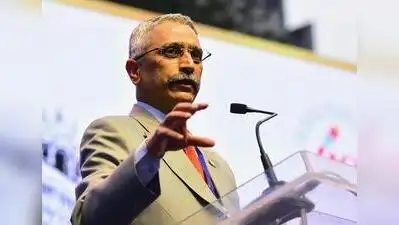
Gen (retd) Manoj Naravane
Explaining the larger lessons from the June 2020 confrontation, he said, “After Galwan incident, we have held our ground. On the night of June 15, 2020, Indian and Chinese troops engaged in a violent face-off in eastern Ladakh during a standoff over the disengagement of forces.
Pune: The Galwan Valley clash with China demonstrated that a military solution to the longstanding boundary dispute between the two countries was no longer an option, former Army chief General (retd) MM Naravane has said, asserting that India’s firm response had sent a clear message against any unilateral attempt to alter the status quo along the frontier. The incident, he said, had given fresh impetus to resolving the dispute through dialogue and diplomatic engagement. “I think that is the greater lesson that has emerged from Galwan, that India in the world gained very much in terms of reputation, both military as well as diplomatic and political,” Naravane said. “With China, we have a longstanding boundary dispute and the boundary itself is about 3,500 km long,” he said, pointing out that disagreements over the alignment of the Line of Actual Control (LAC) had persisted across several stretches. Given the length of the disputed frontier, differences over the perceived alignment of the LAC were inevitable, he said. “Such areas of disagreement had repeatedly witnessed confrontations and could continue to remain flashpoints until the boundary question was resolved,” said the former chief.
We have shown that the unilateral use of force to change boundaries or borders is not acceptable. It should be the last option. He emphasised the distinction between a recognised international border and an unsettled boundary. a boundary dispute involves disagreement over the precise alignment of the dividing line While an international border is generally well demarcated and accepted by the countries concerned. The Galwan Valley clash was one such confrontation. Twenty Indian Army personnel were killed in the clash, while China subsequently acknowledged that four of its soldiers had died. The confrontation marked a major deterioration in bilateral relations and triggered a prolonged military standoff along the LAC.
The talks had remained stalled for a considerable period before being revived, according to Naravane. It is the first step towards resolving a boundary dispute,” he said. The broader lesson from Galwan, he said, was that India’s response had strengthened its standing while reinforcing the principle that differences along the frontier must be addressed through sustained dialogue rather than unilateral action.
He also pointed to the revival of talks between the special representatives of the two countries as an important development. India’s National Security Adviser Ajit Doval and Chinese Foreign Minister Wang Yi, who serves as Beijing’s special representative, have been involved in the mechanism for addressing the boundary dispute. “The emergence of the term ‘delimitation’ in a recent round of discussions was particularly significant.