
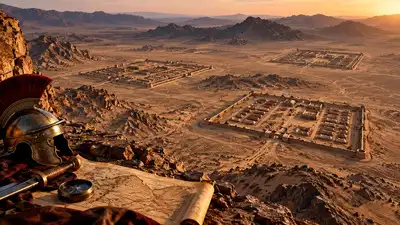
AI Representation: Archaeologist Michael Fradley identified three possible Roman military camps in Arabia while examining satellite images for Oxford’s EAMENA project in 2023. Image credits: Chatgpt
In the paper, it is stated that the annexation of Trajan in AD 106 added Hegra, located in northwestern Saudi Arabia, along with northern Hijaz, to the province of Arabia; there are also some inscriptions about Roman forces located there. The Antiquity article notes that the Roman army was present as far south as Hegra by AD 175, but argues that Roman control of the area was long established by then, which makes that period a less convincing setting for the campaign than Trajan’s annexation after AD 106. Because roman literature mentions no major military campaign, as The Past explains, the transfer of power after the death of the last Nabataean king, Rabbel II Soter, in AD 106 is usually seen as peaceful. Because the camps cannot yet be dated, the same study considers the annexation by the emperor Trajan after AD 106 the most plausible time frame for the expedition, but calls it a hypothesis.
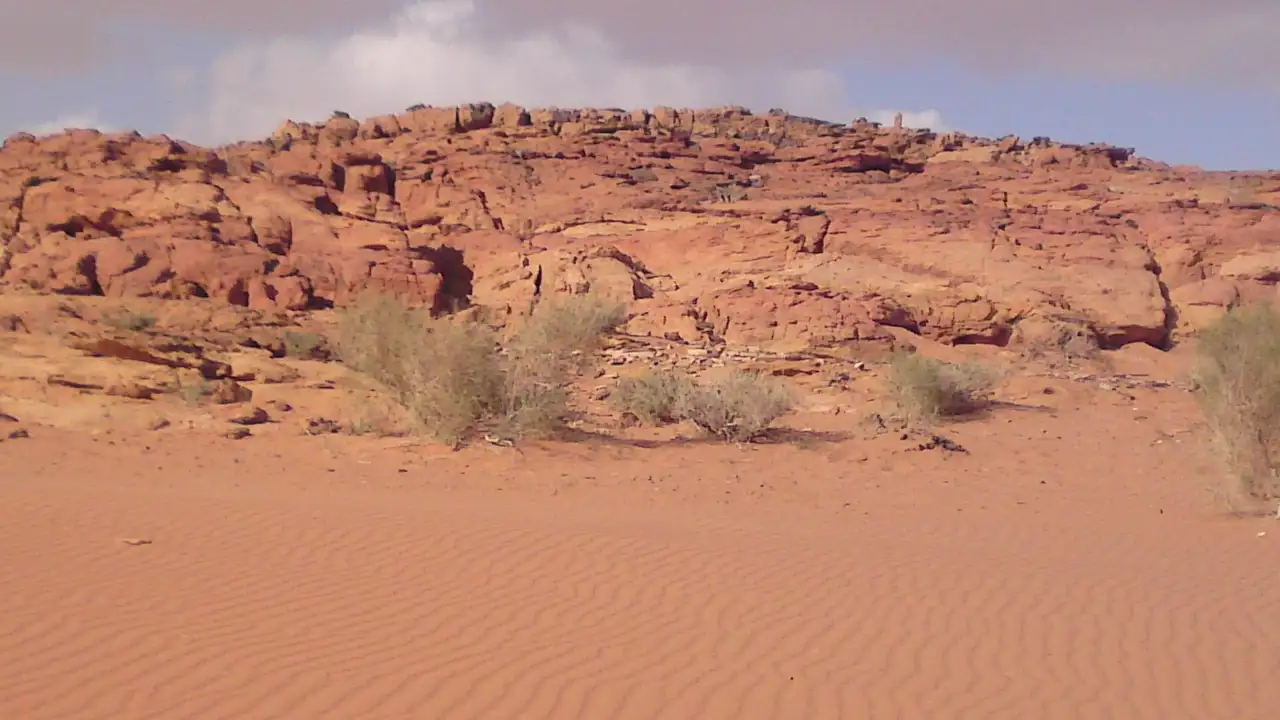
“The Roman Military Camp in Ancient Hegra” is written by Zbigniew Fiema and François Villeneuve, published in 2018 in the proceedings of the 23rd International Limes Congress. The camps paint a different picture. In its news release on the discovery, the University of Oxford reports Professor Andrew Wilson, a co-author of the paper, as saying that the camps suggest the annexation was not entirely straightforward and that Rome moved quickly to secure the kingdom, if the early second-century dating is correct. Southern Jordan’s desert landscape, where researchers identified traces of three probable Roman temporary camps using satellite imagery. Image credits: Wikimedia Commons The authors of the above-mentioned study suggest that further investigation near Dumat al-Jandal and Sakaka, which could have been the goal of the campaign, might reveal more about the Roman army in the region. Roman troops at Hegra and the questions still open Other sources indicate the operation of Rome in the area. Still, questions regarding the new camps are to be resolved. In comments for Sky News, Dr. Wilson expressed his surprise about why the western camp might be almost twice as spacious as the other two camps. The Jerusalem Post reports possible explanations, including that the garrison may have been smaller or that the camp may have supported the others with water supplies. You use AI every day. Now get your AI Quotient. Take the AIQ test.
The EAMENA survey and the three camps east of Bayir The EAMENA website states that the Endangered Archaeology in the Middle East and North Africa project was set up in 2015 and that its team uses satellite imagery, aerial photography and on-the-ground visits to record archaeological sites and assess their condition. Oxford’s research archive lists the publication date as 27 April 2023, which matches the online publication date shown on the paper’s Cambridge University Press page. The paper says remote sensing in southern Jordan identified at least three Roman temporary camps east of Bayir, with the western camp covering roughly 1.291 hectares. The authors argue the alignment points to an expedition toward Dûmat al-Jandal and may fit the Roman annexation of the Nabataean kingdom after AD 106. Camp dimensions and the 1982 and 2017 satellite images The heritage news website, The Past, says the western camp spans approximately 125 by 105 metres, while the central and eastern camps each span around 95 by 65 metres. The above-mentioned study places the eastern camp 37.7 kilometres east-southeast of the central camp. The satellite image of the eastern camp provided by Google Earth and Maxar in The Past is dated 26 February 2017. However, since most of the land has been converted to central-pivot irrigation, the researchers also used the Kh9 Hexagon imagery dated 24 August 1982. Why the camps may belong to the Nabataean annexation of AD 106
Because the construction has not been excavated or examined yet, this is what the researchers define as a hypothesis,. They have been recognized by the research group as possible Roman temporary camps due to their playing card shape, their symmetrical entrance and the tituli placed in front of the entrances. An investigation of the nearby terrain revealed additional formations in a similar direction. The findings were published in Antiquity in the study A lost campaign? This imagery did not show any additional camps, although the paper notes that further camps east of the easternmost camp may have been lost under wind-blown sands.
At the University of Oxford, a team that records endangered heritage sites across the Middle East and North Africa used freely available satellite images to find and document archaeological remains. Oxford attributed the discovery to Michael Fradley, who first spotted a faint rectangular outline on Google Earth while the team was exploring the border zone between southern Jordan and Saudi Arabia. It was a typical formation of Roman soldiers’ enclosures, which were erected when troops were on the march. Roman literature contains nothing about any large-scale military action during the conquest of the Nabataean Kingdom and it has traditionally been considered a relatively peaceful operation. New evidence of Roman temporary camps in northern Arabia , by Michael Fradley, Andrew Wilson, Bill Finlayson and Robert Bewley. There are three camps to the east of the settlement of Bayir, located in a row leading to Dûmat al-Jandal in the Jawf region of Saudi Arabia. The paper adds that the Aerial Archaeology in Jordan project later photographed the western and central camps from the air. This discovery is rare.
Temporary encampments are the type of construction an army leaves behind during a march, so a line of them running far into the desert suggests a previously undocumented expedition, although the western camp’s larger size means the three camps cannot yet be assumed to have held one uniform force. An earlier review by Kennedy, cited in the paper, identified only four possible Roman temporary camps in Jordan.