
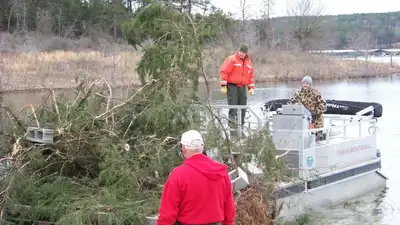
Instead of building concrete reefs, conservation workers in Nebraska have turned trees cleared from overgrown lake banks into underwater fish habitats, placing around 150 trees at 16 locations across two lakes. The project, completed in September 2026, aims to give smaller fish places to hide from predators while improving fishing access along the shore.
The trees were transported and submerged using a new Aquatic Habitat Barge at Bridgeport State Recreation Area, according to the Nebraska Game and Parks Commission.
The commission announced the work on October 22, explaining that the brush piles would provide shelter for smaller fish and help support the aquatic food web. The project is part of Nebraska’s wider effort to improve lake habitats and make fishing more productive.
The different projects show that habitat restoration does not depend on a single design. Depending on the water body and its needs, managers can use woody material, rocks or purpose-built structures to increase habitat diversity. The Bridgeport project specifically uses trees rather than newly constructed rock structures. However, the commission has not described it as a formal replacement for concrete reefs, and the wider state programme continues to use other habitat-building methods where appropriate.
Bridgeport State Recreation Area, located in western Nebraska, covers approximately 326 acres, including 78 acres of water spread across five sandpit lakes. The Nebraska Game and Parks Commission’s Aquatic Habitat Program was established in 1997. It has generated more than $90 million for improvements to 137 water bodies across the state, according to the agency.
The Nebraska Game and Parks Commission said the brush piles are intended to benefit fish populations and anglers by improving habitat conditions. The area offers fishing, boating, camping, swimming and other outdoor activities, according to the state agency. However, the announcement does not provide post-project monitoring data demonstrating a measured increase in fish numbers at the two lakes. The trees are not simply dumped into the water at random. Crews transport and position them at selected underwater locations, while the commission makes approximate placement information available through its lake habitat and structure maps. These help anglers identify underwater features that may attract fish. Its waters support several fish species, including largemouth bass, walleye, bluegill, yellow perch and channel catfish. Rainbow trout are also stocked in some of the area’s lakes. Improving underwater habitat can help fisheries managers maintain suitable conditions for fish while making recreational waters more useful to visitors. Nebraska has been using a range of approaches to improve aquatic habitats, including submerged trees, artificial fish attractors and rock structures. The programme supports projects intended to improve aquatic conditions, fisheries and recreational access. The state has made the approximate locations of the newly installed brush piles available through its lake contour and habitat maps, allowing anglers to find the underwater structures.