
Pune: Expelling the 14-year-old boy who allegedly stabbed his classmate at an English-medium school in the city on Friday was against the law, said child protection officers and experts working in the field.
Experts said the Juvenile Justice (Care and Protection of Children) Act, 2015 was rooted in a reformative and rehabilitative philosophy. “Since he (the boy of the school) is not 16 or above, he cannot be tried as an adult. On school trips, students aged 14 and above are permitted to carry phones during the day, with devices collected at night as part of our supervision arrangements and in consideration of parents’ requests.”
Because then you are pronouncing him guilty,” said Chiddarwar, but the school cannot expel the student for this. The school cannot give a negative character certificate, nor will there be any problems for the child in the future due to this act, as per law,” said Baviskar.
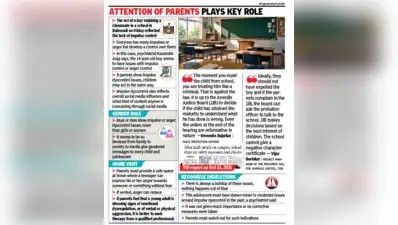
If the parents want to take a leaving certificate, then they can, but if they complain, action may be taken against the school,” said Child Protection Officer Devendra Rajurkar, working under the District Child Protection Unit (DCPU), women and child development department. Assistant public prosecutor Radha Chiddarwar said the moment a minor was found in conflict with law, they were produced before JJB. Vijay Baviskar, project manager of the resource cell for juvenile justice, Tata Institute of Social Sciences, maintained that expelling the boy from the school was wrong, but said since it was a private institution, the school could have bylaws giving powers under certain conditions. The school, in a statement, said, “Cellphones are not permitted in school for students up to Std X.
“The moment you expel the child from school, you are treating him like a criminal. That is against the law. It is up to the Juvenile Justice Board (JJB) to decide if the child has attained the maturity to understand what he has done is wrong. Even the orders at the end of the hearing are reformative in nature. The school in Balewadi expelled the boy after he allegedly stabbed his classmate with a knife. Maximum punishment is three years, but even then the child is sent to a special home. Most of the time, they are acquitted, or admonished, or sent for community service. “Ideally, they should not have expelled the boy and if the parents complain in the JJB, the board can ask the probation officer to talk to the school. JJB makes decisions based on the best interest of children. The dispute stemmed from the boy posting videos on social media of some girl students dancing during a school picnic. Following arguments with other students, he was forced to delete the videos. Holding a grudge over the incident, the boy attacked the girl.
The school authorities told TOI on Saturday evening that they had a zero-tolerance policy towards violence, under which the boy was expelled.