
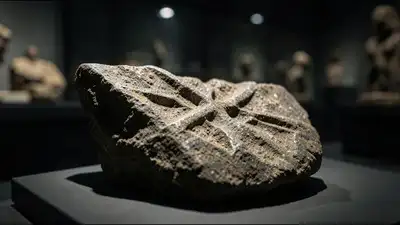
Representative Image of a Bronze Age stone casting mould on display, revealing intricate details of a spearhead shape (AI-generated image)
The mould was discovered in 2007 in Morkůvky, a village in the Břeclav District of South Moravia. It measures about 23 centimetres in length and is made from rhyolite tuff, a volcanic rock. The form therefore offered an important clue to the mould’s origins.
According to the research published in Archeologické rozhled titled A unique stone mould for casting a spearhead from Morkůvky in South Moravia as an example of long-distance import in the Urnfield Period, and its technological contribution , the object is a well-preserved half of a stone casting mould. Spearheads of this type are commonly found in the Carpathian Basin and are generally associated with the Late Bronze Age, according to the study. The stone was found in a garden, where it was sticking slightly out of the ground near the foundations of an old barn. The impression in the stone shows that it was used to cast a socketed, lance-shaped spearhead. The blade had longitudinal ribs along its wings and central midrib, while the socket featured a sharp ridge. The socket was designed to receive the end of a shaft, allowing the finished bronze head to be attached to a spear. Researchers then used petrographic analysis, which examines the mineral and structural characteristics of rocks, to investigate where the stone came from.
The research was published in 2025, about 18 years after the stone was discovered. The mould now helps researchers understand how spearheads were made and how materials and technological traditions moved across Central Europe about 3,350 years ago. Unlike a finished spearhead, which shows the shape and design of a weapon, a casting mould offers evidence of the manufacturing process itself. It can reveal how a metal object was formed and how the craftspeople who made it worked with stone, metal and heat. The mould’s clear impression and traces of intensive heating make it useful for studying prehistoric metalworking technology. Its identification transformed an unremarkable piece of a barn’s foundations into evidence of Bronze Age craftsmanship and long-distance exchange.