
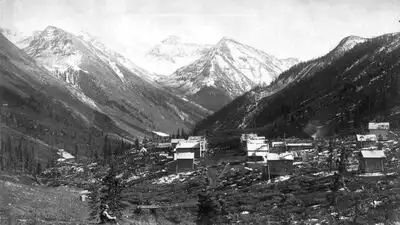
Animas Forks, Late 1870s. Image Credit: Colorado Encyclopedia
Over time, these pressures emptied the settlement, leaving only 9 historic buildings as reminders of a community that once supported hundreds of people. Animas Forks, a former mining settlement high in Colorado’s San Juan Mountains, grew rapidly after prospectors discovered valuable mineral deposits in the surrounding area. Established in the 1870s, the remote town attracted miners, businesses and families hoping to benefit from the silver and gold boom. But its growth came with considerable challenges, including extreme winter weather, declining mining profits and destructive fires.
Animas Forks was established in 1875 and developed into a centre for hard-rock silver and gold prospecting, according to History Colorado. However, the settlement’s beginnings date back to 1873, when prospectors built the first cabin in the area, as documented by Western Mining History. Originally known as Three Forks of the Animas, the community adopted the shorter name Animas Forks in 1875 to accommodate the US Post Office Department, according to HistoryNet. A wagon road built by transportation entrepreneur Otto Mears in 1875 improved connections between Animas Forks and other mining communities, helping people and supplies reach the remote settlement. By 1876, the camp had developed into an active mining community with around 30 cabins, a hotel, a general store, a saloon and a post office, according to Western Mining History. Animas Forks stood at an elevation of approximately 11,200 feet, making it one of the highest mining settlements in the American West. Western Mining History records that a severe blizzard in 1884 lasted 23 days and left around 25 feet of snow across the settlement. By 1883, its population had reached approximately 450, according to Western Mining History. Its newspaper, the Animas Forks Pioneer, began publication in 1882 and continued until October 1886. The settlement’s population began declining in the 1910s after reaching about 400 people during its more prosperous years, according to the National Trust for Historic Preservation. The arrival of the Silverton Northern Railroad in 1896 brought renewed interest by connecting Animas Forks with Silverton, but the railway did not expand as originally anticipated. Mountain Studies Institute’s historical account records that a devastating fire in 1891 destroyed 14 of the town’s approximately 30 buildings, leaving the settlement virtually abandoned. Construction of the Gold Prince Mill began in 1905, bringing workers and renewed economic activity to the area. The mill closed in 1910, and most of its machinery was removed in 1917 for use at a new facility in nearby Eureka, according to Western Mining History. A second major fire in 1913 further damaged the town, accelerating its decline. 9 buildings remain at the historic townsite, according to History Colorado. Among the best-known structures is the Duncan House, built in 1879. Constructed with thick wooden walls, the jail had 2 cells and served the community when the town was active. Its surviving buildings form part of the Alpine Loop, a 65-mile route connecting mountain communities and historic sites in southwestern Colorado. History Colorado records that 4 of the 9 remaining buildings required stabilisation when the site received preservation funding.
Preservation work has therefore become essential to the site’s survival. The settlement took its name from its location near the forks of the Animas River. The surrounding mountains contained mineral deposits that attracted people seeking work and investment opportunities. These facilities served the miners working in the surrounding districts and helped transform a small prospecting camp into a more established settlement. Its location offered access to mineral-rich areas, but the same mountainous surroundings made everyday life difficult. Residents had to dig tunnels through the snow to travel between buildings. The extreme conditions disrupted normal activities and demonstrated how exposed the town was to mountain weather. The cold also shaped the community’s seasonal routine. Many residents moved to the lower, warmer town of Silverton each autumn, returning when conditions improved. Despite these difficulties, Animas Forks continued to attract residents. The town supported shops, drinking establishments and other businesses that served both permanent residents and the seasonal mining workforce. The town’s early success depended heavily on mining, leaving it vulnerable when the industry struggled. Mining activity had already weakened by the late 1880s. Fires also inflicted serious damage. The destruction damaged its commercial centre and dealt a major blow to local businesses. A later revival briefly offered hope. The large industrial facility was intended to process ore from nearby mines, helping support another period of mining-related employment. However, the improvement did not last. By the 1920s, Animas Forks had become a ghost town. The departure of mining workers and businesses left buildings exposed to years of harsh weather, neglect and damage. Together, they provide a glimpse of the settlement’s former life and the architecture used in remote mining communities during the late 19th and early 20th centuries. The historic jail is an important surviving building. Other surviving structures include former homes and a miner’s boarding house. The remains of the Gold Prince Mill also mark the location of the industrial operation that briefly revived the settlement’s fortunes in the early 20th century. Animas Forks has gained renewed importance as a historic destination Although mining no longer supports a resident community. The National Trust for Historic Preservation has documented how the settlement’s popularity created new challenges. Increased visitor numbers, harsh weather and vandalism placed pressure on structures that had already endured more than a century of exposure. Such work helps protect the structures from further deterioration and keeps the settlement’s history accessible to visitors. You use AI every day. Now get your AI Quotient. Take the AIQ test.