
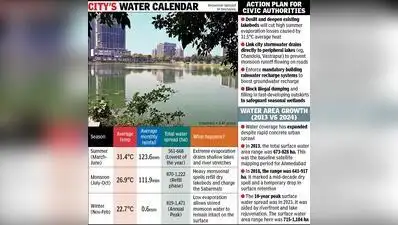
Ahmedabad’s surface water area
But a 12-year satellite study shows the opposite: Ahmedabad’s surface water has grown, although modestly, and the upward trend is statistically significant. The study analysed 144 monthly Landsat-8 image composites from 2013 to 2024. In summer (March to June), temperatures average 31.4°C, driving intense evapotranspiration, and water spread falls to its annual minimum of 561 to 668 hectares. Monsoon refills dry basins, raising coverage to 870 to 1,222 hectares. Winter holds the year’s largest reserve, 819 to 1,471 hectares, as cooler weather averaging 22.7°C limits evaporation and preserves monsoon runoff. The mean annual surface water coverage, the study pointed out, rose from 673-828 hectares in 2013 to 715-1,104 hectares in 2023. Sabarmati river channel, Vasna Barrage and Kankaria lake held water in all 12 years, resilient against brief dry spells. Combining multi-model satellite analysis with local climate records cut prediction error by 85% compared with traditional climate-only models.
The research paper, titled “Understanding Spatiotemporal Dynamics of Urban Water Bodies via Multi-Classifier Machine Learning Approaches in Semi-Arid Ahmedabad City”, states, “Temperature is a significant driver of water change, and precipitation has low impact in the long-term water area change. Using Mann-Kendall trend tests on the 144 monthly observations, the authors found that “a slight upward trend is evident with both yearly and monthly trend with Mann-Kendall test across all the classifiers”. The researchers conclude that data-driven monitoring offers vital insights for “data-driven governance of water resources, providing insights into sustainable urban development and environmental conservation strategies aligned with Sustainable Development Goals (SDGs) 6 and 11, which focus on clean water and urban sustainability”.
Ahmedabad: Extreme summer heat and urban sprawl would normally suggest shrinking lakes and river channels. Some experts feel this can be capitalised with better management of the monsoon bounty to boost the city’s groundwater table, although measures are already in place. The satellite maps also show a clear divide. Smaller lakes and catchments on the expanding southern and western outskirts lasted just one to three years, swelling in the monsoon and shrinking in the heat. The research was conducted by Shreekant Varshney of the department of mathematics and Ankit Deshmukh of the department of civil engineering at Pandit Deendayal Energy University, Gandhinagar. It was published as a preprint on EarthArXiv. You Can Also Check: Gold Rate in Ahmedabad | Silver Rate in Ahmedabad | Bank Holidays in Ahmedabad | Public Holidays in Ahmedabad | Ahmedabad AQI | Weather in Ahmedabad | Petrol Price in Ahmedabad | Diesel Price in Ahmedabad | CNG Price in Ahmedabad | LPG Price in Ahmedabad