
What the study says
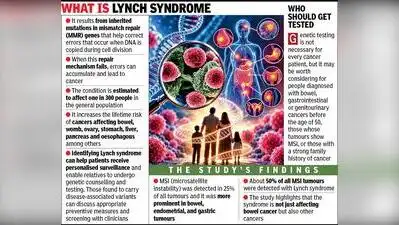
Ahmedabad: A seven-year study involving 519 cancer patients has found that nearly half of the tumours showing microsatellite instability (MSI) — a marker of defects in DNA repair — were associated with Lynch syndrome, an inherited condition that increases the risk of several cancers. Dr Sheth, head of advanced genomics technology division at FRIGE-Institute of Human Genetics in Ahmedabad, said that the multi-centre study tested tumours from patients with 11 cancer types and found MSI in 25% of all tumours examined. The study found that mutations in the MLH1 gene accounted for 70% of Lynch syndrome cases. Two variants, c.306G>T and c.156delA, together accounted for 33% of cases.
The findings provide India’s first molecular epidemiological evidence linking MSI and Lynch syndrome across multiple cancer types, potentially expanding opportunities for early diagnosis and cancer prevention, according to researchers. By extending screening beyond colorectal cancer, the study highlights an opportunity to identify hereditary cancer risk earlier and improve prevention for patients and their families, said researchers. The study, ‘Pan-cancer prevalence of microsatellite instability and Lynch syndrome in India’ by Harsh Sheth, Jyoti Sadhwani, Bhawna Sirohi, and Senthilkumar Ramasamy among others has been published in Springer Nature journal, Familial Cancer. Researchers also identified geographical patterns associated with these variants: c.306G>T was enriched in North India, while c.156delA was enriched in Siddhpur, Gujarat.