
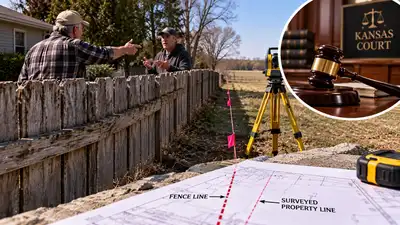
Image AI generated
The dispute concerned neighbouring properties in Sections 23 and 24, Township 30 South, Range 13 West, in Barber County, Kansas, according to the Kansas Court of Appeals. Dan Hittle owned land in Section 23 that had previously belonged to his great-grandfather and had been passed down or sold within the family. The fence along its eastern side did not follow the section line described by the legal property boundary.
How did a fence dispute escalate in 2021
A 65-year-old fence has become the centre of a property dispute between neighbouring landowners in Kansas, USA, after a court was asked to decide whether the old fence or the surveyed property line determined ownership of approximately 5.13 acres of land. Around 2014, Ron Loftus rebuilt part of the fence near the creek. The dispute became more direct after Don Queal and Donna Hoener-Queal purchased part of the Hittle family property in 2021. Don subsequently removed the fence and cleared trees along approximately 400 yards of the section line before Ron returned from holiday and insisted that the fence be restored to its previous position, claiming ownership through adverse possession. In 2023, Queal and Hittle brought a lawsuit seeking to establish ownership of their properties according to their deeds.
Because of difficult terrain and the labour-intensive construction methods available at the time, the ruling, filed on 28 August 2026, followed a dispute over a fence originally built away from the boundary. It therefore granted Queal’s request for quiet title, a legal determination of ownership, and rejected the Loftuses’ adverse possession claim. The Kansas Court of Appeals upheld a lower court’s ruling that the legal boundary described in the property deeds took precedence over the irregular fence, rejecting the neighbours’ claim that they had acquired the disputed land through long-term possession. Hittle saw the work and spoke with him, but the two did not discuss moving the entire fence or changing the boundary. After examining the fence, Don asked Hittle about a noticeable bend and learnt that the fence did not mark the legal boundary. Don then discussed moving it with Ron Loftus. The two did not reach an agreement. The work stopped. The Loftuses filed a counterclaim arguing that they had acquired the disputed land through adverse possession. They also maintained that the original owners had established the fence as the agreed boundary and had occupied their respective properties accordingly. After hearing evidence and visiting the property, the district court found insufficient evidence of an agreement permanently fixing the boundary at the fence line. The lower court accepted Hittle’s account that the fence had been positioned for convenience and to reduce construction costs. It also found that the fence’s right-angle bend and other irregularities should have alerted the Loftuses that it did not follow the section line. the court concluded that this belief was not objectively reasonable Although the Loftuses claimed that they believed they owned the disputed land. The Court of Appeals agreed that the findings were supported by substantial competent evidence. The Court of Appeals explained that property boundaries are ordinarily determined by the legal description in the deed. It acknowledged that neighbouring owners can establish a different boundary through mutual agreement, provided they agree on the line and subsequently occupy their properties in accordance with it. However, the court distinguished an agreed boundary from a fence erected merely as a practical barrier. It stated: “A fence may be maintained between adjoining lands for convenience only, and without the intention of thereby fixing a boundary. The court found that the evidence supported the conclusion that the original fence was built for convenience rather than to establish a different legal boundary.