
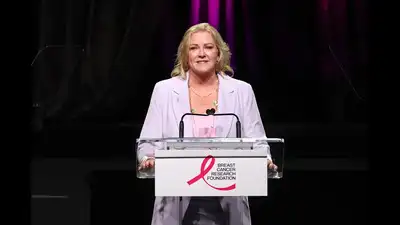
Telecom entrepreneur Rob Hale and his wife Karen Hale have pledged $50 million to the Breast Cancer Research Foundation (BCRF), marking what the organisation described as the largest single gift ever made to breast cancer research. The announcement was followed days later by another fundraising effort that saw more than 1,000 employees help raise an additional $583,000 for breast cancer research. It follows a $10 million gift from the couple in 2024. Karen Hale has served on BCRF’s board since 2019 and became co-chair in 2024, and the couple received the foundation’s inaugural Carolyn Lynch Humanitarian Award in 2016.
Another $11 million goes to BCRF Ventures, the foundation’s venture philanthropy fund, which backs early-stage companies working on breast cancer prevention, detection, diagnosis and treatment. Because they have seen first-hand how it drives change and brings scientists together, adding that they want to fund the best and that the best is BCRF, rob Hale said the couple chose BCRF.
BCRF says the fund targets a persistent gap in funding that causes promising science to stall before reaching clinical development. Karen Hale said the cause is personal. “Breast cancer has touched my family deeply,” she said in BCRF’s announcement. She described having more time with her mother as she lives with metastatic disease, and said that an AI-based risk assessment, which she credited to BCRF-funded research, now gives her the power to potentially stave off her own diagnosis. BCRF president and CEO Donna McKay said the gift lets researchers pursue breakthroughs across some of the most important frontiers in the field.
The funds will support research in five areas: breast cancer in younger women, metastatic disease, artificial intelligence, immunotherapy and prevention. The gift will also establish the Hale Family Collaborative of New England Investigators, which will bring together BCRF researchers at leading Boston-area institutions to strengthen collaboration across disciplines.
The company donated $250 for every employee who wore pink on October 22, and the Hale family matched each donation, for $500 per person. Staff also contributed through raffle tickets and T-shirt sales, and more than 1,000 employees took part across the company. Constance Lehman, a Harvard Medical School radiology professor, breast imaging specialist at Massachusetts General Hospital and BCRF-funded investigator since 2019. Granite Gives Pink began in 2025, when more than 800 employees raised $500,000, bringing the campaign’s total for BCRF to more than $1.08 million. Granite also says it has contributed more than $400 million to charitable causes under Hale’s leadership, covering cancer research, healthcare, education and community development.
Because we have seen first-hand the power the Foundation wields when it comes to driving change and bringing scientists together, “We’re entrusting BCRF with this gift.
Six days after the announcement, Granite said its second annual “Granite Gives Pink” fundraiser raised $583,000 for BCRF. Rob Hale said breast cancer affects so many people the company’s staff love, and that supporting the foundation is a privilege. Granite’s chief people officer, Sana Sheikh, said wearing pink is personal for many employees, as a way to honour or remember someone or to stand beside a person in treatment. Commenting on the donation, Rob Hale said the couple wanted to accelerate the most promising research efforts. We want to fund the best, and the best is BCRF,” he said. It builds on Granite’s “Saving by Shaving” campaign, which the company says has raised more than $62.7 million over 13 years.
The event centred on a town hall at Granite’s headquarters in Quincy, Massachusetts, with a check presentation to BCRF. The guest speakers included Dr. She is also the founder and CEO of Clairity, and she spoke about AI that uses mammograms to predict future breast cancer risk, which supports more personalised approaches to screening and prevention. The BCRF described the contribution as a transformational investment that has the potential to influence breast cancer research and treatment for generations. You use AI every day. Now get your AI Quotient. Take the AIQ test.