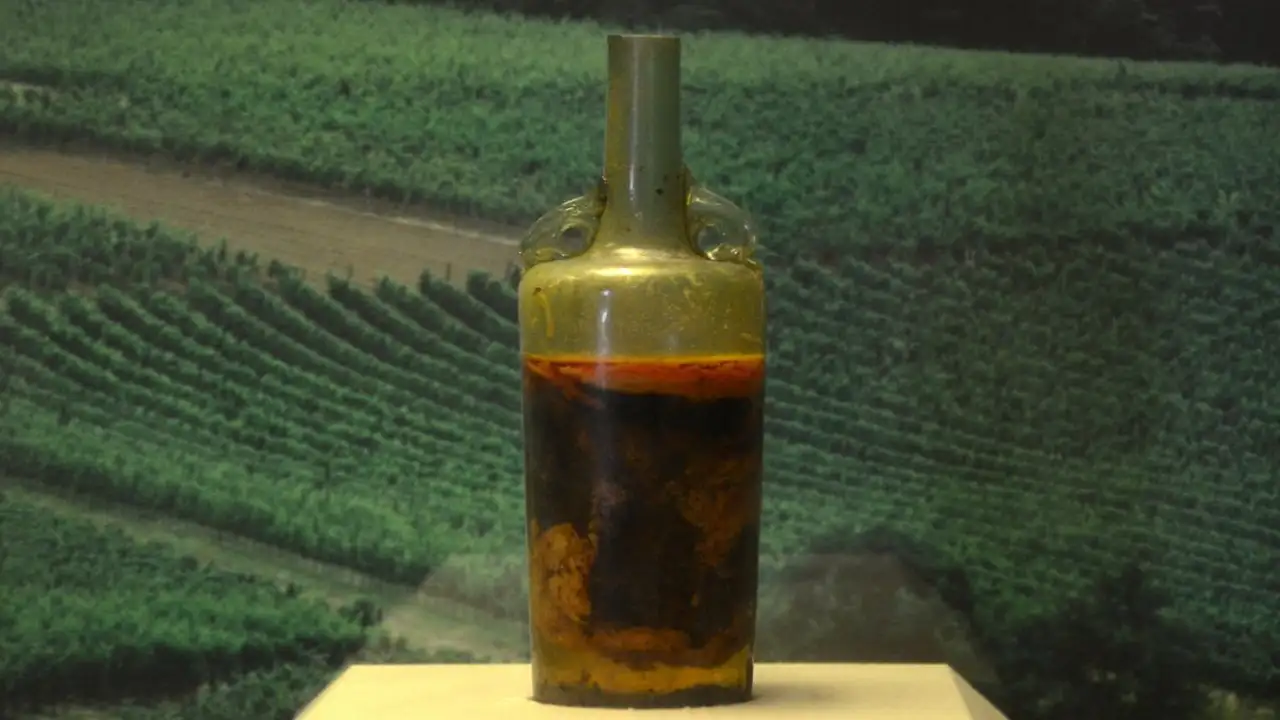
Known as the Speyer wine bottle, the vessel dates to around AD 325.
The liquid has remained in a largely undisturbed environment for more than 1,600 years, and scientists cannot be certain what would happen if the seal were broken. Could the 1,600-year-old wine still be drunk? In a report published by The Drinks Business in 2023, wine professor Monika Christmann said: “Micro-biologically it is probably not spoiled, but it would not bring joy to the palate.
“It’s not clear what would happen if air gets into the wine,” Tekampe said. Tekampe said the contents had remained stable during his time at the museum. It was a strange feeling,” he said. Wines of Germany says there is no alcohol left in it.
Opening the bottle could help researchers investigate its contents, but it would also carry risks. European digital news publisher The Local quoted Ludger Tekampe, who was responsible for the bottle’s preservation at the museum. Museum officials were also concerned that careless handling could break the glass and destroy the contents. The liquid might be examined to learn more about its age and origin, but the possibility of damaging the unique object has weighed against opening it. He also described the experience of handling it during renovation work. “I held the bottle in my hand twice during renovations. The bottle has survived not only its long burial but also its recovery, transfer to the museum and the passage of time. Keeping it sealed allows the vessel and its contents to remain together as a historical object. The mixture has undergone extensive chemical changes, and its present appearance is very different from that of a drinkable vintage. Some experts have suggested that the liquid might not be microbiologically spoiled, but that is not the same as establishing that it is safe or pleasant to drink. For researchers, its value lies in what it reveals about ancient practices rather than in the possibility of serving a glass of Roman wine. Opening it might answer some questions, but it could also irreversibly alter the very evidence that makes it important. A surviving record of Roman winemaking
The fact that the bottle still contains liquid does not mean that its contents would taste like wine today.
A bottle of wine made during the Roman Empire has remained sealed for more than 1,600 years. Discovered in a Roman tomb in Germany in 1867, the bottle still contains liquid, making it one of the most remarkable surviving objects from the history of winemaking. Known as the Speyer wine bottle, the vessel dates to around AD 325. In 2024, researchers identified wine in a Roman funerary urn in Carmona, Spain, dating to the first century AD. The bottle was discovered in 1867 during the excavation of a Roman burial site in Speyer, a city in southwestern Germany. More than 1,600 years after it was sealed, the questions surrounding its contents remain, while preserving the object takes priority over satisfying curiosity about its taste.
Because they do not know how the ancient liquid would react to exposure to air, and opening the bottle could damage an archaeological object that has survived for centuries, museum officials have long been reluctant to break its seal. Because it preserves wine inside its original sealed vessel, the Speyer bottle remains remarkable. Because they are not simply liquid wine as it would appear in a modern bottle, the bottle’s contents are unusual.
Archaeologists found two sarcophagi belonging to a man and a woman who had been buried in the fourth century, according to the official website of Wines of Germany. A clear liquid remains at the bottom, while a thick, resin-like mixture fills roughly two-thirds of the vessel, according to Wines of Germany. It is now preserved at the Historical Museum of the Palatinate in Speyer, Germany. it has never been opened Although researchers have studied its contents. The Speyer bottle is widely described as the oldest surviving sealed bottle of wine. However, it is not the oldest surviving wine in liquid form. The graves contained several glass vessels that were probably intended to hold provisions for the dead in the afterlife. Six glass vessels were found in the woman’s tomb and ten in the man’s. Only one bottle retained liquid. The vessel has a yellow-green colour and two handles shaped like dolphins. It is cylindrical, with a distinctive form that sets it apart from many modern wine bottles. The bottle is preserved at the Historical Museum of the Palatinate in Speyer. The museum identifies it as a significant surviving example of Roman wine culture. Museum officials were also concerned that careless handling could break the glass and destroy the contents. The explanation lies in how the Romans sealed it. A mixture of wine and herbs was placed in the bottle, followed by a larger quantity of olive oil. The oil formed a barrier that limited the wine’s exposure to oxygen. The bottle was also sealed with wax. Over time, the olive oil and other material became thick and resinous, helping preserve the contents. Analyses have indicated that at least part of the remaining liquid was once wine, although the alcohol is no longer present. The preservation does not mean that the wine has continued to mature in the way a vintage stored in a modern cellar might. Its chemical composition has changed over many centuries. What remains is valuable primarily as an archaeological record of Roman winemaking and preservation practices. Wine was an established part of life in the Roman world, and the Speyer bottle offers a rare physical link to that history. The burial vessels suggest that liquids and other provisions were placed with the dead, while the bottle’s construction and contents provide evidence of how people attempted to preserve them. For now, the bottle remains closed. You use AI every day. Now get your AI Quotient. Take the AIQ test Get the latest Lifestyle News and more. Download the TOI app.