
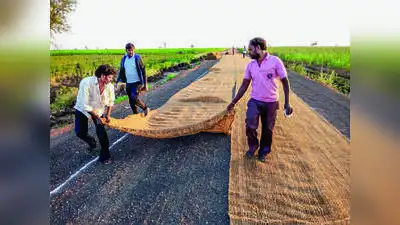
mounting losses: Coir worth thousands of crores of rupees are lying piled at export units
They say 60% of workers have been laid off or moved to agricultural work, and are seeking govt support to build domestic demand for an industry that employs about 10 lakh people across 7,500 units. About 70% of the state’s production is exported. He adds that a 40ft high cube container from India to Boston, which cost $3,100 in March, now costs $12,800 as vessels take longer routes avoiding the Strait of Hormuz. His monthly turnover, once more than `10 lakh, has become negligible since June. “I had 70 workers. I’ve had to let 40 of them go. G Sivam Muruganandham, president of the Coimbatore District Coir and Allied Products Manufacturing Association, says goods worth `5,000 crore are lying unsold in the state.
Because of the West Asia conflict, making overseas orders unviable, industry representatives say shipping costs have risen. Because of its high stiffness and naturally high potassium levels, “Indian coir fibre is preferred for value-added products.
Until five months ago, when the mother of two was told she was being let go. My husband too is a daily-wage worker,” says Revathy. For the past seven months, I have had no orders,” says Muthukumaran, a lorry owner. “We are a major global coir exporter because of the quality of fibre and coco peat,” says P Poochamy of the Federation of Tamil Nadu State Coir Associations. “If goods worth `20 lakh have a freight charge of `12 lakh, exports are no longer viable,” he says. This is like a Covid situation for the industry,” he says.
For six years, P Revathy earned a living processing coconut husks at a coir fibre unit in Thottipalayam in Karur district. “I’ve been borrowing to meet household expenses. She is now trying to find employment at the coconut farms that used to supply husk to the unit where she worked. Across Tamil Nadu’s coir belt, workers like Revathy, many of them women, are seeking agricultural work as an export slowdown leaves factories with unsold stocks. The slowdown has also affected transport operators dependent on the industry. “I have two lorries and a truck that transport coconut husks from farms to coir units in Pollachi. My business depends entirely on the coir industry. Tamil Nadu accounts for a third of India’s coir production, with Coimbatore and Pollachi serving as major manufacturing centres. For V Selvakumar, who manufactures coir grow bags and coco peat blocks, the rise in freight costs has hit exports to Russia, Australia and the US. I have employed them on my coconut farm at reduced salaries. We give them rice instead.
Before Feb, a unit would pay `2 lakh towards electricity charges. The industry has appealed to Centre and state govt to extend interest-free loan schemes, restore the 4.5% incentive under the remission of duties and taxes on exported products (RoDTEP) scheme, and promote the use of coir mattresses in govt hospitals and hostels. India’s annual coir exports are valued at 7,000 crore, while the domestic market is estimated at 8,000 crore. More than 15 products, including coir fibre, coco peat, mattresses, mats and geotextiles, are manufactured in the country.
Because production has reduced,” he says, now, the amount has fallen to `50,000. You Can Also Check: Gold Rate in Chennai | Silver Rate in Chennai | Bank Holidays in Chennai | Public Holidays in Chennai | Chennai AQI | Weather in Chennai | Petrol Price in Chennai | Diesel Price in Chennai | CNG Price in Chennai | LPG Price in Chennai Stay updated with the latest Chennai news.
“The impact of El Niño and changes in greenhouse cultivation practices in Europe have also reduced the possibility of an early recovery in exports,” says Poochamy. “The shutdown of coir units has badly affected rural employment, particularly for women. He adds that coir fibre and coir chips exported to China have also been affected by quality-related certification issues. Some manufacturers, however, were receiving orders from Maharashtra, where the govt is promoting polyhouse cultivation. Manufacturers have also sought training and awareness programmes through Tamil Nadu’s agriculture department to promote coco peat-based polyhouse cultivation. Such measures, they say, can help boost domestic demand and clear stocks held up at production centres. Download the TOI App.