
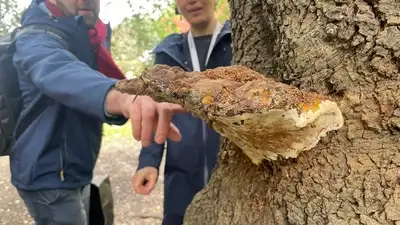
In 1781, medicinal mushrooms Ganoderma lucidum and Ganoderma lingzhi got mixed up as one and the same due to their similar look; after 245 years, scientists unmasked the false lingzhi
For more than two centuries, two mushrooms, so alike at first glance, have been bundled together, their identities tangled in a scientific misunderstanding that began way back in 1781. Only now, after 245 years, have researchers finally separated fact from fiction. In fact, the two split onto different evolutionary paths at least 16 million years ago. Viktor Papp, digging through Kew Gardens’ vast Fungarium collection in 2025, uncovered a mislabelled mushroom from a hazel tree (Corylus avellana) near London. Out of over a thousand (1,130, precisely) G. lucidum barcode sequences circulating publicly, only 149 could be certain matches.
It perfectly matched Curtis’s description, and unlike that lost 18th-century fungus, this one had DNA that could be tested.
The research, published in Plants, People, Planet on October 27, 2026, thanks to the Royal Botanic Gardens, Kew, and their global partners, puts forward a new common name: “False Lingzhi” for G. lucidum. But because they look so much alike, and because “G. lucidum” was often slapped onto lots of similar Ganoderma mushrooms, scientists and supplement makers kept muddling them up for generations. The original mushroom, i.e., the “type specimen,” vanished, leaving later scientists guessing whether the mushrooms they found matched Curtis’s drawing at all. With fresh genetic data, the team compared this “rediscovered” G. lucidum to other Ganoderma DNA, revealing that G. lucidum and G. lingzhi are miles apart on the fungal family tree. Scientists often rely on DNA “barcodes,” which are short genetic snippets that help identify species.
Per the Royal Botanic Gardens, Kew, using a combination of DNA analysis and old museum specimens, scientists have cleared up which is which: Ganoderma lucidum, a European species, and Ganoderma lingzhi, an East Asian mushroom celebrated in traditional medicine. This isn’t just a tidy fix for some dusty botanical textbook. The confusion has real-world consequences for the booming industry around medicinal mushrooms, not to mention the studies that try to back up centuries-old health claims. This way, people can finally distinguish it from the genuine lingzhi (or reishi) mushroom long tied to Eastern remedies. Dig a little deeper, and you’ll find these mushrooms aren’t just distant cousins. The real trouble started when William Curtis, a British botanist, detailed G. lucidum all those years ago. The only thing left of his work? An illustration. To complicate things, the Ganoderma group features several mushrooms with nearly identical shapes and colors. Over time, naming got messy, and people lumped different species together under the G. lucidum label. That might seem like a small problem, until you realize the impact. Medical research, especially studies hunting for mushrooms with useful compounds, sometimes jumbled up their subjects. Results for one species got mistakenly applied to another, leaving us with a blurry picture of what each mushroom really offers. Everything changed when Dr. This was the key to cracking open the centuries-old puzzle. And there’s more. The research turned up something worrying in the world of genetic databases. For Ganoderma mushrooms, this method worked poorly. Even more alarming, none of the seven full genome sequences labelled as G. lucidum actually belonged to that species at all. For years, researchers weren’t even studying the right mushroom. Moreover, this confusion doesn’t just stay in labs; it seeps into the products we buy. Lingzhi, or reishi, is packed into pills, teas, and powders, claiming all sorts of benefits, from fighting inflammation to boosting immunity. Many studies point to compounds found in Ganoderma fungi, especially things like beta-glucans and triterpenoids. There’s some evidence these might be powerful, at least in animals, but the studies are often mislabelled or based on mixed species. So, when you buy a reishi supplement, it might not actually be made from the mushroom you expect. The new research doesn’t accuse the whole industry of fraud, but it shows how tough it is to guarantee what’s really in any given product.
Why the discovery matters for medicinal mushrooms and what’s next
The story’s still unfolding: Kew’s team even found that within G. lucidum, there might be distinct groups, including one from East Asia now recognized as Ganoderma sinolucidum as of September 2026.
By naming the European species “False Lingzhi,” researchers hope to clear the fog for scientists, industry regulators, and everyday shoppers alike. Dr. Torda Varga, who led the work, summed up the stakes: treating G. lucidum and G. lingzhi as the same would be like mixing humans and orangutans, the two creatures that split off from a common ancestor millions of years ago. They might look similar, but inside, they’re very, very different. Now comes the push for clarity. However, it’s important to make it clear that no one’s saying G. lucidum is useless or lacks any medicinal qualities; just that we can’t assign it the same effects as its East Asian counterpart. Researchers need to take a careful look at each species’ unique compounds and potential health benefits, starting from scratch now that names and identities are straightened out. This whole saga highlights why it’s so important to preserve historic collections. That mislabelled mushroom at Kew sat quietly for generations, waiting for someone to give it a closer look. Revisiting these specimens, not just in mushrooms but across plant and animal kingdoms, can set the record straight and change the way we think about everything from research to what ends up on our shelves. In separating False Lingzhi from true lingzhi, scientists are not just solving an old mystery; they’re building the foundation for better science, safer products, and a deeper understanding of what nature really has to offer. You use AI every day. Now get your AI Quotient. Take the AIQ test Get the latest Lifestyle News and more. Download the TOI app.