
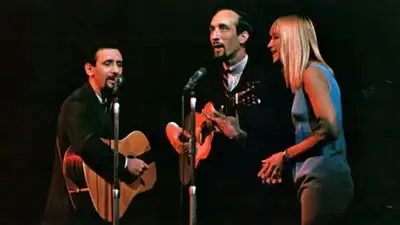
Peter, Paul and Mary in 1965. Image Credit: The Maine Magazine
In 1971, Noel Paul Stookey, the singer and guitarist known as Paul in the folk trio Peter, Paul and Mary, released a song written for his musical partner Peter Yarrow’s wedding. Over the following decades, the initiative generated more than $2 million for charity. The story began in 1970, when Peter Yarrow asked Stookey to write a song for his wedding to Marybeth McCarthy. The song was eventually recorded and included on Stookey’s first solo album and released in 1971. Stookey’s official website records that the foundation had raised more than $2 million for social and charitable causes. Their repertoire included songs associated with peace, civil rights and social justice, and the group had performed at the 1963 March on Washington, where Martin Luther King Jr. delivered his I Have a Dream speech. After the trio took a break from its demanding touring schedule, Stookey and his wife, Betty, moved with their 3 daughters to Blue Hill, Maine. The two began exploring ways to build on the wedding song’s charitable legacy around 2000, according to Music to Life’s official history. Music to Life became an official nonprofit organisation in 2018. A pilot began in 2020, followed by additional programme formats developed in late 2022 and 2023.
As reported by Music to Life, he sought spiritual guidance before writing the song, asking how the divine might be present at Yarrow’s wedding. The Maine Magazine reported that Stookey directed the proceeds from Wedding Song towards charitable work by establishing the Public Domain Foundation.
The request came during a period of personal and spiritual change for the musician, who had begun reconsidering his priorities after years of performing with Peter, Paul and Mary, according to the account published on Stookey’s official website. What began as a personal gift soon reached far beyond the couple, becoming a popular choice for marriage ceremonies and a source of funding for charitable causes. Rather than keep the royalties, Stookey directed the earnings from the song, titled Wedding Song (There Is Love), to a foundation established to support social causes. Stookey approached the task as more than a songwriting exercise. The resulting lyrics reflected his belief that love and faith could bring people together. The song became known as Wedding Song (There Is Love). Its words explore the union between two people, the meaning of marriage and the presence of love in a shared commitment. The lyrics include the recurring idea that love is present when people gather in faith. The composition became an immediate hit. It subsequently found an audience beyond the folk music scene, featuring in films, television programmes and wedding celebrations. The decision to donate the song’s earnings was rooted in Stookey’s understanding of how the composition had come to him. In an account published by Guideposts, he explained the personal significance of the experience and why he felt compelled to relinquish the financial rewards. Stookey believed the song was a gift rather than something he could claim as entirely his own. This raised a practical question about the royalties generated by its publication and performance. Rather than treating the composition as a conventional source of personal income, he created a mechanism through which its earnings could benefit organisations working on social and political issues. The foundation was intended to distribute publishing income to charities in the United States and internationally. Its work eventually extended beyond simply passing on money, supporting music that addressed social concerns and helping artists connect their creative work with organisations pursuing change. The decision to donate the royalties reflected a broader change in Stookey’s life around the beginning of the 1970s. His official biography explains that a spiritual experience in the late 1960s prompted him to reconsider the demands of his performing career and devote more attention to his family and personal beliefs. At the time, Peter, Paul and Mary were among the best-known acts in American folk music. Stookey’s work continued to reflect the socially conscious tradition of folk music. his work increasingly combined music with questions of conscience, faith and social responsibility Although he continued to record and perform. The next stage of the project grew from Stookey’s partnership with his daughter, Liz Sunde. Their aim was to help musicians use their talents to address social problems and support communities. Rather than limiting the initiative to donations generated by one successful song, they sought to create opportunities for artists whose work could encourage awareness, participation and practical action. Its development marked a shift towards providing structured support for socially conscious musicians, including training, mentoring and opportunities to work alongside community organisations. It developed the Musician Changemaker Accelerator, a programme designed to help artists build the leadership and practical skills needed to turn their ideas into community projects. These initiatives address issues including racial, environmental and economic injustice. Music to Life also supports performances, original music projects and professional networks that allow musicians to collaborate with organisations working towards social change. Stookey’s official website identifies Music to Life as an extension of the charitable work associated with Wedding Song. The Public Domain Foundation’s achievements also helped establish the basis for a broader approach to music-led activism. You use AI every day. Now get your AI Quotient. Take the AIQ test.