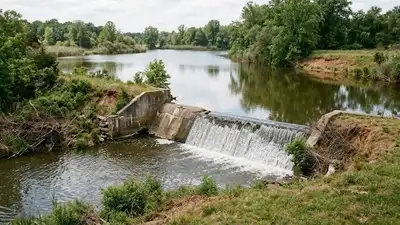
AI-generated representative image showing an ageing mill dam with a broad pond behind its concrete spillway, illustrating the type of barrier removed to reopen fish habitat in Maryland. Credits – Gemini
One such structure stood near Millington on Maryland’s Eastern Shore, where Cypress Branch Dam was removed in 2025 after decades of deterioration and planning. Its exact construction date is unknown, but consultants estimated that it dated to about 1900 based on the aggregate in the concrete. The Maryland Department of Natural Resources reports that removal was completed in April 2025, reopening more than 35 miles of habitat for herring, hickory shad and other fish. Consultants from Hurt and Proffitt estimated the current dam dated to about 1900, based on the aggregate in the concrete. The mill pond property was purchased by the state of Maryland in 1994.
Because the dam had been ruptured for so long, American Rivers said, work started in 2019 when the Maryland Geological Survey tested the silt behind the dam and discovered it wasn’t toxic and the amounts were low.
The state’s history of the site says there have been dams and mill ponds in the area since the 18th century. Taking it down American Rivers, which worked with the state on the restoration, said the history is a remnant of the Eastern Shore’s milling era with no recognised builder. Dams built to power mills can continue to obstruct migratory fish long after their original purpose has ended. The structure, called Cypress Branch Dam in state records and also known as Cypress Mill Dam, was built to hold water for the mill races in Millington. The project required years of planning, several rounds of funding and work to resolve a railway crossing issue. A dam from the mill era The dam consisted of an earthen berm and a concrete spillway. It had breached decades before its removal and was in an advanced state of disrepair, but the remaining structure still obstructed fish passage. A large mill pond to the north fed a smaller pond to the south, which supplied the mill races in Millington. No one knows exactly when it was built. The estate passed through a lengthy line of owners, including Philadelphia merchant Thomas Gilpin in the 1760s and subsequently the Higman family, whose grist mill gave the property one of its names. It is currently part of Cypress Branch State Park.
the remaining structure continued to impede fish passage Although the dam had breached years earlier.
Fish and Wildlife Service was an early booster, seeing an opportunity to reunite more than 35 miles of habitat. Construction began in early 2025. An early Maryland Department of Natural Resources planning document estimated that the project would reconnect 18 miles of habitat, comprising more than eight miles of Cypress Branch and 10 miles of tributaries. After completion, the department reported that the project reopened more than 35 miles of habitat. The Chesapeake Bay Program originally set a goal of opening 1,000 additional stream miles to fish passage by 2025. Partners achieved that target in 2016, nine years ahead of schedule. Under a later goal, partners opened 303 stream miles during 2022 and 2023.
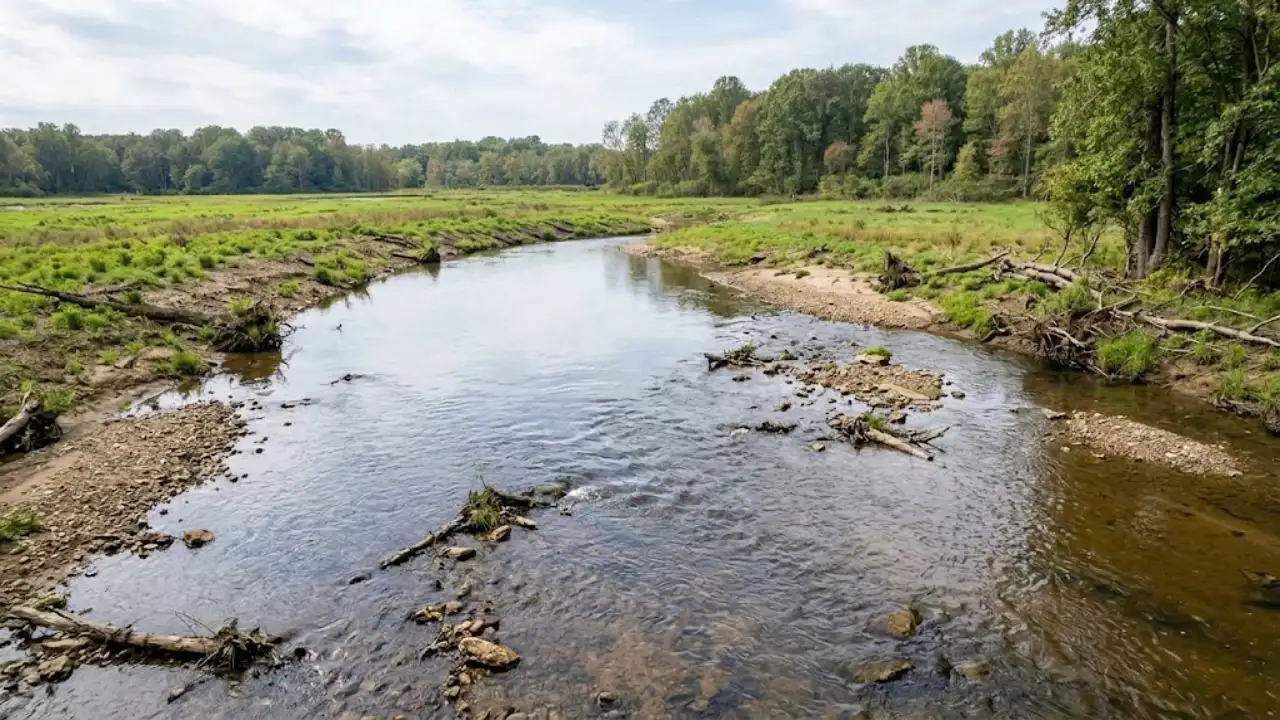
Because the site needed historical mitigation and a strategy for what to do if the restoration didn’t work out the way they hoped, permits took time, too, in part. The U.S. Then the pandemic slowed the design work. Construction expenses went up. And the project required more money. That came in the form of a grant from the Environmental Protection Agency, through the National Fish and Wildlife Foundation. Crews demolished the concrete of the old spillway, relocated parts of the earthen dam and straightened out a canal that had broken up into multiple pieces to go around the spillway. They also built big structures of root wad along the banks to hold the soil in place. A late issue was a railway crossing near the access road, which was rectified on the way out thanks to a state financial increase. AI-generated representative image showing a restored freshwater channel with flowing water and stabilised natural banks, illustrating the habitat reconnection achieved through dam removal. Credits – Gemini What the river gets back The target species include alewife and blueback herring, collectively known as river herring, and hickory shad. These fish spend their adult lives in the Atlantic and return to freshwater each spring to spawn. The two figures come from different stages of the project, and the published documents do not explain exactly how the latter total was calculated. The project forms part of a wider effort to restore migratory fish routes throughout the Chesapeake Bay watershed. The Cypress Branch project team also established a monitoring plan to assess whether herring and shad return in healthy numbers. After the restoration work, American Rivers documented an osprey catching a fish in the former pond area. The Cypress Branch project shows that a breached, disused dam can continue to impede fish migration long after its original purpose has disappeared. Its removal restored access to upstream habitat, and monitoring will help determine how herring and shad use the connected streams. You use AI every day. Now get your AI Quotient. Take the AIQ test.
These are separate milestones, so the later figures do not conflict with the earlier achievement.