
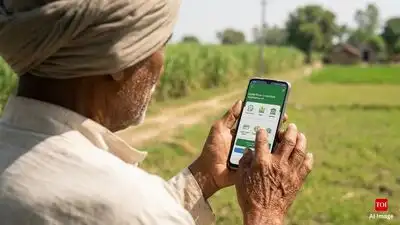
An Indian farmer accesses the Digital Kisan Credit Card portal via smartphone, illustrating Uttar Pradesh’s pioneering milestone in modernizing rural agricultural finance. (AI image)
Karnataka ranks second with approximately 95,000 applications, followed by Haryana with around 42,000. Launched in Uttar Pradesh in February 2026 by Chief Minister Yogi Adityanath, the facility is operated through a digital framework supported by the National Bank for Agriculture and Rural Development (NABARD). Introduced nationally in 1998, the scheme was designed to ensure that farmers could obtain timely and adequate credit for agricultural operations without having to depend excessively on informal sources of borrowing. Karnataka has recorded around 95,000 applications, while Haryana has received approximately 42,000. The state’s February 2026 launch of the facility, supported by NABARD’s digital framework, reflects an effort to bring agricultural finance closer to farmers through technology.
A delay in obtaining credit can therefore affect sowing schedules, crop management and, ultimately, farm productivity. For people living in remote villages, these requirements could mean lost working hours, transport expenses and additional administrative burdens. The state’s performance also places it ahead of the other states mentioned in the reported figures. The reported achievement of more than one lakh applications in eight months provides an important measure of the initial reach of the initiative.
More than one lakh farmers have applied through the e-KCC portal or mobile application within just eight months of the facility’s launch, making Uttar Pradesh the first state to cross this mark in the period. The achievement reflects the growing acceptance of digital services among farmers and the state’s efforts to make institutional agricultural credit more accessible. By enabling farmers to initiate the application process online, Digital KCC seeks to reduce dependence on repeated visits to bank branches and simplify the procedures involved in seeking financial assistance for cultivation and allied agricultural activities. It represents an important step in integrating technology with the rural credit system, particularly for farmers who require timely funds for seeds, fertilisers, pesticides, irrigation, labour and other agricultural expenses. The Kisan Credit Card scheme has long served as an important instrument for providing farmers with access to institutional credit. Agriculture involves expenditure at different stages of the crop cycle. Farmers must purchase quality seeds, prepare their fields, arrange irrigation, apply fertilisers and plant-protection products, pay labour costs and manage harvesting expenses. The Kisan Credit Card framework seeks to address this challenge by providing eligible farmers with a revolving credit facility, subject to the terms and limits sanctioned by the lending institution. Instead of treating every agricultural requirement as an entirely separate borrowing exercise, the facility allows farmers to access sanctioned credit as and when eligible expenses arise. Over time, the coverage of KCC has expanded beyond conventional crop cultivation to include eligible investment and working-capital requirements associated with animal husbandry, dairy, fisheries and other allied agricultural activities. The precise credit limit and permissible uses depend on the borrower’s eligibility, the activity financed and the applicable banking guidelines. The scheme is particularly important for small and marginal farmers, who frequently operate with limited financial reserves and have relatively little capacity to absorb unexpected increases in input costs. Access to formal credit can help them manage seasonal expenses, plan agricultural operations and reduce their dependence on expensive informal borrowing. Digital KCC builds upon this established framework by focusing on how farmers can access the application process more conveniently. Traditionally, applying for an agricultural credit facility could involve several visits to a bank branch. Farmers might need to enquire about eligibility, obtain application forms, submit documents, clarify discrepancies and follow up on the progress of their applications. These difficulties can be particularly significant during the sowing season, when farmers need to devote their time to preparing land and arranging agricultural inputs. The Digital KCC facility seeks to simplify this experience by allowing farmers to initiate applications through an online portal or mobile application. Digital access can reduce the need for repeated physical visits merely to begin the process or submit information through conventional channels. For farmers who are comfortable using smartphones and digital services, the facility offers a more convenient way to enter the formal agricultural credit system. It also creates opportunities to streamline the movement of application information between digital platforms and participating financial institutions. The initiative does not mean that every application is automatically approved or that all banking procedures have been eliminated. Banks continue to assess applications under the applicable eligibility conditions, documentation requirements, credit norms and sanctioning procedures. However, a digital application channel can make the initial stages of the process easier and potentially reduce avoidable delays. The broader objective is to make agricultural finance more accessible without compromising the checks required for responsible lending. The most striking feature of Uttar Pradesh’s performance is the speed at which farmers have adopted the digital facility. Crossing one lakh applications within eight months of its launch demonstrates considerable interest in a technology-enabled approach to agricultural credit. The comparison highlights the scale of participation in Uttar Pradesh, a state with a vast agricultural population, extensive rural settlements and diverse cropping patterns. Agriculture remains a major source of livelihood across its eastern, western, central and Bundelkhand regions, although the crops cultivated and the financial requirements of farmers differ considerably from one region to another. The large number of applications suggests that a digital channel can be particularly relevant in a state where reaching a wide farming population through conventional service delivery mechanisms presents a substantial administrative challenge. As a matter of fact, the double-engine governance approach places emphasis on coordination between different levels of government and the implementation of programmes intended to benefit rural households. In the case of digital agricultural credit, the effectiveness of this coordination depends on how smoothly digital services, banking institutions and local support mechanisms work together. It also offers an opportunity to strengthen awareness campaigns, improve application assistance and identify the reasons why eligible farmers may find the process difficult. Uttar Pradesh’s emergence as the national leader in Digital KCC applications is a noteworthy development in the modernisation of agricultural finance. The milestone indicates that digital channels can attract substantial participation when they address a practical need in rural areas.
These requirements often arise before the crop generates any income.
With Karnataka at approximately 95,000 applications and Haryana at around 42,000, the state has established a strong early lead. Because farmers must make time-sensitive decisions based on weather, crop conditions, market prices and the availability of inputs, in agriculture, this approach is increasingly relevant. A well-functioning digital credit system should therefore combine convenience with transparency, accountability and adequate human assistance.
The achievement of crossing one lakh Digital KCC applications within eight months places Uttar Pradesh at the forefront of the initiative among the states cited in the reported figures. You Can Also Check: Gold Rate in Lucknow | Silver Rate in Lucknow | Bank Holidays in Lucknow | Public Holidays in Lucknow | Lucknow AQI | Weather in Lucknow | Petrol Price in Lucknow | Diesel Price in Lucknow | CNG Price in Lucknow | LPG Price in Lucknow Stay updated with the latest Lucknow news. LUCKNOW: Setting a new milestone in agriculture finance, Uttar Pradesh, emerged as the leading state in the country in applications under the Digital Kisan Credit Card (e-KCC) initiative. Nevertheless, applications are an indicator of participation rather than a direct measure of credit disbursed. The ultimate impact of the initiative will depend on how many eligible applications progress to approval, how quickly sanctioned credit becomes available and whether the facility enables farmers to meet their requirements at the appropriate stage of the agricultural cycle. Tracking these outcomes will be essential to assessing the scheme’s longer-term contribution to rural financial inclusion. Small and marginal farmers stand to benefit significantly from improvements in the accessibility of agricultural credit. Their operational holdings are relatively limited, and their ability to finance cultivation from personal savings can be constrained by household expenditure, uncertain farm incomes and fluctuating input prices. For such farmers, even a modest delay in obtaining funds may affect the purchase of seeds or fertilisers at the right time. Borrowing from informal sources can also place pressure on farm earnings when interest costs are high or repayment terms are inflexible. By simplifying the application process, Digital KCC can help reduce some of the practical barriers that discourage farmers from approaching formal financial institutions. Farmers can begin the process digitally, potentially saving time and travel costs while remaining engaged in their agricultural activities. The convenience is particularly relevant to those living far from bank branches. It can also help farmers who find repeated paperwork and in-person follow-ups difficult to manage. However, digital access must be accompanied by effective assistance for farmers who are unfamiliar with smartphones, online forms or digital documentation. Local banking correspondents, agricultural extension personnel, cooperative institutions and village-level service centres can play an important role in helping eligible applicants navigate the system. Ensuring that digitally excluded farmers are not left behind will be essential to making the facility genuinely inclusive. One of the principal objectives of the Kisan Credit Card framework is to strengthen farmers’ access to formal institutional finance. The Digital KCC initiative can support this objective by making it easier to initiate applications and interact with the formal credit system. Institutional borrowing provides a structured alternative to informal credit arrangements. Depending on eligibility and the applicable scheme provisions, KCC borrowers may also benefit from interest-related concessions available under relevant government policies. Such benefits are subject to prevailing rules, loan limits, repayment conditions and the terms of the lending institution. Timely access to credit can help farmers purchase inputs when required instead of postponing expenditure until funds become available. It can also provide greater flexibility in managing routine farm operations and certain eligible allied activities. At the same time, the success of agricultural credit depends on more than the availability of an application platform. Awareness of eligibility, transparent lending procedures, adequate banking outreach and prompt decisions on applications are equally important. Digital KCC can provide a more accessible entry point, while banks and other participating institutions remain responsible for assessing applications and ensuring that eligible farmers receive appropriate financial support. The expansion of Digital KCC reflects a broader shift towards technology-enabled public service delivery. Digital platforms can help government programmes and financial institutions reach large populations more efficiently, particularly when physical access to services is difficult. Financial services that are easier to access can complement these decisions by helping farmers plan and finance their activities. The benefits of digitalisation, however, depend on reliable connectivity, simple interfaces, local-language assistance, secure handling of personal information and accessible grievance-redressal mechanisms. Farmers should be able to understand the status of their applications and obtain help when technical difficulties or documentation issues arise. Banks and service providers must also maintain safeguards against fraud and ensure that applicants understand the terms and conditions associated with borrowing. The expansion of Digital KCC in Uttar Pradesh has taken place under the broader policy framework of cooperation between the Union and state governments. The priority now is to convert this initial momentum into measurable improvements in credit access. This requires monitoring the number of applications processed, approval rates, the time taken to sanction eligible loans, the amount of credit made available and the participation of small and marginal farmers. Greater awareness of KCC benefits and eligibility conditions will also be important. Farmers need clear information about permissible uses of credit, interest obligations, repayment schedules and the consequences of overdue payments. Digital convenience must be accompanied by responsible borrowing and effective financial literacy. The system should also remain accessible to farmers who cannot independently complete online applications. Assisted digital services and effective grievance redressal can help ensure that technology expands access rather than creating a new barrier. In the longer term, easier access to agricultural credit can complement improvements in irrigation, crop diversification, storage, processing, market connectivity and agricultural technology. Credit alone cannot resolve every challenge faced by cultivators, but timely and affordable institutional finance is an important component of a stronger agricultural economy. More importantly, the initiative represents an effort to make an essential financial service more convenient for the farming community. By allowing farmers to initiate applications online, Digital KCC seeks to reduce procedural difficulties, save time and improve access to formal agricultural credit. Download the TOI App.
The real test of this achievement will lie in its impact on farmers’ lives: whether eligible applicants receive timely credit, whether small and marginal cultivators find the process easier, and whether digital services become accessible to farmers across rural Uttar Pradesh. If these objectives are achieved, Digital KCC could become an important instrument in strengthening financial inclusion, improving the management of seasonal farm expenditure and supporting the wider transformation of agriculture in the state. Uttar Pradesh’s early performance has established a significant benchmark; sustained implementation and farmer-focused support will determine how far this digital initiative translates into lasting benefits for the state’s agricultural economy.