
US Midterms 2026: The Indian looking to conquer Texas cowboy country
Meanwhile, for millions of Indians who don’t live in the US, the state is perhaps most familiar for being the home state of Sheldon Cooper, the breakout star of the “white supremacist” (one wishes one was making that up) sitcom The Big Bang Theory . For older Indians who have consumed American culture through Hollywood Westerns, there are numerous cowboys-versus-“Indians” fights that, in classic Hollywood fashion, gloss over the genocide while romanticising life on the frontier. There are are two Texases in the Indian imagination. For many Indians working in America, it’s the perfect state to move to thanks to saner school rules – where one’s children are less likely to be taught critical race theory or gender studies – and fewer homeless people than in bigger cities. We go deeper into the Lone Star State in the TBBT prequel Young Sheldon , where we discover that Texans take Christianity, alcohol and American football quite seriously – in no particular order – and that a child prodigy interested in theoretical physics is something of an aberration. Indian-Americans have come a long way from their Samosa Caucus days, and there are numerous desis in the fray in the midterms, representing both sides of America’s political divide.
Today, the real Indians are back, but they are more likely to work in medicine, engineering or technology, and their presence appears to have made many Americans – particularly the redneck, Bud-drinking MAGA variety – deeply unhappy.
When a video of Indian-American Boy Scouts leading the Pledge of Allegiance went viral, Thakur hit back: “If you go after Boy Scouts, 10-year-old kids doing literally the most American thing ever, how can you also say the issue is assimilation? On November 3, the voters of District 47 will decide whether Sethi gets the opportunity to become a Texan lawmaker. Sethi’s challenges therefore extend beyond the racism directed at her campaign. Whether Sethi wins or loses, the result is unlikely to settle that debate because, for many folks, skin pigmentation is a bigger nationality test.
Thakur had served in the American military, embraced American citizenship and conservative politics, and won an American election.
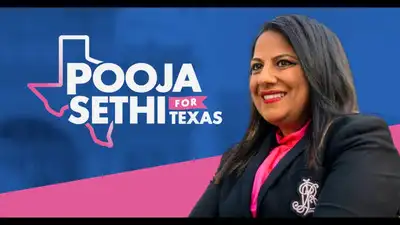
“The only way I can change it was by going into that building,” she recalled. Ronald Reagan famously said: “You can go to live in France, but you can’t become a Frenchman. But perhaps the most curious aspect of the backlash was that the City Council included Burt Thakur, an Indian-born American citizen, a US Navy veteran, Trump supporter and Republican. Yet he found himself listening to speakers questioning whether Indians belonged in his city. Burt Thakur, an Indian-born American citizen, a US Navy veteran, Trump supporter and Republican. The immigration debate has taken a shriller turn in the state, with Texas Governor Greg Abbott directing state agencies and public universities to suspend H-1B petitions, arguing that taxpayer-funded employment ought to prioritise Texans. And amid this particularly vicious anti-Hindu, anti-immigrant sentiment, Pooja Sethi is hoping to become a Texan lawmaker. Sethi has spent four years working inside the Texas Legislature While she’s being pitched as an outsider. Born in America to Indian immigrant parents, Sethi studied at George Washington University and Syracuse University College of Law before becoming an immigration attorney with Catholic Charities. Her entry into politics came from her experiences helping migrant children separated from their families during Trump’s first administration. In a September interview with Austin PBS, she recalled travelling to San Antonio to help reunite separated children. When Governor Greg Abbott’s administration decided to shut down the convention-centre facility involved in the operation, she approached Democratic state representative Vikki Goodwin, hoping to reverse the decision. Goodwin offered her a job as chief of staff. Sethi initially declined, convinced that her legal work was more useful, but eventually changed her mind. She subsequently spent more than four years in Goodwin’s office, dealing with legislation, constituent concerns and the workings of the Texas government. She also served as chair of the Travis County Democratic Party. But perhaps the most revealing incident explaining why Sethi wants to become a legislator involves a school notebook with a bullet hole. She must win an election, demonstrate that she can represent a constituency with diverse political priorities, and potentially work within a legislature where her party has limited control over the agenda. If elected, she would also become the first Indian-American and first Hindu to serve in the Texas Legislature, a milestone in a state where Indian-Americans have become increasingly prominent in business, technology, medicine and local politics. You can go to live in Germany, but you can’t become a German. You can go to live in Japan or Turkey, and you cannot become Japanese or Turkish. But anyone, from any corner of the world, can come to live in the United States and become an American. It’s a sentiment that’s not particularly popular these days. Norman Tebbit’s original formulation questioned whether immigrants could genuinely belong to a country when their sporting loyalties remained with their ancestral homeland. In Texas, Indian-American students were attacked despite cheering for their own American university, wearing its colours and celebrating its victory. Pooja Sethi presents a variation on the same question. She was born in America, trained as an American lawyer, worked inside an American legislature and is now asking American voters to elect her to that institution. Yet her Indian heritage has become a source of hostility for people who question whether she belongs. The reverse Tebbit test has already exposed the peculiar nature of her Texas challenge: apparently, even when Indians cheer for the home team, some people still want them sent home. Even Sheldon Cooper, who often had trouble deciphering human emotions like sarcasm, would have found that ironical. You use AI every day. Now get your AI Quotient. Take the AIQ test.

Numerous other Indians are in the fray, but none have a task quite like Pooja Sethi, a Democrat running for House District 47, who is hoping to become the first Indian-American and first Hindu to be elected to the state legislature. Of course, among those pictured were naturalised American citizens, not to mention that Texas law reserves 90% of freshman places for Texas residents, with 10% for out-of-state and international students, the latter accounting for only 4.3%. The Texas House has 150 members and began its current legislative session with an 88–62 Republican majority.
Because nothing quite says cultural dysmorphia and lack of assimilation like a bunch of college-goers wearing their college jerseys, drinking beer from a horn and celebrating a famous win.
To her credit, Sethi – unlike Vivek Ramaswamy – responded by pointing out that her heritage wasn’t an “insult” but her story. In October 2025, Bo French, the Republican candidate for Texas Railroad Commissioner – a position that has nothing to do with the trains Sheldon Cooper loved the most – called for Native American protesters photographed at Mount Rushmore to be “denaturalised and deported”, calling them “third world savages”. Megan Basham, another conservative commentator, claimed the problem wasn’t the ethnicity and that the demographic changes reflected an “expansion of H-1B” and weren’t organic, an argument that doesn’t pass the basic smell test. As is par for the course in American discourse, the photograph made its way downstream to Nick Fuentes, the leader of the despicable far-right group called the Groypers, who called the Longhorns photograph “the most evocative image in recent memory of white replacement”. Fuentes has, in the past, been at loggerheads with numerous figures in MAGA, including VP JD Vance, who told him to “eat s****”. Frisco, a Dallas suburb where one in five residents is Indian, saw its City Council meetings become a forum for anti-India hate, with speakers complaining about H-1B visas, demographic change and “the Indian takeover”.
Vivek Ramaswamy – who’s suddenly discovering that being BFFs with Trump isn’t the electoral benefit that was promised – is facing off against Amy Acton for governor in Ohio. Meanwhile, we see some internecine desi battles, with Ro Khanna facing off against Ritesh Tandon, while Pramila Jayapal must defend her seat against Republican Nirav Sheth. She faces an uphill task. Her decision to run was greeted by MAGA commentator Savanah Hernandez with a pointed caption: “Welcome to politics in Texas. She later admitted in an interview with the Houston Chronicle that it did make her anxious about her child back home. Of course, Texas has always had a rather complicated history with Indians: both Asians and Native Americans. During the 19th century, the Republic of Texas pursued numerous military campaigns against Indigenous communities, particularly the Cherokee and Comanche, while President Mirabeau B Lamar advocated their expulsion. These campaigns ended in bloodshed, as did the later Red River War, which forced many Indigenous tribes of the Southern Plains onto reservations. Hollywood, the greatest tool of American propaganda ever to exist, played its part in condensing this brutal history into a simpler formula of Cowboys versus Indians while ignoring the actual atrocities. And if that wasn’t enough, Texas managed to throw up a political candidate who could be equally racist towards both Indians and Native Americans. Many years ago, British Conservative politician Norman Tebbit came up with the Tebbit Test to check an immigrant’s loyalty: when England played India, would British citizens of Indian origin support England or India? Bo French somehow came up with its most bizarre reversal when he looked at a picture of brown students celebrating a famous Texas Longhorns victory over Ohio State and posted: “I heard UT graduation this year looked like this. I didn’t believe it. The problem is now obviously far worse than anyone imagined. Sethi, responding to French’s remarks, hit back: “If you look at a crowd of diverse Texas students celebrating together and see a ‘problem,’ the problem isn’t the students. She followed that with a more distinctly Texan observation: “This is what Texas looks like. And if you don’t like it, you can leave. But Sethi’s challenge goes beyond Fuentes or members of the online dystopia whose hatred has a way of spilling onto the streets. A demonstrator even tore apart an Indian flag outside City Hall while members of the crowd chanted: “F*** India! Sethi’s campaign is firmly based on the unglamorous tasks of improving suburban American life While her critics have made it about her race. Sethi, meanwhile, has made her opposition to private-school vouchers and support for reproductive rights explicit. She also wants greater state investment in public education and healthcare. Of course, winning the seat would create another challenge for Sethi. Even if Sethi is elected, she would have to negotiate with Republican colleagues to advance her various proposals. Her experience as Goodwin’s chief of staff may help her navigate the legislative process, but knowing how the institution works and persuading it to change direction are two different matters.
Sethi’s campaign website recalls her standing beside the father of a child killed in the 2022 Uvalde school shooting. The father had brought his dead child’s notebook, pierced by a bullet, to the Texas Legislature while seeking a hearing on legislation that would increase the minimum age for purchasing certain semiautomatic rifles from 18 to 21. Sethi is running to replace her former boss, Goodwin – who is leaving to contest the lieutenant-governorship – and the latter secured 60.2% of the vote in a district that can be considered a Democratic stronghold. Sethi herself won the March Democratic primary with 76.1% of the vote against Joseph Kopser, receiving more than 21,000 votes.
Sethi claims the Republican chairman of the committee offered his condolences and walked away without agreeing to the hearing. This, for Sethi, was proof enough of what was wrong with the state’s policies. Her campaign has focused heavily on children and schooling, and she has stated: “We cannot keep telling kids that they matter while passing budgets and bills that say otherwise. Beyond gun safety and public education, she supports Medicaid expansion, abortion rights, higher teacher salaries and water conservation. She has also raised concerns about the proposed construction of an AI data centre, questioning its potential impact on local water supplies. Her Republican opponent, Jennifer Mushtaler, is an obstetrician-gynaecologist and former Austin Planning Commission member who has spent decades living and working in the region. Mushtaler has made public-school finance, property taxes, healthcare and infrastructure central to her campaign. Interestingly, both candidates agree that Texas’s complicated school-finance recapture system requires reform, although their proposed approaches and wider political priorities differ.