
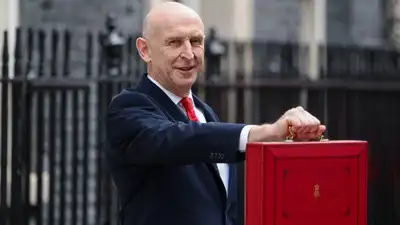
Britain’s Chancellor of the Exchequer, John Healey, holds up the traditional red ministerial box outside No 11 Downing Street before departing to the House of Commons to deliver the first budget under Prime Minister Andy Burnham’s government
British finance minister John Healey on Wednesday announced a £100 one-off energy payment for 20 million lower- and middle-income households, retained the £20,000 annual tax-free cash ISA limit and raised taxes on savings and property income in his maiden budget. The government also announced a two-percentage-point increase in the tax rates on savings and property income from April 2027. Tax on savings income will rise to 24%, 44% or 49% for basic-, higher- and additional-rate taxpayers, respectively.
The measures aim to ease the impact of the Iran war on household finances while encouraging investment and managing the country’s rising debt.
Healey said the OBR forecasts showed that the government would spend an additional £14 billion on debt interest this year. The earlier proposal, introduced by former finance minister Rachel Reeves, aimed to encourage more people to invest in stocks and shares and support Britain’s stock market.
Healey said the government had to respond to the economic fallout of the conflict, which has pushed up energy prices and weakened growth prospects. “My choice in the budget today is to give families and businesses some breathing space now,” he told parliament. The chancellor said he would explain how the government plans to meet the target when it publishes its three-year spending plans next year.
The government will explore ways to encourage first-time investors to buy stocks and shares through a proposed new ‘Starter’ ISA. However, some experts have criticised the plan for potentially adding complexity to investment products.
The commitment is particularly significant for Healey, who resigned as defence secretary earlier this year over concerns about funding.