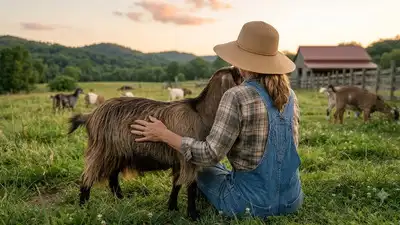
AI Representation: After 15 years as a CPA, Linda Harrison left corporate office work to raise fainting goats in Tennessee. Image credits: Chatgpt
Linda Harrison, a certified public accountant (CPA), spent 15 years in accounting, as she explained in a 2007 interview with Brett Farmiloe’s Pursue the Passion project. In the interview, published on November 13, 2007, Harrison said she had been ranching for two and a half years, which places the start of her ranching experience around 2005. The 2007 interview with Pursue the Passion captures her reasons for pursuing ranching and the lessons she learned along the way. Having spent 15 years in accounting, she discovered that she could marry her love for the outdoor life, caring for animals and her entrepreneurial spirit through goat-raising.
Because they stiffen and may collapse when startled, but they do not actually faint, myotonic goats are called fainting goats.
Their cooperation was complementary, according to her. Ranching became her passion Looking back on those first years of ranching, Harrison told Pursue the Passion in 2007, “Ranching is my passion and goats are my dream,” adding that she had never been happier. The tale told by Harrison is not just that of a woman moving out of an office into the open air.
A career can provide financial stability without necessarily offering the kind of everyday life a person wants. Even so, she kept searching for ways to spend more time outdoors. Eventually, Harrison and her husband, Brian, decided to raise fainting goats on their land in Hermitage, Tennessee. The change was gradual, though, as the farm grew alongside their careers and became a bigger part of their future. Why accounting no longer suited her Harrison’s career began in public accounting as a CPA and later moved to contract jobs for various firms. it could not eliminate the dissatisfaction associated with spending long hours indoors Although contracting allowed for some flexibility. Harrison enjoyed going jogging in parks during weekends or her off time. Being outdoors was very important to her and she was looking for ways of arranging her working life in a manner that would give her more opportunities to be outdoors. Another option she considered was learning botany, hoping that yet another qualification would give her a chance of working in her desired environment. At the same time, she was wondering if getting another degree would only bring her back to an office. Harrison did not plan to spend years saving up before quitting accounting. Instead, she looked into other alternatives, knowing that any new business idea needed its own financial justification. How the Tennessee farm began Harrison and her husband purchased property in Hermitage, Tennessee, while they were both employed. She started with a few sheep and miniature goats to cut down on the time and labor that was necessary for her to maintain her land. Over time, she realized that the livestock would become more than a method of clearing her property. Harrison and Brian began by breeding registered goats. The cause is a genetic condition called myotonia congenita, which the University of California, Davis, Veterinary Genetics Laboratory explains in its official guide to myotonic goats. Caring for livestock became part of Harrison’s daily routine as her small Tennessee farm grew into a goat-breeding business. Image credits: Wikimedia Commons As the herd grew, Harrison established a website to promote the animals and reach potential customers. This allowed the farm to attract buyers from beyond the immediate Tennessee market and helped turn a small livestock operation into a recognised breeding business. Caring for goats became part of her daily life The management of the farm included some tasks aside from feeding the animals and searching for customers. Harrison was responsible for monitoring the goats and caring for them when they became ill. Harrison’s commitment was tested when she spent about three weeks nursing a single sick goat at home. This process required both time and money, which made Harrison wonder how much she should spend on a goat that would not be profitable enough. However, she felt responsible for the goat and took care of it. This situation demonstrates the dilemma that every livestock farmer faces: they must keep the enterprise profitable while also taking responsibility for the animals’ lives. Brian searched for the necessary information concerning feeding the animals, while Harrison did most of the work with the heart. The excitement had seen her through the more boring aspects of farm life, such as the tasks in winter, taking care of the farm animals and making sure they had something to drink during the chilly season. All these were part of the work and not just interruptions to it. Rather, it is one of slowly constructing an alternative while knowing what she had been looking for in her career. You use AI every day. Now get your AI Quotient. Take the AIQ test.