
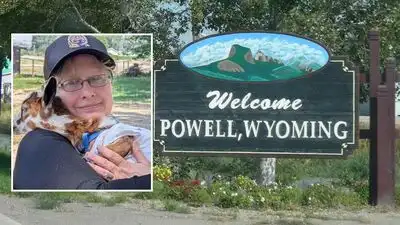
Venus Bontadelli claimed that the city’s decision violated her constitutional rights. Image Credit: Courtesy Venus Bontadelli/Cowboy State Daily
What happened to Porsche Lane during the legal battle
In January 2026, a settlement allowed the goat to return home, ending the immediate dispute without a court ruling on the constitutional claims. The case centred on Porsche Lane, a pygmy goat weighing about 20 pounds that had become part of the Bontadelli family. The Pacific Legal Foundation filed the lawsuit in the US District Court for the District of Wyoming in November 2025. In a press release published on 14 January 2026, the Pacific Legal Foundation announced that Powell had agreed to issue Bontadelli a permit allowing Porsche Lane to return to the family.
Because the permit process did not provide sufficiently clear standards for deciding applications, its complaint argued that Powell’s ordinance violated the constitutional right to due process. Because it involved a relatively small pet rather than livestock kept for commercial purposes, bontadelli’s case also attracted attention. The legal dispute had therefore achieved its immediate objective, although the settlement did not establish a general right for other Powell residents to keep miniature goats.
Cowboy State Daily reported that Bontadelli had sued Powell over the decision. Wyoming Public Media reported that Porsche Lane had been sent to California to stay with a friend after the city refused permission for the animal to remain in Powell.
The goat was given to the family as a graduation present for their teenage daughter, according to Wyoming Public Media. The city council rejected the family’s appeal, according to the report. A Wyoming woman’s attempt to keep her miniature goat at home became a legal dispute over local animal regulations, the fairness of government decisions and constitutional rights. Venus Bontadelli, a resident of Powell, challenged the city’s permit process after officials refused to let her keep the animal as a pet. The disagreement raised questions about how local authorities classify companion animals and whether residents receive a fair opportunity to seek exceptions to restrictions. She had been bottle-fed and raised as a companion animal. Bontadelli wanted to keep Porsche Lane at her home in Powell, but the city’s rules restricted livestock in residential areas. The family’s attempt to obtain permission through an exotic pet permit application became the starting point of the dispute. The Pacific Legal Foundation, which represented Bontadelli, argued that the city’s process was unfair. The organisation maintained that residents should have clear standards explaining when permission to keep an animal can be granted, rather than having applications depend on officials’ discretion. The disagreement was about more than whether a goat belonged in a residential neighbourhood. It also raised questions about how local governments make decisions affecting residents and whether their procedures provide adequate protection against arbitrary treatment. Pacific Legal Foundation argued that the city’s approach made it difficult for residents to understand what they needed to demonstrate to receive approval. Local authorities can regulate animals in residential areas to address concerns such as public health, neighbourhood conditions and the potential problems associated with livestock. However, disputes can arise when a resident believes a regulation has been applied unfairly or when the process for obtaining an exception lacks clear requirements. Bontadelli viewed Porsche Lane as a household pet rather than an animal kept for agricultural purposes. The city’s restrictions created a conflict between that understanding and the rules governing which animals residents could keep. Its coverage described her efforts to keep the goat and the legal challenge arising from the city’s restrictions. The dispute demonstrated how the classification of an animal can have practical consequences for its owner. Even a small goat raised for companionship may fall under rules intended to regulate livestock, leaving residents to seek permission from their local government. Due process is a constitutional protection intended to ensure fairness in government procedures. In this case, the legal challenge focused on whether the city had established clear criteria governing who could receive permission to keep an otherwise restricted animal. The foundation argued that residents should not have to rely on uncertain or inconsistent decisions when seeking approval. those rules can be challenged when residents believe the procedures used to enforce them are constitutionally unfair Although cities have authority to establish rules for residential areas. the family could not keep the goat at home While the dispute continued. The separation made the disagreement a personal matter for the family, which had raised the goat as a companion animal. Concerns were also raised about whether allowing the application could lead to more residents keeping goats within city limits. The settlement provided a practical resolution without requiring the court to decide whether the city’s rules were unconstitutional. You use AI every day. Now get your AI Quotient. Take the AIQ test.
The lawsuit did not, however, result in a final judicial decision on those arguments.
The case was resolved through a settlement before the court issued a ruling on the constitutional claims.