
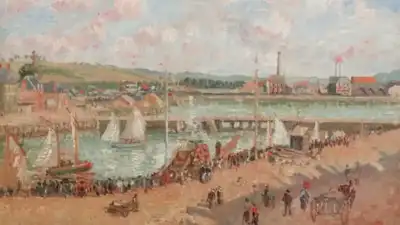
A painting by French Impressionist Camille Pissarro, sold by Sotheby’s for £1.2 million in 2024, has become the centre of a legal battle involving the heirs of a Jewish banker whose art collection was seized by the Nazis during World War II. The auction house disputes the claim that the artwork was looted and has also challenged the French court’s jurisdiction.
Seven descendants of Salomon Flavian have approached a Paris court seeking to overturn the agreement that allowed the painting to be sold, arguing that most of the family was not consulted before the settlement was reached.
Seven family members told the Paris court during a September 18 hearing that only two relatives, Gilles and Nicolas Flavian, had signed the agreement, according to The Art Newspaper. The letter said an 8% share of the net sale price had been accepted on their behalf in exchange for their cooperation. An accompanying account statement referred to a 16% commission associated with the two heirs who signed the agreement.
The court’s decision could therefore determine not only whether the settlement can be challenged, but also how the family’s claims will proceed. Four months after the auction, other family members reportedly received a letter from Mondex Corporation, a Toronto-based firm specialising in recovering assets lost during the Holocaust.
In a statement reported by The Jewish Chronicle, the auction house said: “Those discussions resulted in a settlement agreement between the consignor and Mondex, which was fully disclosed in our catalogue and pursuant to which the work was sold. ” The heirs’ lawyer, Corinne Hershkovitch, challenged that conclusion. The legal challenge is not limited to whether the painting was stolen. It also concerns how the settlement was negotiated and whether all the heirs were properly represented. Under the arrangement, the two signatories waived their rights to the painting in connection with the sale. The seven plaintiffs are seeking to have the settlement annulled, arguing that they were excluded from decisions affecting their family’s claim to the artwork. Sotheby’s maintains that the settlement was disclosed in its catalogue. She argued that the absence of the painting from the Nazi inventories did not necessarily prove that it had not been looted. She also questioned whether the historical records used in the research had been interpreted correctly and argued that additional family archives could help clarify the painting’s ownership. The ruling is not necessarily a final determination of the painting’s wartime history or ownership. The case highlights the difficulties that can arise decades after the Holocaust, when artworks have passed through multiple owners, historical records are incomplete and descendants seek to recover property taken from their families.
They argue that the other descendants were not consulted before the deal was finalised.
Which reported on the proceedings in September 2026, the dispute concerns ‘Darse de pêche et bassin Duquesne, Dieppe, après-midi ensoleillée’, a 1902 painting depicting the French port town of Dieppe, according to The Art Newspaper. Sotheby’s sold the work in London on June 25, 2024, for £1.2 million, below its estimated price range of £1.5 million to £2.5 million. The Paris court is expected to deliver its ruling on November 5, 2026.