
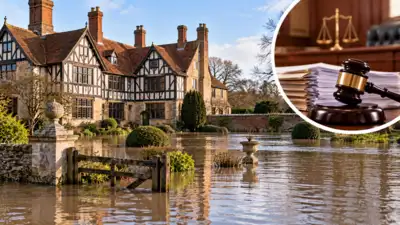
Image AI generated
A Tudor-era home in Sandwich, Kent, associated with Henry VIII, has been awarded £3.315 million in compensation after Environment Agency flood-defence works caused years of water damage. The tribunal issued its final decision on 12 June 2026. The tribunal’s 2023 decision found that the works had raised groundwater levels at the property by between 0.5 metres and one metre, probably nearer to one metre.
Because the property had a historic dock, whose wall met the new structure at a right angle, the wall did not extend continuously across the entire frontage. The Upper Tribunal ruled that the works raised groundwater levels by up to one metre, damaging the historic property’s structure and flooding its garden. Roger and Suzanne Brookhouse, the owners of The King’s Lodging, will receive compensation covering repairs to the house, restoration of the garden, measures to address the groundwater problem and replacement of the swimming pool. The Environment Agency constructed a flood-defence wall along the river frontage of The King’s Lodging as part of its flood-protection works in Sandwich. In the years following construction, the property’s garden experienced flooding, with water entering from below ground.
The tribunal also recorded that the agency had undertaken remedial work in 2015, 2016 and 2017, but the underlying cause of the water ingress had not been addressed. That finding remained in force when the tribunal assessed compensation in 2026. The parties agreed that the core cost of the necessary work to the house was £36,742, but disagreed over the associated expenses, including surveys, professional fees, contingencies and other preparatory work. After considering the evidence, the tribunal determined that compensation for the house repairs, including the associated costs it allowed, amounted to £90,000 before VAT. The garden and swimming pool were also addressed under the terms of a deed dated 6 November 2014. The parties agreed that £728,828 was payable for the garden restoration work, while the tribunal considered additional costs for irrigation, aftercare and inflation. It determined that the total compensation for the garden under the deed was £814,500. The swimming pool, which dated from the 1980s and had been re-lined in 2004, was found to be beyond repair. It concluded that the agency’s works had probably caused the damage that made replacement necessary and awarded £197,500 before VAT for the pool. The final decision followed an eight-day hearing in March 2026, during which the tribunal considered expert evidence covering drainage, water levels, structural engineering, heritage and architecture, horticulture, swimming pools, property valuation and construction costs. The proceedings followed the tribunal’s 2023 decision on liability, which established that the Environment Agency’s works had caused the groundwater problems. The later hearing focused on the cost of putting the property and its grounds back into the appropriate condition and determining the compensation due under the Water Resources Act 1991 and the parties’ deed. The tribunal awarded Roger and Suzanne Brookhouse £3,315,200, including VAT. It also determined that the property’s current market value, disregarding the effects of the agency’s works, would be £1.85 million. In explaining the circumstances of the case, the tribunal acknowledged that the property was the couple’s retirement home and that the consequences of the works had disrupted their lives for more than 12 years.
Because it considered that approach to be based on an incorrect understanding of the problem, the tribunal rejected the drainage-trench proposal.
The raised groundwater levels affected the foundations and structure of the historic house, with further deterioration expected if the problem remained unresolved, according to the Upper Tribunal’s final decision. The judgment stated that the agency had “done its best and has acted fairly throughout”, while maintaining that its task was to establish the compensation payable. Evidence from the agency’s consulting engineers supported the existence of a flow path beneath the wall of the property’s dock. During the compensation hearing, the parties disagreed over the appropriate engineering solution for restoring groundwater levels to their pre-construction condition. The owners’ drainage expert, Mohammad Yadollahi, proposed demolishing the existing dock wall and installing new sheet-steel piling deep enough to address water ingress beneath the riverbed. The proposal was designed to connect the new piling to the existing flood-defence wall and prevent water from entering through the flow path beneath the dock wall. The Environment Agency’s expert, Richard Brinkworth, instead recommended installing a drainage trench with a perforated pipe and a pumped outfall to control local groundwater levels. The judgment stated: “But the Tribunal has already found that this is not a drainage problem. It is an inflow problem, causing raised water levels which are damaging the house, and causing inundation of the garden at times of particularly high tides. The tribunal found that the deeper sheet-steel piling scheme was the appropriate solution. The selected scheme was intended to address the cause of the problem rather than merely manage its effects. The compensation award covers several categories of work at The King’s Lodging. For the house itself, the tribunal considered repairs to external stonework and brickwork, a bowed east wall, water-damaged timber posts, panelling, plaster, flooring, fireplaces and tiling. The decision sets out the sums required to address the damage to the historic home, restore its garden and replace the swimming pool, following the tribunal’s findings about the consequences of the flood-defence works. You use AI every day. Now get your AI Quotient. Take the AIQ test.
The tribunal concluded in its earlier ruling that the building had been damaged by the agency’s works and would sustain further damage in the future. It also considered the evidence that the existing dock wall had been damaged during earlier remedial works and that previous interventions had failed to eliminate the underlying water ingress. the tribunal found that there was no evidence of the downward movement and separation of its steel panels before the works Although the pool had already been in poor condition before the flood-defence works.