Lukas Rieppel, Associate Professor of History & Faculty Director of the Native American Studies and Indigenous Studies Initiative, Brown University
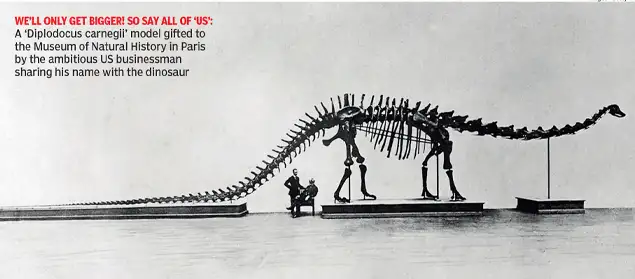
The United States, created 250 years ago, became an economic power particularly in the second half of the 19th century, after the bloody Civil War fought over the enslavement of African people. Further, the people who profited enormously from the rise of this industrial extractive economy developed a cultural fascination with fossils that were dug up as a result of mining. His parents became economically destitute due to a new technological innovation — steam power. Because it was felt the benefits of industrialisation were not running very deeply across society, however, it wasn’t called the ‘Golden Age’ — it’s the ‘Gilded Age’. Because society’s productive resources being concentrated among its most talented and farseeing individuals —such as himself — meant this wealth could be used well, as he was doing in the Natural History Museum, however, he wrote, that was a good thing.
This was not lost on anyone — a lot of newspaper coverage commented on how the dinosaur’s massive size seemed to represent something significant about the industrial and political ambitions of the United States.
Carnegie himself wrote copiously, including, most famously, an essay called ‘The Gospel of Wealth’ where he said capitalism did mean tremendous wealth becoming concentrated at the top of the economic hierarchy. Lukas Rieppel is Associate Professor of History & Faculty Director of the Native American Studies and Indigenous Studies Initiative at Brown University. Speaking with Srijana Mitra Das at Times Evoke, he discussed how the growth of scientific knowledge intersected with the rise of billionaires in America’s ‘ Gilded Age ’ — and why the super-rich began turning to philanthropy for institutions of learning: What is the core of your research? I’m a historian of science and I also work in an interdisciplinary field called Science Technology Studies (STS). The basic premise of both fields is to think about how the history and current practice of science are entangled with broader social, cultural, political and economic issues. People often think science is distinct or separate from the rest of society — many scholars like myself are interested in figuring out the opposite of that. Science is not separate from the rest of society — rather, there are connections between the content of scientific knowledge, how scientists work, the ideas they produce and how those are related to or entangled with broader social, cultural, political and economic history. You write on how vertebrate paleontology got linked with the rise of American capitalism — can you elaborate? A lot of my work is on the history of paleontology and how this connected to capitalism and imperialism in North America. Much of what fueled its post-Civil War economic rise was the expansion of an industrial economy, made possible by new developments in scientific fields like physics and chemistry but also, the extraction of mineral resources. As it turned out, the United States was especially rich in mineral resources that were very important for building an industrial economy. Many American capitalists who created tremendous wealth in the 19th century were involved in mineral extraction — and that became deeply tied with paleontology, the scientific study of pre-historic fossils. These were often discovered by people in mining, especially prospectors looking for gold, silver, coal, copper, etc. In their searches, they’d stumble across prehistoric fossils. Hence, the rise of the extractive economy in the 19th century boosted the scientific study of fossils. Fossils also played an important role in mining — they can tell you the age of various rocks and thus, they became important clues for where to find rich minerals. They began lavishly funding museums in urban centres like New York City, Chicago and Pittsburgh, where such fossils were put on display. Can you tell us about these American industrialists? The best example is Andrew Carnegie, a fascinating figure who exemplifies much of what made this late 19th century period in American capitalism so distinctive. Carnegie was born to a family of handloom weavers in Scotland. Once steam power was used in the textile industry, many handloom weavers, like Carnegie’s parents, were put out of work. A large political protest movement, Ludditism, grew in Britain, with people objecting to new technologies being brought into industry and ruining working-class people. Carnegie came out of that background. His parents moved to the United States for a brighter future — and there, Andrew succeeded beyond anyone’s wildest dreams, becoming the richest person in the US and among the wealthiest people alive at the turn of the 20th century. He made his fortune off the extractive economy, especially steel manufacturing. Using that wealth, Andrew Carnegie became a famous philanthropist and built several cultural institutions, including a natural history museum in Pittsburgh, where his parents had settled. Curators of the ‘Carnegie Museum of Natural History’ began looking for a star specimen, a show-stopping centrepiece — they found a dinosaur in Wyoming, discovered by William Harlow Reed who’d worked for the Union Pacific Railroad and was thus connected to the industrial economy. They brought this fossil to Pittsburgh and attached Carnegie’s name to it, calling it ‘Diplodocus carnegii’, Latinising the industrialist’s name in the scientific literature. This was placed in the grand hall of the Pittsburgh Natural History Museum — Carnegie was so pleased with this majestic dinosaur in his museum, he tasked his curators with manufacturing plastercast replicas of it on a quasi-industrial scale. Dinosaur fossil named after US businessman Carnegie then went across the world, depositing replicas of this dinosaur bearing his name in the most famous museums, including the British Museum in London and others in Paris, St. Petersburg, Berlin, Madrid, Argentina, etc. Carnegie used the dinosaur as a way of broadcasting what he understood to be the exceptional promise of the United States. How did billionaire philanthropy in science then intersect with economic tensions? This period of reconstruction after the American Civil War is often called the Gilded Age. It was an era of tremendous economic expansion. Some people were gaining enormously from industrial capitalism but many weren’t — in fact, working-class people did not see their prospects improve much. Wages were relatively stagnant and there was economic uncertainty, even moments when real wages declined. There was also mass migration taking place from Europe and China to the US then. Many migrants, especially from Europe, brought radical ideas about socialism and communism. The picture — stagnant wages, tremendous wealth inequality, horrific, dangerous and unhealthy conditions workers faced versus the amazing growth of wealth among the Gilded Age elite — was stark. The importing of radical political ideas, invoking people like Karl Marx, created an intellectual landscape of dissent. Thus, this also became a time of labour organising and fairly open class warfare. Against this backdrop, American capitalism was experiencing great ideological crisis — and Gilded Age industrialists like Andrew Carnegie turned to philanthropy. Associating with institutions of learning and culture like universities, museums, libraries and halls for classical music was a way forward for someone like Carnegie, who came from a fairly humble working-class background. Many of these capitalists did not come from established wealth — they were ‘new money’ and had to find ways of performing their social distinction, signaling their new status often by backing institutions of culture and learning. Another reason was that by funding cultural institutions, they could argue that American capitalism — which was so controversial — was producing public goods in addition to private profits. The suggestion was, American industry was not only benefiting the wealthy few but improving all of society. Carnegie was deeply interested in publishing in such arguments. So, Carnegie argued through philanthropy, the productive capacity of capitalism could be unleashed, concentrated and redistributed to benefit working-class people as well. I leave it to you to decide whether you find that argument convincing or not. Lands containing mineral wealth belonged mostly to Native Americans — why were they absent from science and profiteering? The United States entirely owes its existence to the dispossession of Native Indigenous people from North America. All the lands from which mineral resources that fueled the United States’ growth, from where gold, silver, coal, even petroleum, were extracted, belonged to the native inhabitants of North America. The rise of America’s industrial economy is entirely based on the dispossession of American Indian lands. However, the prehistoric fossils unearthed during the extraction of such mineral resources were used to write new narratives about ‘evolutionary progress’ — where ‘extinction’ played a key role. Now, as almost all dinosaurs had suffered a cataclysmic mass extinction event, they were seen as a model organism for studying extinction. Theories produced by late 19th century American scientists — using those dinosaurs — argued extinction played a necessary role in evolutionary advancement. They claimed nature had an innate tendency to progress — but extinction was a necessary part of that evolution and old lineages had to disappear for new ones to grow. That same narrative was then projected back onto the native inhabitants of the US to fuel its economic expansion. Fossils extracted from Native American lands were used to justify the dispossessing of those same people by erroneously describing them as ‘naturally doomed to extinction’. Fortunately, Native American people have not gone extinct in the US. They contribute tremendously to American culture and science. Native Americans also knew about the fossils on their lands — but their scientific knowledge and ideas were displaced by such notions about evolution and extinction. Views expressed are personal You use AI every day. Now get your AI Quotient. Take the AIQ test.