
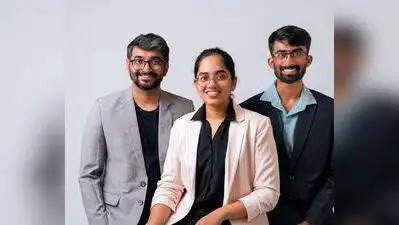
Amit Chowdhary, Janhavi Gore, and Dhruv Sangal founded Cosmochute, a startup incubated at IIMA Ventures
The team is mentored by Mylswamy Annadurai, former programme director of Isro’s Chandrayaan-1 mission. “We achieved the milestone of 18 mN (millinewton) of thrust using air as the only propellant in Oct. It was just after 18 months of founding.
Chowdhry, co-founder and COO of Cosmochute, said that their dream is to be part of the emerging economy in the next decade. Our idea is simple – we are building reusable, interoperable rovers for the Moon that will cut cost of surface mobility for the countries,” he said. “Here we intend to recreate the lunar surface with help of similar regolith (crystalline rock fragments) design and simulate very less gravity through steps such as reducing the rover’s weight in a specific proportion, using a rig design that can simulate very weak gravity of the lunar surface,” said Gore, co-founder and CEO of Cosmochute. We will iterate our control algorithms to optimise the camera function for when the sun is directly in front of them,” she said. Every component is designed and built in-house in India,” said Parmar, adding that it paves the way for an orbital demonstration in the near future.
Founders of the startup — Amit Chowdhary, Janhavi Gore, and Dhruv Sangal — relocated from the UK to Ahmedabad after working together for nearly four years at Orbex, a Scotland-based space launch company. The team is positioning itself early in the emerging Lunar Economy – a term denoting interest in moon for commercial and industrial purposes – as global activity around moon gathers pace. “There has been a renewed interest in the moon, and right from the US, Europe, Japan, UAE, Turkey, to India, several countries have planned missions around it. She added that another major aspect of the simulator is an artificial sun. “One of the major issues faced by the rover cameras is direct sunlight on its camera, making surface navigation and proximity operations of the mechanisms challenging. For Om Space, the startup aiming to create a reusable rocket, the month marked the completion of creating a nose cone – positioned at the forward section of the vehicle – and a kick stage – providing the final propulsion and structural support required to help place the payload into its intended orbit.