
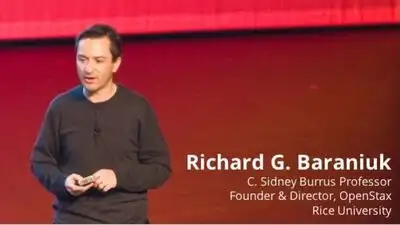
Image Credit: Rice University Website
A project started by a Rice University professor in 1999 has grown into an international effort to make education more accessible through free textbooks and digital learning resources. The story began in 1999, when Richard G. Connexions had become one of the largest open-education platforms, offering more than 19,000 educational modules and reaching over two million people each month. The organisation announced plans to release 10 new titles during that year, expanding its collection for students and educators.
Baraniuk founded the project to bring textbooks and other learning resources into the internet age, according to Rice University. Richard G. Baraniuk founded Connexions with the aim of making educational materials available online without the high costs traditionally associated with textbooks. More than two decades later, the initiative has evolved into OpenStax, a nonprofit educational project whose textbooks are used by millions of students across the world, helping reduce the financial burden of education. Baraniuk, a professor at Rice University in Houston, Texas, established Connexions, an online platform for sharing educational materials. At the time, traditional college textbooks could cost hundreds of dollars, creating an additional expense for students already dealing with tuition fees and other educational costs. The OpenStax website traces its origins to this problem, explaining that its founder wanted to create an alternative in which course materials could be developed and shared by the communities that used them. Rather than following the conventional publishing model, Connexions allowed educators, authors and learners to publish, modify and use educational content freely. The platform encouraged collaboration and gave teachers greater flexibility to adapt learning materials to their requirements. The project also attracted considerable attention in its early years. Two of the latest publications mentioned in the report were Introduction to Anthropology and the Writing Guide with Handbook, designed for English composition courses.
These additions brought the total number of available textbooks to 50 at the time. The report highlighted how far the initiative had progressed since publishing its first textbook in 2012. OpenStax has partnered with more than 60 educational technology providers to help educators use its resources across different disciplines. It had also saved more than 22 million students an estimated $1.7 billion through its open educational resources, according to the 2022 report. The organisation has reached 49 million students in total, with 5.4 million students reached annually. The students have saved $3.8 billion through its resources over time, including $374.3 million in annual savings. Its materials have reached learners across 172 countries, while 71% of US colleges and universities use its resources annually. The organisation also reports that its materials are used by 56,810 educators and 9,710 K-12 schools each year. Its digital resources attract approximately 15 million active web users annually. A Polish nonprofit partner, OpenStax Polska, has adapted its educational titles for local students, with its physics edition accounting for 70% of the Polish market.
Further titles were also being developed in subjects such as finance, political science, computer applications, contemporary mathematics and world history. OpenStax’s reach has continued to grow beyond its original focus on American college courses. OpenStax has also extended its reach through translations and partnerships. Availability of textbooks in multiple languages, including Spanish. You use AI every day. Now get your AI Quotient. Take the AIQ test.
The next major development came in 2012, when the original project evolved into OpenStax College, later known simply as OpenStax. OpenStax College planned to release free, publisher-quality textbooks for 5 of the most popular college courses in the United States. The initiative received financial backing from several organisations, including the William and Flora Hewlett Foundation, the Bill and Melinda Gates Foundation, the 20 Million Minds Foundation and the Maxfield Foundation. Baraniuk estimated that reaching just 10% of the market with the first 5 books could help one million American college students save $90 million over five years. By 2022, the initiative had reached an important milestone. In a March 31, 2022, report titled 10 for 10, Rice University News marked OpenStax’s 10th anniversary of publishing free textbooks.
Because openly licensed content can be adjusted to meet the needs of different classrooms and courses, teachers also benefit.
Its books are peer-reviewed and developed with contributions from educators working at community colleges, public universities, land-grant institutions and research universities, according to the organisation. The organisation moved beyond providing a platform for sharing educational material and began publishing complete, free textbooks for widely taught college subjects. Its first two books, College Physics and Introduction to Sociology, were scheduled for publication in March that year. Three additional textbooks covering biology, anatomy and physiology were also in development. The original plan focused on courses with large student enrolments, where expensive textbooks affected the greatest number of learners. An important part of the model was that the books would not simply be free to read. Their open licences would also allow teachers to modify and adapt the content to suit their courses. Students could access the material through computers, tablets and smartphones, while affordable printed editions were available through print-on-demand services. OpenStax developed its publishing approach around two important principles, accessibility and academic quality. Unlike informal collections of online notes, its textbooks were designed to meet the standards expected of conventional academic publications. This approach allows students to access structured learning material without having to purchase expensive commercial textbooks. The model has also expanded beyond simply providing digital books. OpenStax now develops additional learning tools, including Assignable, a practice and assessment system designed to support teaching and help students understand course material. Its work also includes education research through SafeInsights, a Rice University initiative that studies how students learn and how educational resources can be improved.