
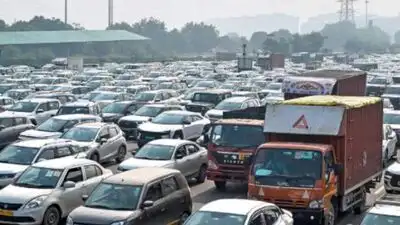
Delhi is beginning to restrict non-BS-VI vehicles registered outside the city, which may create significant traffic jams.
Average co₂ emissions per vehicle: approximately 30.7 grams per minute of idling. those further back could remain stuck for 15–20 minutes While some commuters may get through within 10 minutes. Estimated tailback: 400 cars Approx co₂ emissions per minute: 12.3 kg If vehicles idle for: 10 minutes: around 123 kg (0.123 metric tonnes) of co₂. 15 minutes: around 184 kg (0.184 metric tonnes) of co₂. 20 minutes: around 245 kg (0.245 metric tonnes) of co₂. Estimated tailback: 30–40 vehicles Approx co₂ emissions per minute: 0.9–1.2 kg If vehicles idle for: 10 minutes: 9–12 kg of co₂. 15 minutes: 14–18 kg. The us energy information administration states that burning one us gallon of gasoline produces approximately 8,887 grams of co₂. Since one us gallon is approximately 3.785 litres, this translates to around 2.35 kg of co₂ per litre of petrol burned. Emissions assumed: burning one litre of petrol releases approximately 2.3 kg of co₂. Fuel consumed per minute = number of vehicles × 0.8 litres ÷ 60. Co₂ emissions per minute = fuel consumed × 2.3 kg.
The big question: How much CO2 is being released by vehicles waiting with their engines running? Barricades and checkpoints could become a regular sight as Delhi bars non-BS-VI vehicles registered outside the city. Gurgaon and Ghazipur saw tailbacks While most borders saw little congestion Sunday. TOI’s Ishita Jairath crunches ground estimates to calculate the fuel consumed and CO2 emissions generated by vehicles idling in these queues. Waiting time varies depending on where vehicles are positioned in the tailback. Emissions over the waiting period = per-minute emissions × number of minutes.
Each car was assumed to consume 0.8 litres of petrol per hour while idling, equivalent to approximately 13.3 ml per minute. Waiting periods of 10, 15 and 20 minutes were used for illustrative calculations, as actual waiting times varied depending on the vehicle’s position in the tailback.
Air has no boundaries, and northern india cannot solve a regional health crisis with isolated city-level band-aids. ” — Shreya Gadepalli Mobility expert “A seamless transition requires automated enforcement, well-equipped peripheral holding areas, synchronised inter-state logistics, real-time tracking, and clear phase-in support for operators.” — Anumita Roychowdhury Executive director-research and advocacy, centre for science and environment You Can Also Check: Gold Rate in Delhi | Silver Rate in Delhi | Bank Holidays in Delhi | Public Holidays in Delhi | Delhi AQI | Weather in Delhi | Petrol Price in Delhi | Diesel Price in Delhi | CNG Price in Delhi | LPG Price in Delhi Stay updated with the latest Delhi news. Note: these estimates are based on available data, ground assessments and general assumptions. Actual figures may vary depending on vehicle models, engine capacity, fuel type, maintenance, idling conditions and time spent in queues. The estimates represent a hypothetical continuous-idling scenario. All vehicle engines were assumed to be running. All vehicles were assumed to be petrol cars. Vehicles were assumed to be stationary and continuously idling during the calculated waiting period. “Tailpipes dump toxic gas straight into our lungs at street level, and while clean vehicles help stop that poison, they continue to resuspend fine road dust into the air. Cleaning our air takes more than changing vehicle technology. It demands dust-free roads in our cities and unified action across state borders. Download the TOI App.