
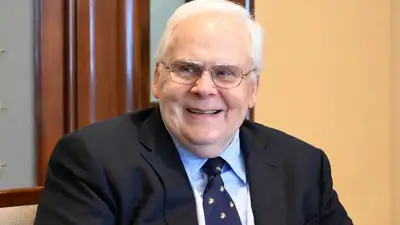
Image of Frederick W. Smith, the founder of FedEx. (Image Credits: Wikimedia Commons)
With only $5,000 left and an urgent bill to meet, the founder gambled the money, per The Washington Post. In 1973, Federal Express was running out of financial runway to set off on its ambition. FedEx began operations in April 1973, serving 25 American cities with a fleet of aircraft. One complication for FedEx was that it could not upgrade its fleet to the larger Boeing 727 until 1978. Access to the Boeing 727 gave FedEx the much-needed boost to expand its air cargo capacity. By 1983, the sky was the limit for the company; it had reported more than $1 billion in annual revenue and was set on expanding further.
Because the reality was it would require substantial investment before it could yield dependable returns, as the saying goes, it’s easier said than done,.
In a 1998 interview, reflecting on that experience, he said: “I was willing to take a chance, because losing wasn’t the worst thing in the world that could happen to you. ” FedEx’s model depended on coordination. The stakes and competition in the business world have always been cutthroat, but rarely has a game of blackjack decided the survival of a company. For Fred Smith , however, a night in Las Vegas became an inseparable part of FedEx ’s early history. The axiom of gambling has always been that the house always wins in the long run. The thumb rule is to cash out before that, but for Smith, the odds favoured his boldness. The return helped keep the company in operation; the real test, however, was turning an ambitious overnight delivery idea into a business that could pay its way. Its aircraft were flying, its delivery system functioned, and the company had started the onerous task of building an overnight parcel service. But the downside was that the company was burning through money faster than it had projected in return. The company had to establish routes, acquire customers and persuade businesses to depend on a service that was still unknown. He served in the US Marine Corps during the Vietnam War and completed two tours. After returning, he pursued the idea that had dawned on him at Yale. Unfettered by the financial and operational challenges that lay ahead, he started the company with some of his inherited family fortune. The idea he had while studying at Yale was rather simple in theory: create a central hub where parcels could be collected, sorted and dispatched to their destinations overnight. Rather than depend on a patchwork of existing transport routes, the company would oversee the process through its own established network of aircraft and ground operations. The change came after years of sustained effort to persuade lawmakers to loosen their rules on air cargo.
A founder shaped by war and the company’s highs and lows Smith’s commitment to business had roots in his earlier life.
The company’s bank accounts were nearing zero, and Smith cashed in all the remaining $5,000 on a blackjack game at the time when the company needed $24,000 to keep its air fleet in operation, according to The Washington Post. Smith ended up winning $27,000, which threw the company a lifebuoy that kept it afloat.