A representative AI image of an antique blue-and-white porcelain vase rests on an ornate wooden stand beside a partially open door. (Image Credits: ChatGPT)
The odds of finding a relic from ancient history amid one’s home seem to be a near-impossible fluke. But for a family in a Long Island home, that far-fetched idea was no mere happenstance; rather, it became a reality. For decades, a rare Chinese vase sat on a wooden stand that the family used as a doorstop.
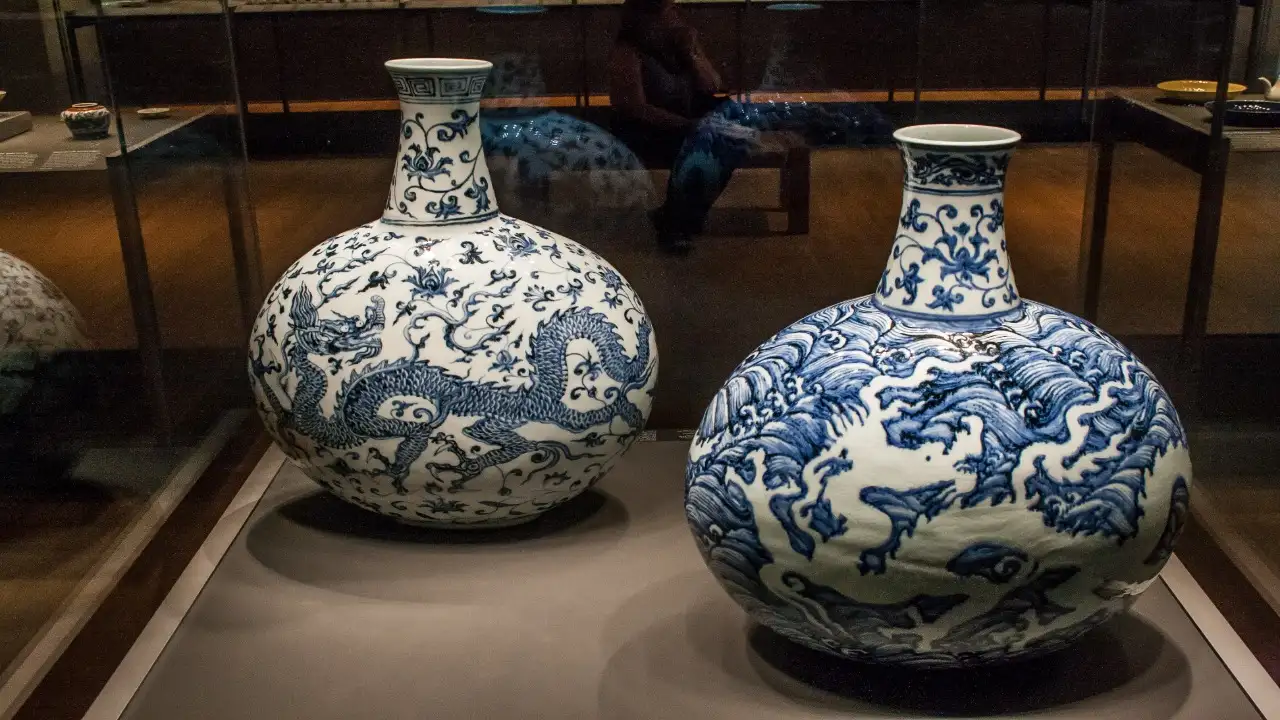
The moonflask went on to sell for more than $1.3 million at Sotheby’s New York auction in September 2012, against a pre-sale estimate of $600,000, according to the BBC. Historian Chuimei Ho estimated that roughly 16% of late Ming-era Chinese ceramic exports, according to her study of the ceramic trade, were bound for Europe, while the remainder headed to Japan and Southeast Asia. Liu Tong, whose book was printed in 1635, provided guidance for collectors attempting to distinguish authentic objects from imitations. Examining the sheen of bronzework could authenticate work from the Xuande era (1426–1435), while the thickness of porcelain would validate work from the Yongle era (1402–1424). Representative image of two flasks with dragons from the Ming dynasty. (Image Credits: Wikimedia Commons) Other objects at Sotheby’s New York auction The moonflask wasn’t the only coveted object offered at Sotheby’s Chinese works of art sale in New York on 11 and 12 September 2012. The auction raised nearly $27 million, exceeding its pre-sale projection of $21.6 million, according to the BBC. The total was almost 20% higher than the equivalent sale just a year before. It sold for nearly $3.5 million, with the proceeds intended to benefit the museum’s Asian Art Acquisitions Fund. The auction also included a pair of 17th-century armchairs that had been given to a church in Victoria, Canada, which the Associated Press reported had been used by clergy and members of the congregation before selling for $758,500.
The Associated Press reported that its owners eventually reconsidered the object after seeing a similar piece in an advertisement for Sotheby’s.
Speaking after the auction, he said: “We saw exceptional demand across the sale, which drove the total to such heights. The vase, a blue and white moonflask, had a lineage that dated back to China’s Ming dynasty. Chinese ceramics during the Ming Dynasty The moonflask came from a period when Chinese ceramics and porcelain were sought after by collectors from China and overseas alike. The World Civilisation chapter on the Ming Dynasty identifies ceramic art as the zeitgeist of the period’s prominent form of artistic production. At the time, its major porcelain production centres were located in the imperial kilns at Jingdezhen in Jiangxi province and the factories at Dehua in Fujian. Dehua manufacturers were producing porcelain that catered to European buyers by the 16th century. The acquisition of porcelain during that time was a privilege exclusive to affluent households, where it was displayed in tandem with silks, jade, ivory and cloisonne. That demand helped make a Ming moonflask like this one a prized object. This widespread practice backed a robust market ecosystem that supported dealers and specialists. This boon, while benefiting legitimate dealers, also made room for counterfeiters. The World Civilisation account records that imitation objects and false attributions circulated during the late Ming period. It notes that counterfeiters profited from this trade. Dr Tao Wang, who had been appointed head of Sotheby’s Chinese Works of Art Department, commented on the results. By his account, collectors from around the world had been drawn to the high-calibre artefacts owing to their distinguished provenance. You use AI every day. Now get your AI Quotient. Take the AIQ test.
Another lot displayed a Wucai fish jar and cover previously owned by the Walters Art Museum in Baltimore.