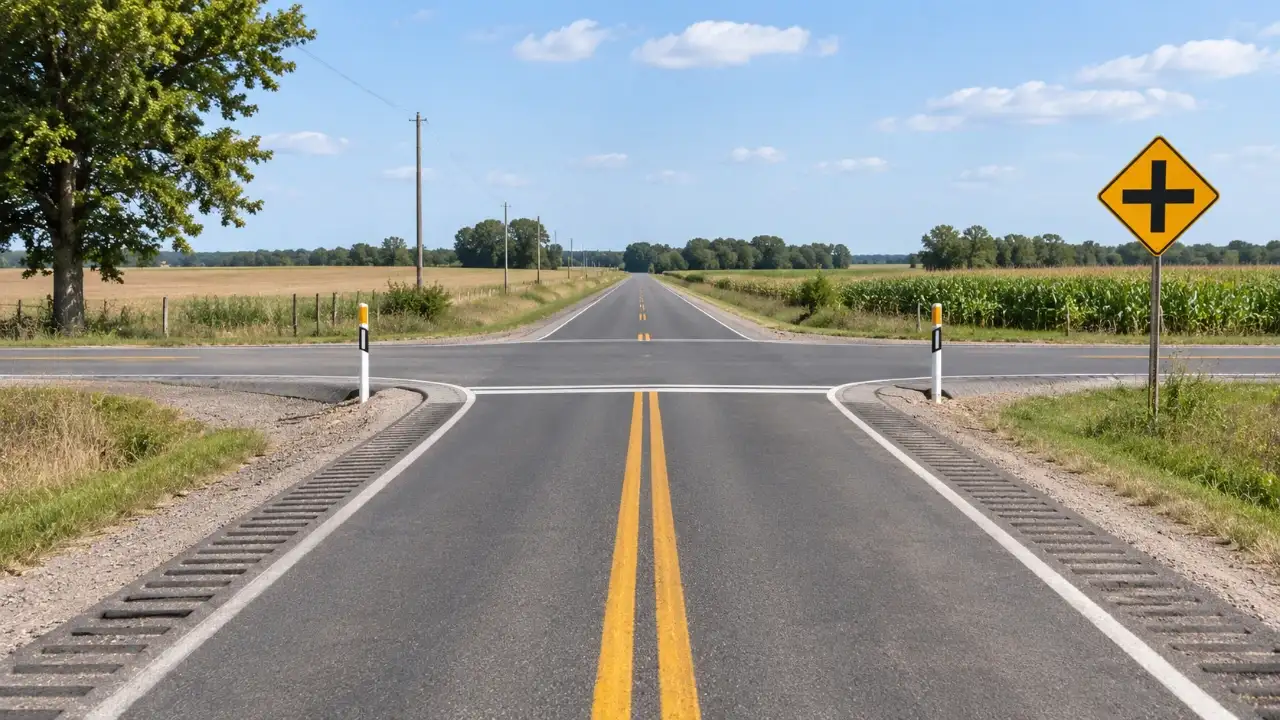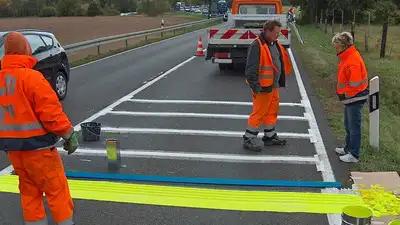
Federal Highway Administration implemented a strategic combination of rumble strips and existing pavement to enhance safety. Image Credits: Wikimedia Commons.
Treatment sites in Missouri, Kentucky, Pennsylvania, Florida and Maryland were part of an experiment from 2007 to 2008, according to a June 2010 Federal Highway Administration technical report. As per the evaluation, there was an overall decrease of 32% in the total number of accidents and 34% in the number of accident-causing fatalities after installing the system. As per the statistics reported in its study, 37% of all the fatal accidents that occurred at intersections across America happened in unsignalized rural intersections. Over 90% of the accidents in such cases took place on two-lane highways, indicating the difficulties drivers face while travelling on narrow highways.
The FHWA came up with this treatment due to the risk caused by unsignalized rural intersections.
The study used 3 to 5 years of pre-treatment data and at least 2 years of post- implementation data. There was an average reduction of 32% in the total number of crashes and 34% in fatal injury crashes. The largest decrease in total crashes occurred at the second site in Pennsylvania, which was 63%. Pennsylvania’s first site Had A 49% reduction in fatal and injury crashes. A study published in Accident Analysis & Prevention investigated a central line rumble strip installed on about 210 Miles of two-lane rural roads in 7 US states. The FHWA report noted several shortcomings, and the reductions at the eight intersections did not reach statistical significance at the 95% confidence level.
In such places, no traffic signal makes motorists slow down on the main road. When drivers encounter vehicles from a side road, differences in speed and reaction time create a crash risk. This can be aggravated, especially where the intersection is not visible, or the driver cannot see any warning sign. Instead of installing a traffic light or building a roundabout, the FHWA considered a treatment that used existing road space more effectively. The purpose of this treatment was to create the illusion of narrowness on the approach, which would prompt drivers to slow down before reaching the intersection. The treatment evaluation involved comparison of crash data before and after the treatment. The evaluation considered the variation in traffic volumes and the anticipated crash frequencies at similar intersections. All eight sites experienced a reduction in crashes on a yearly basis following the treatment; however, there were different extents of improvement. The study applied an empirical Bayes before-and-after evaluation to assess any changes in crash frequency involving vehicles crossing to the opposite traffic lane. Though the research addressed a different application of rumble strips, it provided additional information regarding their possible benefit to road safety and improvement. Researchers explained this by a small number of sites included in the study and the variance in implementation of the treatment. They suggested adding more sites and collecting more data to test the treatment’s effects. The findings gave transportation agencies a less costly option compared to reconstructing intersections. Through the use of pavement markings and rumble strips, the project showed how some changes in engineering design could be incorporated into rural road safety programs.