
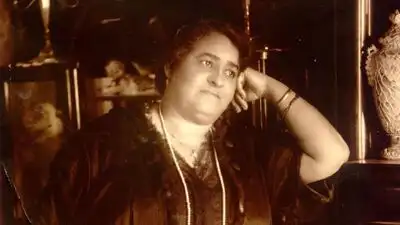
Maggie L. Walker. Image Credit: NPS Photo
Born in 1864, shortly after the American Civil War, she grew up in a society shaped by racial discrimination and limited opportunities for Black women. In 1903, she established the St. After graduating, she taught for several years before leaving the profession following her marriage to Armstead Walker in 1886.
Because banking leadership was dominated by men, while African American women faced additional barriers under segregation, her preparation was particularly significant. Maggie Lena Walker rose from modest beginnings in Richmond, Virginia, to become one of America’s most influential African American business leaders. Luke Penny Savings Bank, becoming the first African American woman in the United States to charter a bank. Her achievement helped transform financial opportunities for Black families and demonstrated how collective savings could support economic independence. Walker grew up in Richmond, where her mother, Elizabeth Draper Mitchell, worked as a laundress after gaining freedom from slavery. The National Park Service records that Walker’s early experiences exposed her to the difficulties faced by working families and influenced her understanding of financial security. She attended Richmond’s public schools for African Americans and trained as a teacher. Her ambitions extended beyond education. Walker joined the Independent Order of St.
She became its Right Worthy Grand Secretary in 1899, taking responsibility for an organisation that needed stronger financial management, according to Encyclopedia Virginia. In 1901, she outlined plans for a newspaper, a bank and a department store that could support Black businesses and create opportunities within the community. Luke Herald, launched in 1902, became an important part of this vision. On 2 November 1903, the St. Nearly 300 customers attended its opening, according to the National Park Service. The Richmond Federal Reserve reports that the bank received more than $8,000 in deposits on its first day. Deposits rose from more than $9,000 at its opening to $170,000 within three years, according to the FDIC. By 1920, the bank had financed more than 600 home loans to residents of Jackson Ward. The Smithsonian records that she recognised declining assets before the 1929 stock market crash and began considering a merger with other Black-owned financial institutions in Richmond. In 1931, St. In 1928, an illness left Walker using a wheelchair, but she continued participating in public and organisational affairs. She died in Richmond on 15 December 1934, aged 70. The FDIC notes that Consolidated Bank and Trust remained the oldest continuously African American-operated bank in the United States until 2009.
Luke, a mutual aid organisation that provided assistance, insurance and burial support to African Americans. Walker worked to improve the Independent Order of St. Luke’s finances and expanded its membership. She strengthened the organisation and encouraged greater participation, particularly among women. She believed economic progress required more than individual effort. The St. The newspaper communicated with members, promoted African American businesses and encouraged readers to participate in the organisation’s activities. Her approach centred on encouraging ordinary people to save money rather than relying exclusively on wealthy investors. Walker understood that establishing a financial institution required practical knowledge. The Federal Deposit Insurance Corporation records that she studied banking operations at Richmond’s Merchants National Bank, learning about financial procedures and management. Luke Penny Savings Bank opened in Richmond. Contributions ranged from small amounts to larger sums, demonstrating how customers with different incomes could participate in the institution. Walker became its first president, making her the first African American woman in the United States to establish and lead a bank. The bank offered African American customers an opportunity to save money and access credit at a time when mainstream financial institutions frequently excluded them. The FDIC explains that St. Luke Penny Savings Bank provided loans to Black homeowners and businesses, supporting economic activity in Richmond’s Jackson Ward neighbourhood. Its growth was substantial. The Smithsonian National Museum of American History reports that deposits eventually reached half a million dollars by the mid-1920s. The achievement reflected the financial strength that could emerge when working families pooled their savings. Walker also believed women should participate directly in business and economic leadership. Walker remained involved in the bank’s operations as it expanded, but economic difficulties eventually threatened its stability. Luke Penny Savings Bank merged with Second Street Savings Bank and Commercial Bank and Trust to form Consolidated Bank and Trust Company. Walker became chairperson of its board of directors. The Richmond Federal Reserve credits her with helping protect the institution through the merger. Consolidated Bank and Trust continued operating for decades, preserving an important part of her banking legacy. Walker also supported civil rights, education and community development. The National Park Service records her involvement with the National Association of Colored Women, the National Association for the Advancement of Colored People and the Virginia Industrial School for Girls. She encouraged African American women to pursue education, business opportunities and leadership roles, while supporting organisations that worked to improve their communities. Her former residence is now preserved as the Maggie L. Walker National Historic Site, managed by the National Park Service. Walker’s banking legacy continued after her death. You use AI every day. Now get your AI Quotient. Take the AIQ test.