
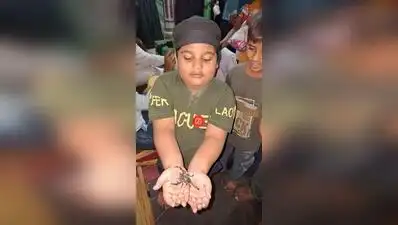
The scorpions crawl about with impunity, apparently oblivious to human presence, proximity or even touch.
All it takes is a trip to a 600-year-old shrine tucked into the bustling Lakra mohalla of Islam Nagar to summon an obliging army of celestial fixers. If Aladdin of Agrabah had a lamp genie at his beck and call, residents of Amroha have boxed arachnids their sleeves to grant their wish. Forget rubbing a lamp. And what an army! Hordes of scorpions that, going by local lore, could give the big blue genie a serious run for his money.
For centuries, scorpions have held undisputed possession of the 54 bighas surrounding the shrine of Hazrat Syed Hussain Sharduddin Shah Vilayat, says Syed Hasan Shuja, a descendant of the Wali. Hazrat Shah Vilayat, a scion of the lineage of Shia Imam Ali, was a 13th-century Sufi saint from Iran who migrated to India nearly 800 years ago.
Come summer, the shrine is practically crawling with them, says Naib Tehsildar Sadar Amroha, Shripal. “Even now, when I handle one, I shiver,” he admits with a laugh. “Haath mein le lijiye,” Afzal urges. The district magistrate of Amroha Nitin Gaur emphatically says no such incidents figure in official records.
He set up camp at Kasba Azeezpur, then a thickly forested settlement, and christened it Amroha. But his arrival apparently didn’t go down well with a neighbouring holy man, Hazrat Shah Naseeruddin. The latter was particularly miffed that his flock was jumping the fence to seek the blessings of the new spiritual heavyweight. First came a polite request to pack up and leave. When that failed, Shah Naseeruddin turned to supernatural muscle. He pronounced a curse: scorpions would haunt the place for eternity. Unfazed, Shah Vilayat accepted the challenge and promptly added a rider to the curse. The scorpions could stay, but they would lose their sting within the shrine’s precincts. And thus began an extraordinary truce between man and arachnid that, devotees insist, holds good to this day. The scorpions crawl about with impunity, apparently oblivious to human presence, proximity or even touch. Mohammad Afzal, a caretaker, is happy to offer living proof. He casually holds two hefty bichchhus in his palm, as if displaying a couple of particularly exotic pets. His first encounter, during an official visit, was anything but divine. The sight left him petrified. He has since made peace with the creepy crawlies, though not entirely. Afzal now leads the way to an enclosure housing the shrine’s ritual paraphernalia. Among the assorted knick-knacks sits a green-painted tin box. He flips open the lid. Inside, half a dozen scorpions, caught in various stages of activity, momentarily freeze at the sudden blast of light and fresh air. A few seconds later, they are back to scuttling about as though nothing has happened. The adult visitors hesitate. Undeterred, he turns to a nine-year-old boy, who eagerly volunteers, apparently oblivious to the murderous looks his mother is shooting in his direction. Around them, devotees, khidmatgars, maulvis and flower vendors carry on undisturbed. No gasps, no raised eyebrows, no drama. For regulars, a scorpion sighting is apparently as unremarkable as a monkey in metropolis! Incidentally, the shrine’s scorpions are also available for home visits, of sorts. These divine troubleshooters, however, are not to be trifled with. Overstay the welcome, and they could turn temperamental — and lethal, local lore warns. Some devotees even catch scorpions themselves, bring them to the shrine for blessings and then take them home for their allotted stint. But has anyone actually been stung? Are there cases of poisoning? The mystery, however, has experts scratching their heads. Dr Amit Shukla, assistant professor of pharmacology at Deen Dayal Upadhyaya Veterinary University, Mathura, floats possibilities ranging from anaesthetising or drugging the creatures to genetic changes induced by suspected prolonged captive breeding. Black and brown scorpions, he points out, are generally less lethal. But what makes these particular residents so remarkably restrained? Even science has no ready answer.
Devotees can take the bichchhus home for a stipulated period, provided they return them before the deadline.
In 1980, he claims, a team of German scientists arrived with some of the deadliest scorpions collected from Uttarakhand’s forests. You Can Also Check: Gold Rate in Lucknow | Silver Rate in Lucknow | Bank Holidays in Lucknow | Public Holidays in Lucknow | Lucknow AQI | Weather in Lucknow | Petrol Price in Lucknow | Diesel Price in Lucknow | CNG Price in Lucknow | LPG Price in Lucknow Stay updated with the latest Lucknow news. Hasan has one more eyebrow-raising anecdote. They were reportedly stunned to see the creatures undergo an unmistakable change after being brought to the shrine. So the stories about, and mystery thickens as does the scepticism. But to the devout the way out of the thickest spot couldn’t have been easier. All you need is a tin box, a Scorpio and a wish! Download the TOI App.