
Pune: Air quality in Pune is expected to deteriorate on Diwali evening and pollution levels are likely to peak in the early hours of Monday, as firecracker emissions combine with unfavourable weather conditions.
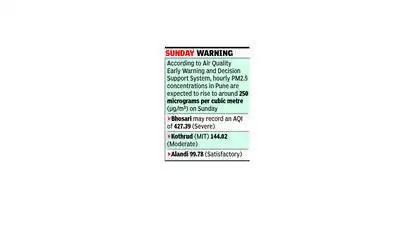
Bhosari is likely to record a severe Air Quality Index (AQI) of 427.39 on Sunday. Winds are expected to slow down overnight, while the minimum temperature in the city is likely to drop from 17°C to 16°C. The highest PM2.5 concentrations are expected in the early hours of Monday, when a short-duration peak of around 360-400 µg/m³ is possible,” an official said.
Because of their adverse impact on children’s health, while these are claimed to emit less smoke, they still release pollutants, he said, adding that firecrackers should be avoided altogether. Because houses were closely spaced, small and often poorly ventilated, she said densely populated localities, including parts of the city’s Peth areas, were particularly vulnerable. You Can Also Check: Gold Rate in Pune | Silver Rate in Pune | Bank Holidays in Pune | Public Holidays in Pune | Petrol Price in Pune | Diesel Price in Pune | CNG Price in Pune | LPG Price in Pune Stay updated with the latest Pune news.
Light winds and cooler conditions could keep smoke and particulate matter closer to the ground for longer, with firecracker emissions adding to the pollution load, said officials from the Air Quality Early Warning and Decision Support System. Exposure to firecracker smoke, particulate matter and other pollutants irritates children’s airways and increases inflammation, making them vulnerable to bouts of coughing, wheezing, asthma attacks, bronchitis and nasal allergies, he said. Dr Lalwani said, “This Diwali is worse than last Diwali. For children with respiratory conditions, staying indoors during peak firecracker activity would be preferable, Dr Lalwani said. “Keep the windows closed, switch on the AC if possible, and use an air purifier in one room at home,” he said. Dr Aparna Birajdar, consultant pulmonologist in the city, said she expected a rise in patients’ footfalls with breathing difficulties after Diwali. “Symptoms may be particularly worse in those with pre-existing asthma and COPD,” she said. “We are seeing sporadic cases from concentrated pockets,” she said. People living in small, ill-ventilated houses and closely spaced buildings have nowhere to escape,” Dr Birajdar said.
The projected pollution levels vary sharply across different parts of the city. This time, even a few days before Diwali, we are seeing several cases. Some of my patients have burst firecrackers and subsequently fallen sick. He cautioned against assuming that green crackers were harmless. “In small, crowded spaces where there is not enough open area, the problem is greater. She also pointed to instances of firecracker activity in crowded neighbourhoods despite advisories asking people to use designated open spaces. Download the TOI App.
We expected cases to increase last year, but that was not the case. “Mumbai, too, is likely to witness a deterioration in air quality during the festival, with its AQI forecast to fall into the poor to very poor categories on Sunday and Monday.
Earlier reporting noted: As per the Central Pollution Control Board (CPCB), an AQI between 0 and 50 is classified as ‘good’, 51 and 100 as ‘satisfactory’, 101 and 200 as ‘moderate’, 201 and 300 as ‘poor’, 301 and 400 as ‘very poor’, and 401 and 500 as ‘severe’. A ventilation index below 6,000 square metres per second, along with an average wind speed of less than 10 kilometres per hour, hampers the effective dispersion of pollutants, according to the EWS.
Dr Siddhant Lalwani, consultant paediatric pulmonologist, sleep and allergy specialist at Bharati Hospital and Research Centre, said several children were coming in with wheezing and asthma attacks before the main Diwali celebrations. “A lot of my asthma patients are already getting sick,” he said. Doctors in Pune have started reporting respiratory complaints among children, particularly those with a history of asthma and allergies.
Earlier reporting noted: Weather and air quality experts have attributed the anticipated deterioration to unfavourable meteorological conditions, the onset of Diwali-related celebrations and vehicular emissions, and the peak period of stubble burning in neighbouring states. Earlier reporting noted: Unfavourable weather conditions are further worsening the pollution situation.
A project of Indian Institute of Tropical Meteorology (IITM) and ministry of earth sciences, hourly PM2.5 concentrations in Pune are expected to rise to around 250 micrograms per cubic metre (µg/m³) on Sunday, according to the Air Quality Early Warning and Decision Support System. The levels could cross 300 µg/m³ between 2am and 5am on Monday, pushing the AQI into the poor category. Bhosari may record an AQI of 427.39, falling in the severe category, while Kothrud (MIT) is expected to record 144.02, in the moderate category. Alandi has a forecast AQI of 99.78, in the satisfactory category.
The system’s location-wise AQI forecast for Sunday indicated considerable variation within the city. The anticipated deterioration comes amid meteorological conditions that are likely to restrict the dispersal of pollutants. The weak sea breeze expected over Mumbai in the coming days, along with falling night temperatures, could further hamper the dispersal of pollutants and cause smoke to remain close to the surface.