
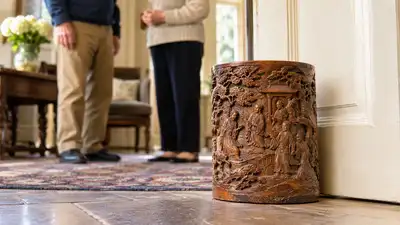
Representative AI image of an intricately carved Chinese wooden brush pot that remained an ordinary household doorstop for decades before its historical and artistic value was recognised. Image Credits: ChatGPT.
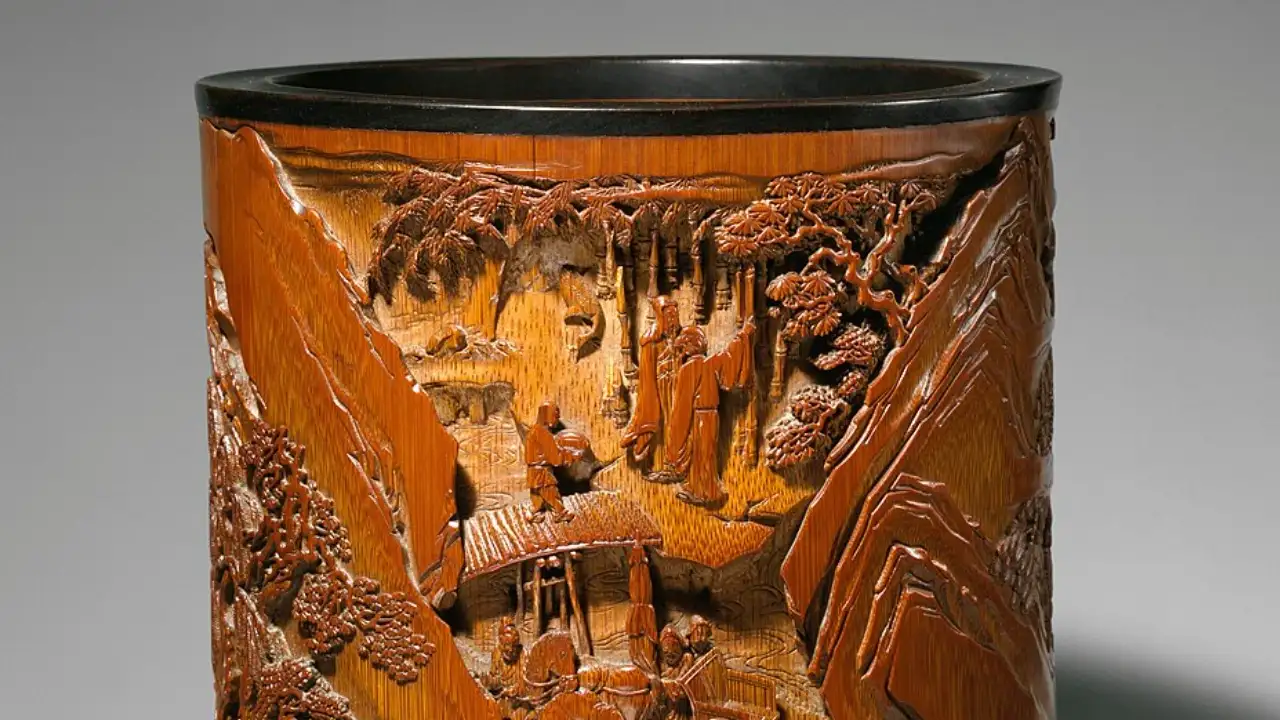
The pair inherited the brush pot and kept it at their home for nearly 40 years. It was a carved Zitan wood ‘Hundred Boys’ biotong, or brush pot, by Sworders, measuring approximately 2.45 cm high; it was dated to the late 18th/early 19th century. It was hammered at £150,000 in April 2014. An intricately carved 18th-century Chinese bamboo brush pot, similar to the antique inherited by a Hertfordshire couple, who used it as a doorstop for 40 years before it sold for £150,000. A £150,000 reminder of hidden heritage
It was a “famous and important” lot which Sworders believed would have excellent prospects. They propped it in the doorway to a sitting room as a doorstop. Its importance was realised when an auctioneer visited to assess the rest of the cottage’s contents. The brush pot intrigued Richard Harrison, who recognised it as an 18th-century Chinese carving, which was to become a major feature of an Asian art sale. There were dozens of small boys carved into the lively design, and a report of the sale quoted Harrison as describing the figure as ‘almost three-dimensional’ and ‘doing all sorts of things,’ notably ‘setting off firecrackers’. He also commented on the remarkable condition of the object, which had been used for many years as a doorstop. The craft and meaning behind a Chinese brush A bitong is the Chinese term for a brush pot. They were placed on the desk alongside writers’ or painters’ brushes and tools. They served an everyday utilitarian function but also displayed dexterity and art. Unlike the other writing instruments kept in the scholar’s studio, the brush pot was the vessel that was merely functional. The tools of writing and painting defined the scholar’s studio, where brushes and ink stones were kept, and the owner’s taste was displayed. The barrel-shaped vessel was carved with an inviting little scene to be examined up close: the Hundred Boys motif symbolised good luck and prosperity for offspring. Carved brush pots were made from many materials, from bamboo and wood, but Chinese furniture makers and carvers especially prized zitan as it was a dense, very desirable timber with tightly grained and dark coloured. Academic research helps explain why these objects deserve attention beyond their practical purpose. A study in Arte Individuo y Sociedad examines Chinese curved bamboo stationery, connecting decorative models with painting and literacy culture research published in Trans/ Form/ Acao , brings together the carved brush pot and closely examines the Hertfordshire example to show how the carved brush conveyed the language of a spatialisation found in landscape painting in three dimensions. The piece is carved from Zitan wood rather than bamboo, but these studies give insight into the artistic aspiration of a scholar’s object. Image Credits: Wikimedia Commons.
A Chinese antique worth £250,000 spent 40 years doing an everyday household chore in a Hertfordshire cottage. Antiques Trade Gazette reported it sold at Sworders’ Asian art sale in May 2014. Sworders, based in Stansted Mountfitchet, Essex, established a specialist Asian art department and drew in collectors from markets such as Hong Kong and Mainland China, and the auction house later described the brush pot as one of the leading Chinese art sales. £150,000 was the hammer price, not what was paid after the premium.
Its owners, who inherited it, used it as a doorstop, not knowing the carved wooden ornament was a valuable example of traditional Chinese craftsmanship. The auctioneer, called in to value the family’s other possessions, recognised the object as a calligrapher’s brush pot carved from zitan wood and decorated with the Hundred Boys motif, dating to the late 18th or early 19th century. An overlooked object comes to light The sale also reinforces how valuable expert knowledge is when it comes to spotting antiques. Without the visit, the pot would have been just a hard-to-ship paperweight. To the couple, The Hunt started as part of a normal valuation of household contents and finished as the realisation that an heirloom had travelled through one of the most prominent artistic circles in the world. You use AI every day. Now get your AI Quotient. Take the AIQ test.