
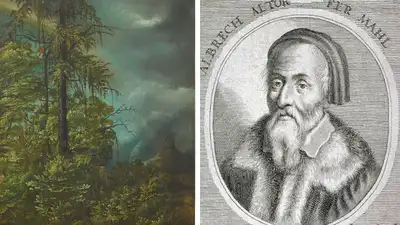
Rare Altdorfer landscape hidden for 70 years after 1957 acquisition could fetch £5 million (Image Credit: Sotheby’s & Wikipedia)
Created around 1520 by German Renaissance artist Albrecht Altdorfer, the small landscape depicts a densely wooded forest, a rainbow behind the trees and a distant castle beneath a cloudy sky. The artwork was acquired by a Swiss collector’s father in 1957 and remained out of public view until its recent identification as a rare work by the Renaissance master. The December sale will mark the first time a known Altdorfer painting has appeared on the market since 1980. At that time, the National Gallery privately acquired his Christ Taking Leave of His Mother, painted around 1520, for a reported £2.4 million. Sotheby’s has estimated the newly identified landscape at £3 million to £5 million, although Gordon has indicated that it could potentially sell for more.
Because of its rarity and historical significance, he also expects museums to show interest in the work. A painting that remained in a private collection and out of public view for nearly seven decades is now attracting attention from the international art world. The rediscovery is more than an auction story.
It brings a previously unrecognised work into the documented history of a major Renaissance artist and offers a rare glimpse into his approach to landscape painting nearly five centuries ago.
The painting is relatively small, measuring 23.4 by 19.8 centimetres. Its identification earlier this year has therefore expanded the recognised body of paintings attributed to the German master. It is signed with Altdorfer’s monogram, AA, on the trunk of a larch tree.
Sotheby’s catalogue describes the medium as oil on parchment, which was later attached to a wooden panel, probably made of limewood. Albrecht Altdorfer was an important German Renaissance artist associated with Regensburg, Bavaria, known for his paintings, drawings and engravings. He is regarded as one of the pioneers of independent landscape painting in Europe, particularly for giving natural scenery a central place in art rather than treating it merely as a background for religious or historical subjects.
The work was previously unknown to Altdorfer scholars and was not included in the artist’s catalogue raisonné, a detailed scholarly record of an artist’s known works.